
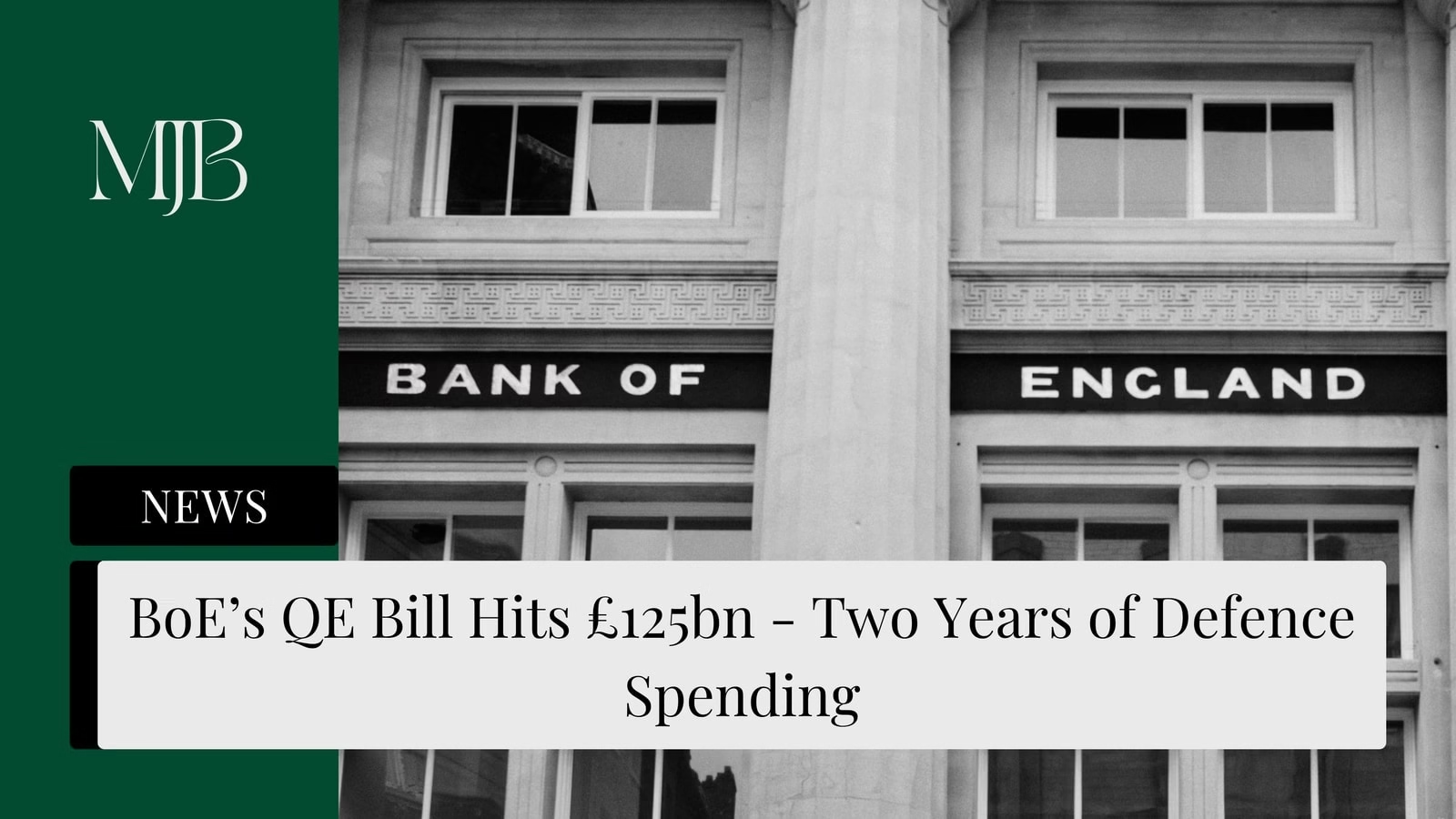
£125bn. That is what the Bank of England now estimates the taxpayer will pay for its quantitative easing programme — up £10bn from the previous forecast and equivalent to roughly two years of UK defence spending. The bond-market policy that was supposed to rescue the post-2008 economy has, in its unwinding, become one of the most expensive single line items in the public finances — and the fiscal pressure on Reeves keeps stacking.
The £125bn number in context
That is what the Bank of England now estimates the taxpayer will pay for its quantitative easing programme — up £10bn from the previous forecast and equivalent to roughly two years of UK defence spending.
The Bank of England‘s updated estimate lifts the projected total cost of QE by £10bn — a meaningful revision in absolute terms and a reminder that the bill is still moving in the wrong direction. £125bn is not an abstract number. Stripped to plain comparisons, it is roughly two years of UK defence budget spending committed to covering monetary-policy losses rather than fighter jets, frigates, or NATO obligations.
OBR figures put last year’s QE programme cost to the Exchequer at £18bn. That single year’s bill was enough to wipe out the bulk of revenue raised from the politically painful employer NICs hike in the 2024 Autumn Budget — the tax change that drove most of the business-confidence damage and the hospitality sector’s job-loss spike through Q1 2026.
In short: a Budget tax raid that triggered a year of public-private friction was offset by a single year of QE losses. That is the scale we are working with.

How QE got so expensive
The mechanics matter. QE — central banks buying up government bonds to push investors into riskier assets — was one of the main tools the Bank of England deployed to revive the UK economy after the crash of 2008. Over the programme’s life, the Bank of England bought roughly £875bn of UK sovereign gilts while keeping interest rates close to zero for nearly 14 years.
Crucially, in 2009 George Osborne’s Treasury and the Bank of England agreed an indemnity that placed losses on the public purse rather than on the central bank’s balance sheet. At the time, with rates near zero and the bond portfolio yielding income, the indemnity looked like a formality. Once rates rose, the indemnity became a liability — every basis point of interest the Bank now pays out on its reserves comes back to the Treasury.
That is the structural difference. Most major central banks have agreed to keep losses from QE on their own balance sheets. The UK’s 2009 deal means every revision to the cost estimate translates directly into pressure on Reeves’ fiscal headroom.

The international outlier — actively selling bonds
The unwind makes the picture sharper. Most major central banks have chosen passive QT, simply letting their bond holdings mature without replacing them. The Bank of England has gone further — actively selling gilts onto the market to shorten the duration of the programme.
That choice has consequences. The active sales add to the supply of UK government debt the market has to absorb at exactly the moment investors are already nervous about UK fiscal trajectory. The result, per multiple bond-market analysts, has been upward pressure on gilt yields — which in turn lifts the government’s own borrowing costs.
The Bank’s Monetary Policy Committee responded to that criticism in September 2025 by slowing the headline pace of disposals from £100bn a year to £70bn. But in the same decision the MPC raised active sales from £13bn to £21bn — a paradoxical move that shrank the headline number while increasing the part of the programme that most distorts the gilt market.
Carsten Jung, a director at the IPPR think tank, said: “Actively selling government bonds is adding unnecessary pressure to the gilt market. It should stop just as every other major central bank has.”
What it means for fiscal policy
The £125bn figure is not the end of the conversation. Jung went further on the cost trajectory: “The large taxpayer losses from the bungled implementation of quantitative easing might now be even larger than the previously expected 22 billion per year. No other major economy imposes such large costs on its taxpayers as a result of monetary policy.”
The Bank’s defence is the macro one — its initial QE programme “sustained employment and growth and reduced the tail risks of severe economic downturns” and generated fiscal benefits during the crisis years. That is true in its time. The cost being audited now is not the QE decision; it is the QT execution and the indemnity terms baked in 16 years ago.
Either way, £125bn is now a number Reeves must work around, every Budget, until the unwind is done. That is what makes today’s revision more than a footnote.

The Bottom Line
The Bank of England’s QE programme rescued the UK economy in 2008. Its unwinding is costing the same economy £125bn — and the bill is still rising. Reeves has zero room to absorb fresh fiscal shocks while QE losses keep arriving every quarter. If you want to understand why the next Budget feels constrained before it has even been written, this is your answer.
Want more like this? Sign up to The MJBurrows Briefing — our free weekly newsletter delivered every Monday morning.
FAQ
Why does the UK taxpayer cover the Bank of England’s QE losses?
Under a 2009 agreement between the Bank of England and George Osborne’s Treasury, the public purse covers any losses from the QE programme — meaning Treasury revenue absorbs the cost rather than the central bank’s balance sheet. Most other major central banks structured their QE without this kind of indemnity.
How does the Bank of England’s QT compare with other central banks?
The Bank of England is the international outlier — it actively sells gilts onto the market to shorten the QT programme, while most other major central banks let their bond holdings mature passively. The active selling adds gilt supply at a time investors are already nervous about UK fiscal risk, pushing borrowing costs higher.
What did the September 2025 MPC change actually do?
The MPC reduced the headline annual disposal pace from £100bn to £70bn but simultaneously raised active sales from £13bn to £21bn. The optics improved while the part of the programme that distorts gilt yields the most actually grew — which is why bond-market critics are still calling for a full pivot to passive maturities.


Disclosure & Editorial Standards
MJBurrows is not authorised or regulated by the Financial Conduct Authority (FCA). The content on this website — including articles, calculators, and tools — is for general informational and educational purposes only. It does not constitute personal financial, investment, tax, or legal advice and does not take into account your individual circumstances, financial situation, or objectives.
Nothing on this site is a personal recommendation to buy, sell, hold, or otherwise deal in any financial product, asset, or service. You should always conduct your own research and seek advice from a qualified, FCA-regulated financial adviser before making any financial decisions.
Our calculators produce estimates based on simplified models using HMRC-published rates for the current tax year. They cannot account for every individual circumstance and should not be relied upon as exact figures. Tax rules and rates may change — verify current rates with HMRC or a qualified tax adviser.
Projections are not guarantees. Where our tools show future values (investment growth, pension projections, compound interest), these are hypothetical illustrations based on assumed growth rates. Past performance does not guarantee future results. The value of investments can go down as well as up.
Market data displayed on this site is provided by third-party sources including Twelve Data, Yahoo Finance, and CoinGecko. We do not guarantee the accuracy, completeness, or timeliness of third-party data.
This content is designed for UK residents and reflects UK tax rules, thresholds, and legislation. It may not apply to other jurisdictions.
Using this website does not create a professional-client relationship of any kind. MJBurrows is not responsible for any financial loss, damage, or decision made based on the content presented. By using this site, you accept these terms.
This disclaimer may be updated from time to time without prior notice. Last reviewed: 23 April 2026.
MJBurrows is an independent UK personal finance publication, written and edited by Matthew Burrows. There is no parent company, no investor group, and no advertising sales team — decisions about what to cover and how to frame it are made by Matthew alone. Our full Editorial Policy sets out how the site operates in detail.
Commercial model. As of April 2026, MJBurrows generates no revenue. The site carries no display advertising, no affiliate links, no sponsored content, no paid product placements, and no pay-for-coverage arrangements. If this changes in future, it will be disclosed openly on the Editorial Policy page.
Sources. Articles and tools reference primary sources — HM Revenue & Customs (HMRC), gov.uk, the Bank of England, the Office for National Statistics (ONS), the Financial Conduct Authority (FCA), Companies House, and UK government departmental publications (DWP, Treasury). Calculator data uses HMRC-published rates for the 2026/27 tax year. Market data (tickers, asset prices) is provided by Twelve Data, Yahoo Finance, and CoinGecko.
Verification. Every published article is fact-checked before going live. Numerical claims are traced to their primary source, quotes are checked against the original speaker or document, and calculator outputs are tested against HMRC worked examples. See our verification and accuracy policy for the full process.
Corrections. If you spot an error, please report it via the Corrections page. A three-tier severity system commits to specific response times:
- Tier 1 — Urgent (material reader harm, defamatory statements, regulatory or legal issues): acknowledged within 24 hours, page actioned within 24 hours, correction published within 48 hours of confirmation.
- Tier 2 — High (significant factual errors that misinform readers): acknowledged within 3 working days, correction published within 7 working days of confirmation.
- Tier 3 — Standard (minor factual errors, dated references, missing context): acknowledged within 7 working days, correction published at the next regular content review (within the quarter).
Significant corrections are logged on the public Corrections log.
Updates and review cadence. Calculators are reviewed at least quarterly, plus event-driven updates when HMRC publishes new rates (Budget, Autumn Statement, new tax year). Guides are reviewed at least twice a year, with major rewrites whenever underlying regulation changes. Tax-year-sensitive content is prioritised for review at the April tax-year transition.
Get in touch. For editorial enquiries — corrections, story tips, reader questions — the address is contact@mjburrows.com. The contact page is at mjburrows.com/contact. Every email is read personally by Matthew.