
NatWest (LON: NWG) printed a £2bn quarterly profit. Margin climbed 20bps to 2.47%. Income guidance was raised. By any operational measure, this was a beat. The stock fell 4% to 563p anyway. Underneath the headline sits a £2.7bn Evelyn Partners deal and a Coutts deposit threshold lifted overnight from £1m to £3m. Here is what the share-price reaction is really telling you.
The numbers were good — properly good
Underneath the headline sits a £2.7bn Evelyn Partners deal and a Coutts deposit threshold lifted overnight from £1m to £3m.
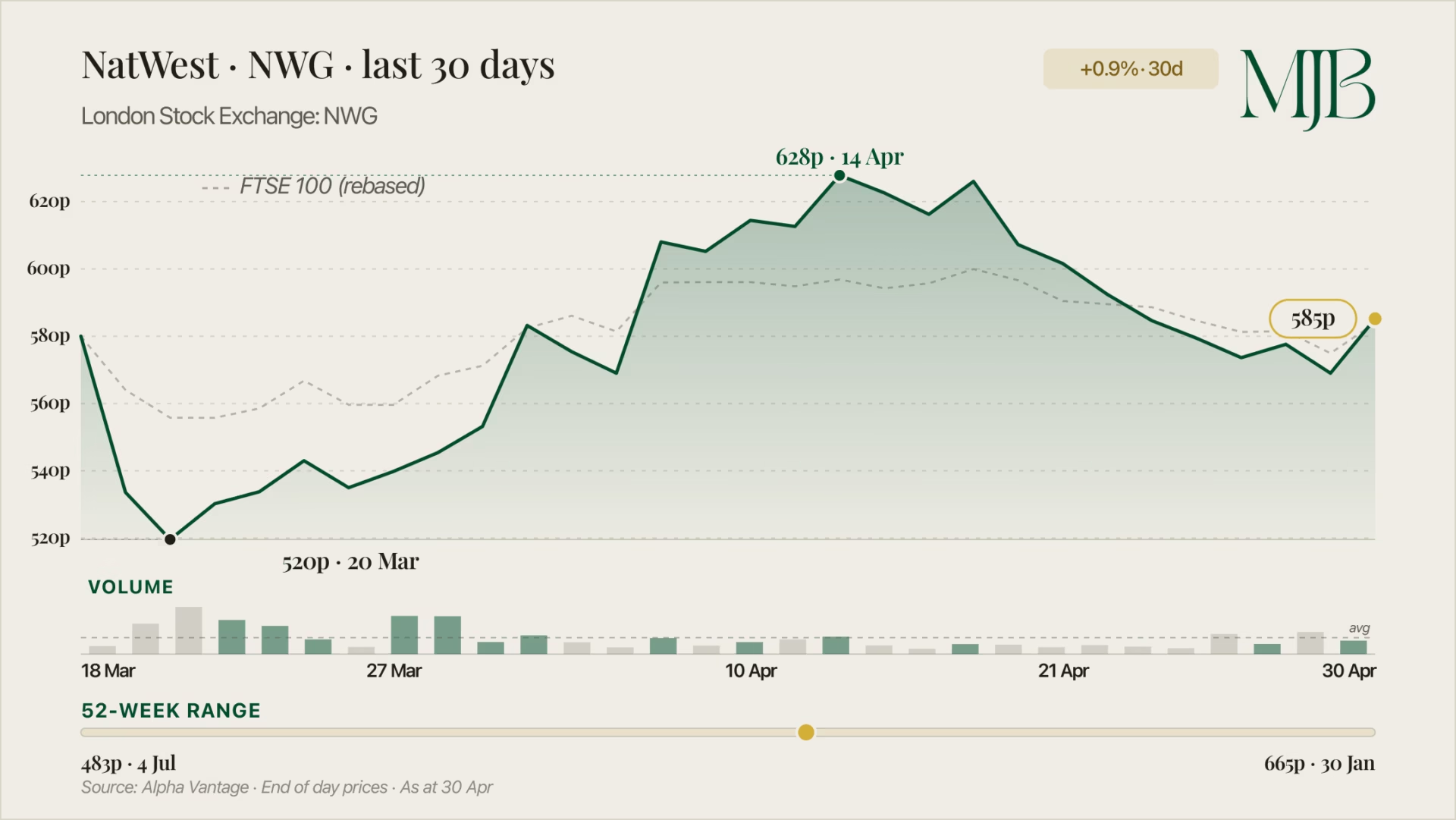
NatWest’s Q1 2026 print was a clean beat on every line that matters. Pre-tax profit hit £2bn, up from £1.8bn the same quarter last year, beating analyst consensus that had pencilled in flat growth. Total income swelled to £4.4bn, a near-10% jump on the prior year. Net interest margin — the spread the bank earns between deposits and lending — climbed 20 basis points year-on-year to 2.47%.
The mortgage book added £3.3bn over the quarter. Commercial and institutional balances grew £3.8bn including a striking 25% surge in start-up customers — a quiet tell on UK small-business confidence. Income guidance for 2026 was nudged toward the top end of the £17.2bn to £17.6bn range, on the back of the Bank of England‘s stickier-for-longer rate path. The BoE held at 3.75% on Thursday but flagged that Middle East-driven inflation could push it higher.

So why did the stock slip 4%?
Two acquisitions sit at the heart of the market’s hesitation. February’s £2.7bn purchase of Evelyn Partners — the wealth manager — added £69bn in assets under management to NatWest’s books, taking the group total to £127bn and making it the largest bank-owned wealth player in the UK. Headline-perfect.
The pricing wasn’t. NatWest paid 9.7x Evelyn’s £179m in earnings — punchy by recent UK financial-services M&A standards. Add £150m of integration spend chasing £100m of promised annual cost savings, and the deal looks underwater for around 24 months before payback starts. CEO Paul Thwaite called Evelyn his “third growth engine.” The market is currently pricing it as the most expensive engine NatWest has bought.
Then there is Coutts. Earlier this year the private bank lifted its minimum deposit from £1m to £3m. Wealth-division return on equity duly jumped from 17.1% to 21.1%, with income up nearly 10% to £291m. Strong on paper. But raising the bar means existing relationships are being repriced, and in private banking, repricing is when clients sometimes walk.

The rate trade is real — but already crowded
NatWest is structurally one of the most rate-sensitive UK lenders. Its profit-and-loss line snaps cleanly to BoE moves through the deposit base. That is why Q1’s margin print landed so well — the maths is well understood. But Lloyds (LON: LLOY) and Barclays (LON: BARC) trade on the same rate-cycle thesis, and HSBC (LON: HSBA) carries the same dynamic at international scale.
If the BoE holds at 3.75% indefinitely, NatWest’s margin tailwind is already in the price. If hikes follow, peers benefit alongside NatWest, and sector ETF flows rather than single-stock conviction drive the move. The 4% slip on a beat suggests positioning had already priced the upgrade — from here, the marginal buyer needs a reason BEYOND the rate trade.
The Bottom Line
NatWest’s Q1 was a clean beat on every operational measure. Shares falling anyway is the market saying the easy rate-cycle gains are priced and the Evelyn-and-Coutts wealth push needs to deliver. By autumn, NatWest needs either Evelyn integration proof or a fresh BoE hike. Without one, its premium to peers will keep eroding.
Want more like this? Sign up to The MJBurrows Briefing — our free weekly newsletter delivered every Monday morning.
FAQ
Why did NatWest shares fall when profits beat expectations?
The market had largely priced the Q1 beat through the rate-cycle thesis — analysts had been raising estimates for months. The 4% drop reflects fresh focus on Evelyn integration costs and the Coutts deposit reset, both of which take several quarters to pay back.
How does the Evelyn Partners acquisition change NatWest?
The £2.7bn deal lifts NatWest’s wealth assets to £127bn, overtaking Lloyds in that segment for the first time and making it the largest bank-owned wealth manager in the UK. It shifts NatWest’s earnings mix toward fee income — less rate-sensitive than lending — though the 9.7x earnings multiple paid is steep by UK financial-services M&A standards.
What does Coutts lifting its minimum deposit mean for clients?
Existing Coutts clients holding less than £3m face higher fees or relationship transition to NatWest’s mass-affluent banking. The strategy concentrates Coutts on ultra-high-net-worth clients where margins are richer, but risks losing long-standing relationships during the transition window.



Disclosure & Editorial Standards
MJBurrows is not authorised or regulated by the Financial Conduct Authority (FCA). The content on this website — including articles, calculators, and tools — is for general informational and educational purposes only. It does not constitute personal financial, investment, tax, or legal advice and does not take into account your individual circumstances, financial situation, or objectives.
Nothing on this site is a personal recommendation to buy, sell, hold, or otherwise deal in any financial product, asset, or service. You should always conduct your own research and seek advice from a qualified, FCA-regulated financial adviser before making any financial decisions.
Our calculators produce estimates based on simplified models using HMRC-published rates for the current tax year. They cannot account for every individual circumstance and should not be relied upon as exact figures. Tax rules and rates may change — verify current rates with HMRC or a qualified tax adviser.
Projections are not guarantees. Where our tools show future values (investment growth, pension projections, compound interest), these are hypothetical illustrations based on assumed growth rates. Past performance does not guarantee future results. The value of investments can go down as well as up.
Market data displayed on this site is provided by third-party sources including Twelve Data, Yahoo Finance, and CoinGecko. We do not guarantee the accuracy, completeness, or timeliness of third-party data.
This content is designed for UK residents and reflects UK tax rules, thresholds, and legislation. It may not apply to other jurisdictions.
Using this website does not create a professional-client relationship of any kind. MJBurrows is not responsible for any financial loss, damage, or decision made based on the content presented. By using this site, you accept these terms.
This disclaimer may be updated from time to time without prior notice. Last reviewed: 23 April 2026.
MJBurrows is an independent UK personal finance publication, written and edited by Matthew Burrows. There is no parent company, no investor group, and no advertising sales team — decisions about what to cover and how to frame it are made by Matthew alone. Our full Editorial Policy sets out how the site operates in detail.
Commercial model. As of April 2026, MJBurrows generates no revenue. The site carries no display advertising, no affiliate links, no sponsored content, no paid product placements, and no pay-for-coverage arrangements. If this changes in future, it will be disclosed openly on the Editorial Policy page.
Sources. Articles and tools reference primary sources — HM Revenue & Customs (HMRC), gov.uk, the Bank of England, the Office for National Statistics (ONS), the Financial Conduct Authority (FCA), Companies House, and UK government departmental publications (DWP, Treasury). Calculator data uses HMRC-published rates for the 2026/27 tax year. Market data (tickers, asset prices) is provided by Twelve Data, Yahoo Finance, and CoinGecko.
Verification. Every published article is fact-checked before going live. Numerical claims are traced to their primary source, quotes are checked against the original speaker or document, and calculator outputs are tested against HMRC worked examples. See our verification and accuracy policy for the full process.
Corrections. If you spot an error, please report it via the Corrections page. A three-tier severity system commits to specific response times:
- Tier 1 — Urgent (material reader harm, defamatory statements, regulatory or legal issues): acknowledged within 24 hours, page actioned within 24 hours, correction published within 48 hours of confirmation.
- Tier 2 — High (significant factual errors that misinform readers): acknowledged within 3 working days, correction published within 7 working days of confirmation.
- Tier 3 — Standard (minor factual errors, dated references, missing context): acknowledged within 7 working days, correction published at the next regular content review (within the quarter).
Significant corrections are logged on the public Corrections log.
Updates and review cadence. Calculators are reviewed at least quarterly, plus event-driven updates when HMRC publishes new rates (Budget, Autumn Statement, new tax year). Guides are reviewed at least twice a year, with major rewrites whenever underlying regulation changes. Tax-year-sensitive content is prioritised for review at the April tax-year transition.
Get in touch. For editorial enquiries — corrections, story tips, reader questions — the address is contact@mjburrows.com. The contact page is at mjburrows.com/contact. Every email is read personally by Matthew.