
£4.3bn buys you out of British telecoms entirely. That is what Hong Kong’s CK Hutchison just collected from Vodafone (LON: VOD) for the 49% stake it held in Three — a clean exit from the UK mobile market following the merger that combined them. Vodafone now owns the lot, the integration savings clock starts ticking on £700m a year by 2030, and UK telecoms loses one of its more colourful long-term shareholders along the way.
The deal in the numbers
The mechanics are clean. Vodafone pays £4.3bn cash to cancel CK Hutchison’s 49% stake in the merged business. The original Vodafone-Three merger was announced in June 2023 with Vodafone holding the controlling 51%; today’s transaction lifts the holding to outright ownership. The combined VodafoneThree business is valued at £13.5bn including debt under the buyout terms.
Full ownership is expected to land later this year. The integration savings clock then starts ticking against a £700m annual run-rate target by 2030 — material money for a FTSE 100 telecoms operator and the number the market will measure Della Valle’s tenure against from here.
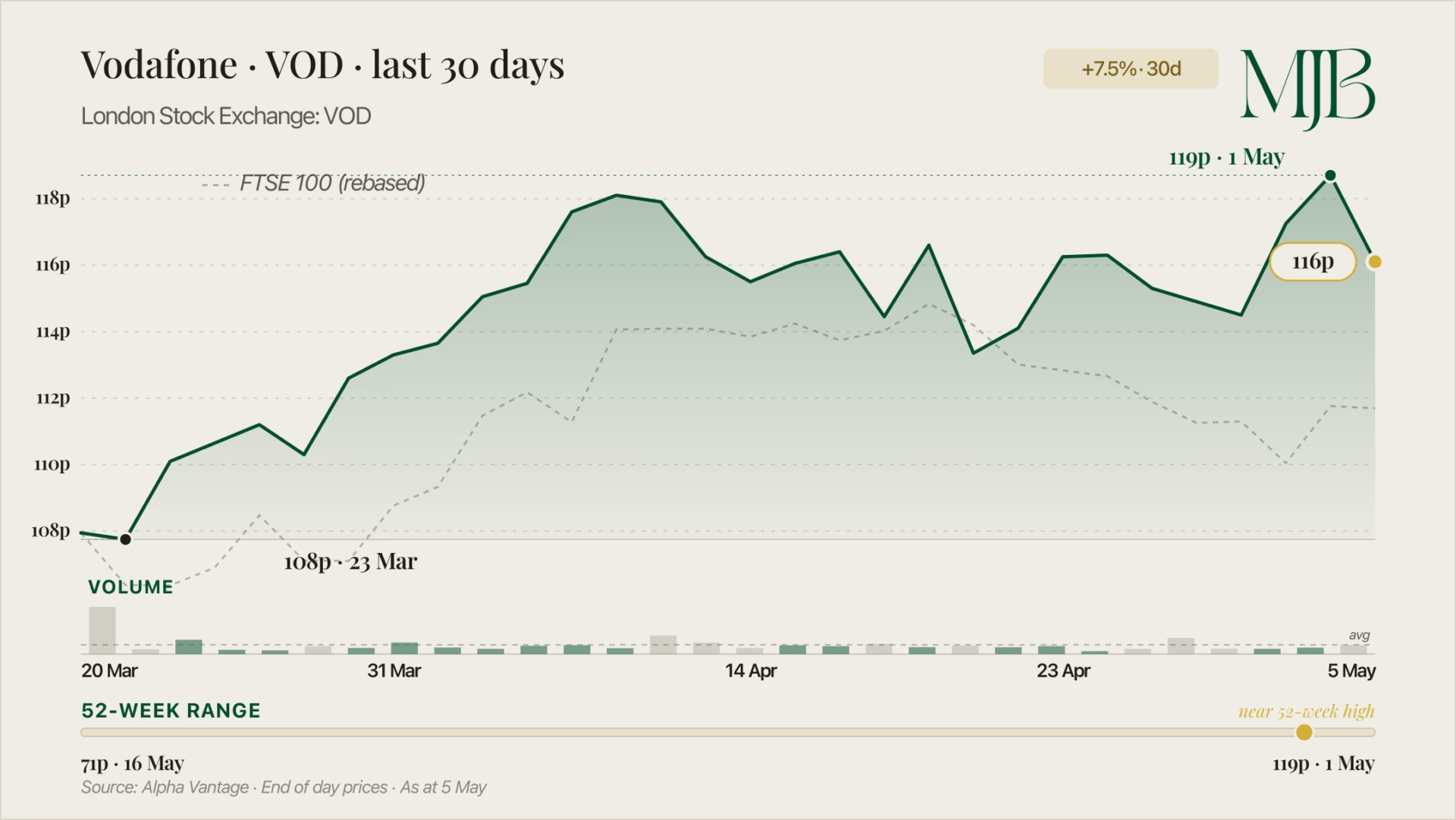
Vodafone’s own share price is up more than 18% year to date at 117p, suggesting the market has been positioning for exactly this kind of consolidation finish line.
Why CK Hutchison is cashing out
CK Hutchison’s UK exit doesn’t end its mobile interests — the Hong Kong group still owns Three’s operations in Ireland, Austria and Indonesia. What it does end is the awkward governance of being a 49% minority owner of a UK business it no longer operationally controls.
That is increasingly the pattern when foreign minority stakeholders sit through a major integration. Once the heavy lifting is done — networks combined, brands aligned, cost lines merged — the minority position becomes a financial holding with limited strategic optionality. Cashing out at a clean valuation lets Hong Kong billionaire Li Ka-Shing redeploy £4.3bn into markets where he has full operational control.
Vodafone said now is the “right time” to take full control. The framing translates: now that the integration is far enough along to value the asset cleanly, both sides got the deal they wanted.

What it means for UK mobile competition
For the UK mobile market, the customer-facing change is small — VodafoneThree was already operating as a single entity post-merger. What changes is the strategic tempo. Della Valle now has all of the savings upside, all of the capex authority, and all of the risk.
The signs that the merger thesis is computing are starting to show. Vodafone Three reported 7% revenue growth in the six months to November, lifting the period to £19.6bn. The high-street rollout is moving — Three is being rolled out to 130 new locations as the combined estate consolidates. The 5G ambition is the headline target: 99% UK population coverage by the end of the decade.
That 99% number is the long-dated promise the integration is meant to fund. Until 2030, every capex line and every cost cut points back to it.
The integration risks ahead
Owning the asset outright means owning every part of that delivery — and the £700m savings number is the only metric that ultimately defends the price paid today.
Three risks deserve flagging now rather than at the autumn print. First, the £700m annual savings target is a 2030 number — running through years of execution against a target the market has already priced. The savings have to actually flow through the P&L between now and then for the buyout maths to work.
Second, VodafoneThree appeared in court in March against 62 of its former franchisees, who allege “irrational cost-cutting measures” left them facing bankruptcy. Cross-party MPs are pushing for new legal protections that could constrain how the planned integration cost-cuts get delivered in practice.
Della Valle said: “I’m delighted that we will now have full ownership of VodafoneThree as we roll out one of Europe’s most advanced 5G networks, provide the UK’s best customer experience and drive long-term value for our shareholders.” The CEO statement is the easy part. The execution sits across 130 store rollouts, a franchisee legal book, and a 5G capex curve that has to deliver coverage Vodafone has been promising the regulator for years.
Owning the asset outright means owning every part of that delivery — and the £700m savings number is the only metric that ultimately defends the price paid today.

The Bottom Line
Vodafone now owns the asset outright, the merger thesis becomes its own to prove, and the £700m savings target is a number Della Valle will be measured against every quarter from here. The easy part — getting the deal done — is the part the market already priced. The hard part starts when integration meets reality across 130 high streets and the franchisee courts. Watch the autumn print.
Want more like this? Sign up to The MJBurrows Briefing — our free weekly newsletter delivered every Monday morning.
FAQ
What is CK Hutchison and why is it selling its Three stake?
CK Hutchison is a Hong Kong-listed conglomerate controlled by billionaire Li Ka-Shing, with mobile interests across multiple European markets. The £4.3bn UK exit reflects the diminished strategic value of being a 49% minority owner once the Vodafone-Three integration is far enough along to value the asset cleanly.
How much will the Vodafone-Three integration save by 2030?
Vodafone has set a £700m annual run-rate savings target by 2030 — a number that has to be delivered against the £4.3bn purchase price for the minority stake to make financial sense. The market is already pricing the upside; Della Valle is now responsible for the execution.
What’s still ahead for the merged UK telecoms business?
Three flashpoints to watch: a 99% 5G population-coverage promise by 2030, the rollout of Three across 130 new high-street locations, and an ongoing court case with 62 former franchisees that could shape how the planned cost cuts can actually be delivered.



Disclosure & Editorial Standards
MJBurrows is not authorised or regulated by the Financial Conduct Authority (FCA). The content on this website — including articles, calculators, and tools — is for general informational and educational purposes only. It does not constitute personal financial, investment, tax, or legal advice and does not take into account your individual circumstances, financial situation, or objectives.
Nothing on this site is a personal recommendation to buy, sell, hold, or otherwise deal in any financial product, asset, or service. You should always conduct your own research and seek advice from a qualified, FCA-regulated financial adviser before making any financial decisions.
Our calculators produce estimates based on simplified models using HMRC-published rates for the current tax year. They cannot account for every individual circumstance and should not be relied upon as exact figures. Tax rules and rates may change — verify current rates with HMRC or a qualified tax adviser.
Projections are not guarantees. Where our tools show future values (investment growth, pension projections, compound interest), these are hypothetical illustrations based on assumed growth rates. Past performance does not guarantee future results. The value of investments can go down as well as up.
Market data displayed on this site is provided by third-party sources including Twelve Data, Yahoo Finance, and CoinGecko. We do not guarantee the accuracy, completeness, or timeliness of third-party data.
This content is designed for UK residents and reflects UK tax rules, thresholds, and legislation. It may not apply to other jurisdictions.
Using this website does not create a professional-client relationship of any kind. MJBurrows is not responsible for any financial loss, damage, or decision made based on the content presented. By using this site, you accept these terms.
This disclaimer may be updated from time to time without prior notice. Last reviewed: 23 April 2026.
MJBurrows is an independent UK personal finance publication, written and edited by Matthew Burrows. There is no parent company, no investor group, and no advertising sales team — decisions about what to cover and how to frame it are made by Matthew alone. Our full Editorial Policy sets out how the site operates in detail.
Commercial model. As of April 2026, MJBurrows generates no revenue. The site carries no display advertising, no affiliate links, no sponsored content, no paid product placements, and no pay-for-coverage arrangements. If this changes in future, it will be disclosed openly on the Editorial Policy page.
Sources. Articles and tools reference primary sources — HM Revenue & Customs (HMRC), gov.uk, the Bank of England, the Office for National Statistics (ONS), the Financial Conduct Authority (FCA), Companies House, and UK government departmental publications (DWP, Treasury). Calculator data uses HMRC-published rates for the 2026/27 tax year. Market data (tickers, asset prices) is provided by Twelve Data, Yahoo Finance, and CoinGecko.
Verification. Every published article is fact-checked before going live. Numerical claims are traced to their primary source, quotes are checked against the original speaker or document, and calculator outputs are tested against HMRC worked examples. See our verification and accuracy policy for the full process.
Corrections. If you spot an error, please report it via the Corrections page. A three-tier severity system commits to specific response times:
- Tier 1 — Urgent (material reader harm, defamatory statements, regulatory or legal issues): acknowledged within 24 hours, page actioned within 24 hours, correction published within 48 hours of confirmation.
- Tier 2 — High (significant factual errors that misinform readers): acknowledged within 3 working days, correction published within 7 working days of confirmation.
- Tier 3 — Standard (minor factual errors, dated references, missing context): acknowledged within 7 working days, correction published at the next regular content review (within the quarter).
Significant corrections are logged on the public Corrections log.
Updates and review cadence. Calculators are reviewed at least quarterly, plus event-driven updates when HMRC publishes new rates (Budget, Autumn Statement, new tax year). Guides are reviewed at least twice a year, with major rewrites whenever underlying regulation changes. Tax-year-sensitive content is prioritised for review at the April tax-year transition.
Get in touch. For editorial enquiries — corrections, story tips, reader questions — the address is contact@mjburrows.com. The contact page is at mjburrows.com/contact. Every email is read personally by Matthew.