

Nvidia (NASDAQ: NVDA) is up 627% in three years. Palantir has done 1,665%. On those numbers the London Stock Exchange looks like a graveyard for growth investors. Reality is messier. Wise (LON: WISE) just grew income 19% and Boku grew revenue 30%. The twist: Wise is moving its primary listing to the US — taking the loudest UK growth story with it. The quieter ones are still on London. And mispriced.
Wise: the £10.8bn fintech moving to New York
Wise (LSE:WISE) just hit a £10.8bn market cap — and it’s leaving for New York. The international money-transfer specialist is moving its primary listing to the US, keeping a secondary line on the London Stock Exchange. Shares currently trade at 1,050p, putting the forward P/E at 26.5.
That price tag looks demanding until you read last year’s numbers. Underlying income grew 19% on a constant-currency basis to £1,619m. Cross-border volume jumped 25% to £181.7bn. Customers climbed 21% to 18.9m. Pre-tax margin guidance sits at 16%. And 75% of transfers now complete instantly — the kind of operational metric that separates a real fintech platform from a payments wrapper.
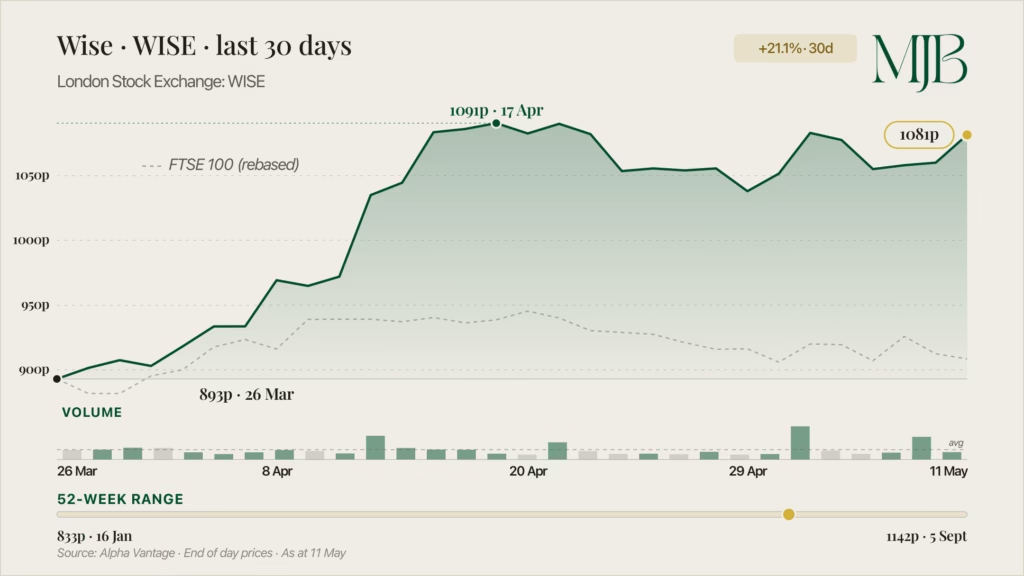
The bear case is the take-rate. Wise is deliberately compressing its fee margins to scale faster, sacrificing near-term profitability for competitive position. Some investors will hate it. Long-term holders should be paying attention. The stock is up 21.5% year-to-date and the listing-move story is far from priced in. Anywhere near 1,050p still looks worth a serious second look.
The take-rate compression also signals what kind of platform Wise wants to be. Not a rent-extractor squeezing margin out of a captive customer base. A scale-first cross-border infrastructure layer that becomes the default plumbing the way Visa (NYSE: V) did in card payments. That ambition is what the forward P/E of 26.5 is paying for — and what the listing move to New York is engineered to unlock.
The listing-move itself is a stress test for the London market. If Wise can lift its valuation simply by changing primary exchange, every other £10.8bn-plus UK growth name will run the same maths — and the London-listed mid-cap discount will keep showing up as US bid premiums on UK targets.

Boku: the £525m payments backbone you’ve never heard of
By 2028, analysts expect that to top £210m, with LPMs forecast to capture 60% of the $11trn global e-commerce market.
Boku (LSE:BOKU) is a fraction of the size at £525m market cap, but it sits underneath some of the largest digital-services companies on the planet. The premise: when someone in Thailand wants to subscribe to Netflix (NASDAQ: NFLX), they pick their local digital wallet at checkout. Boku is the plumbing that connects that wallet to the merchant. Its network now spans more than 200 local payment methods (LPMs) across more than 60 countries.
Last year revenue jumped 30% to £129m, up from £62m in 2021. By 2028, analysts expect that to top £210m, with LPMs forecast to capture 60% of the $11trn global e-commerce market.
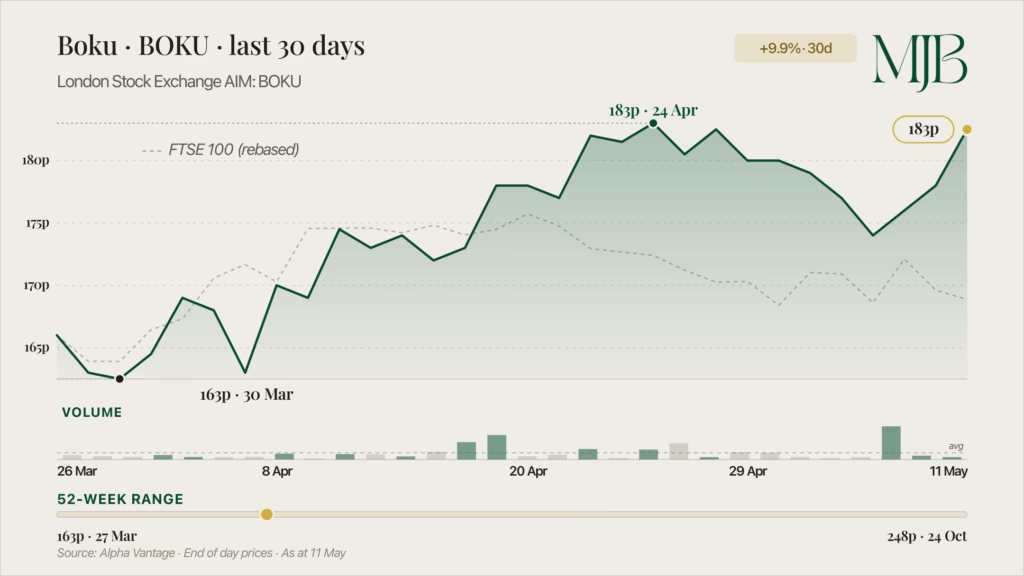
And unlike a typical hyper-growth fintech, Boku is profitable. Earnings are growing alongside the top line, with management guiding for margin expansion in the years ahead. The valuation hasn’t caught up — the stock trades on a forward P/E of 18, modest for a scalable platform expected to grow at 20% over the medium term.
Two risks. A global slowdown that crimps merchant volumes is one. Pressure from the larger payments rails moving down into LPM aggregation is the other. Both real, neither immediate.
The more interesting structural question is distribution. Boku doesn’t win by building consumer brand. It wins by becoming the back-end every digital-services merchant has to support to access local wallets in markets where credit-card penetration is thin. That moat compounds. Once a merchant integrates 200-plus LPMs through one API, ripping that out and re-integrating elsewhere is real engineering pain. The lock-in is structural.

What this means for UK growth investors
Two takeaways. First, the listing exodus story — Wise to New York — is real, and it will likely accelerate. But that doesn’t mean the LSE is empty. It means the survivors get less attention, less analyst coverage, and frequently lower valuations. Quiet alpha for retail investors willing to look.
Second, the £525m end of the market is where the structural inefficiency sits. Boku is a B2B payments-infrastructure play with a global merchant base, profitable margins, and analyst forecasts pointing to revenue growth toward 2028. On a US exchange it would trade north of 30 times earnings.
On the LSE it sits at 18 times. That’s the discount UK retail investors get for showing up — and it lines up with the recent shift in UK equity flows finally turning back toward home.
Practical screen: revenue growth above 20% year-on-year, gross margin trending up, and a forward P/E below 25. Wise and Boku both clear the bar. So do a handful of other LSE-listed mid-caps that don’t appear in FTSE-100 headlines but show up in the small-cap-growth screens every quarter.

The Bottom Line
Forget the doom narrative on UK markets. Wise will be a US stock soon, but its London tail still pays. Boku stays — and at 18 times forecast earnings with 30% revenue growth, the mispricing is the opportunity. Position the LSE as your hunting ground for quiet 20%-plus compounders. The headline-makers are already in Manhattan.
Want more like this? Sign up to The MJBurrows Briefing — our free weekly newsletter delivered every Monday morning.
FAQ
What is Wise’s price-to-earnings ratio?
Wise (LSE:WISE) currently trades at a forward P/E of 26.5 based on a share price of 1,050p. That’s elevated for a UK financials peer, but justifiable given 19% underlying income growth and 16% pre-tax margin guidance.
How does Boku actually make money?
Boku (LSE:BOKU) earns transaction fees by routing local-payment-method transactions for global merchants in more than 60 countries — digital wallets, carrier billing, local cards. Its 200-plus LPM network captures a slice of every cross-border digital-services payment it touches.
Are UK growth stocks worth buying right now?
The LSE has fewer headline growth names than US exchanges, but pockets of structural mispricing — Boku-style — remain. Screen on revenue growth and margin profile rather than chasing American multiples; the discount is the entry point.



Disclosure & Editorial Standards
MJBurrows is not authorised or regulated by the Financial Conduct Authority (FCA). The content on this website — including articles, calculators, and tools — is for general informational and educational purposes only. It does not constitute personal financial, investment, tax, or legal advice and does not take into account your individual circumstances, financial situation, or objectives.
Nothing on this site is a personal recommendation to buy, sell, hold, or otherwise deal in any financial product, asset, or service. You should always conduct your own research and seek advice from a qualified, FCA-regulated financial adviser before making any financial decisions.
Our calculators produce estimates based on simplified models using HMRC-published rates for the current tax year. They cannot account for every individual circumstance and should not be relied upon as exact figures. Tax rules and rates may change — verify current rates with HMRC or a qualified tax adviser.
Projections are not guarantees. Where our tools show future values (investment growth, pension projections, compound interest), these are hypothetical illustrations based on assumed growth rates. Past performance does not guarantee future results. The value of investments can go down as well as up.
Market data displayed on this site is provided by third-party sources including Twelve Data, Yahoo Finance, and CoinGecko. We do not guarantee the accuracy, completeness, or timeliness of third-party data.
This content is designed for UK residents and reflects UK tax rules, thresholds, and legislation. It may not apply to other jurisdictions.
Using this website does not create a professional-client relationship of any kind. MJBurrows is not responsible for any financial loss, damage, or decision made based on the content presented. By using this site, you accept these terms.
This disclaimer may be updated from time to time without prior notice. Last reviewed: 23 April 2026.
MJBurrows is an independent UK personal finance publication, written and edited by Matthew Burrows. There is no parent company, no investor group, and no advertising sales team — decisions about what to cover and how to frame it are made by Matthew alone. Our full Editorial Policy sets out how the site operates in detail.
Commercial model. As of April 2026, MJBurrows generates no revenue. The site carries no display advertising, no affiliate links, no sponsored content, no paid product placements, and no pay-for-coverage arrangements. If this changes in future, it will be disclosed openly on the Editorial Policy page.
Sources. Articles and tools reference primary sources — HM Revenue & Customs (HMRC), gov.uk, the Bank of England, the Office for National Statistics (ONS), the Financial Conduct Authority (FCA), Companies House, and UK government departmental publications (DWP, Treasury). Calculator data uses HMRC-published rates for the 2026/27 tax year. Market data (tickers, asset prices) is provided by Twelve Data, Yahoo Finance, and CoinGecko.
Verification. Every published article is fact-checked before going live. Numerical claims are traced to their primary source, quotes are checked against the original speaker or document, and calculator outputs are tested against HMRC worked examples. See our verification and accuracy policy for the full process.
Corrections. If you spot an error, please report it via the Corrections page. A three-tier severity system commits to specific response times:
- Tier 1 — Urgent (material reader harm, defamatory statements, regulatory or legal issues): acknowledged within 24 hours, page actioned within 24 hours, correction published within 48 hours of confirmation.
- Tier 2 — High (significant factual errors that misinform readers): acknowledged within 3 working days, correction published within 7 working days of confirmation.
- Tier 3 — Standard (minor factual errors, dated references, missing context): acknowledged within 7 working days, correction published at the next regular content review (within the quarter).
Significant corrections are logged on the public Corrections log.
Updates and review cadence. Calculators are reviewed at least quarterly, plus event-driven updates when HMRC publishes new rates (Budget, Autumn Statement, new tax year). Guides are reviewed at least twice a year, with major rewrites whenever underlying regulation changes. Tax-year-sensitive content is prioritised for review at the April tax-year transition.
Get in touch. For editorial enquiries — corrections, story tips, reader questions — the address is contact@mjburrows.com. The contact page is at mjburrows.com/contact. Every email is read personally by Matthew.