
Forget the crypto-winter narrative. Tom Lee — Wall Street’s most-tracked Bitcoin bull — has just called the entire bear market dead, with one condition: Bitcoin closes May above $76,000. Bitcoin is currently trading near $80,000, up roughly 5% in May after positive returns in March and April. Three consecutive positive months means the bear is dead by Lee’s framework — and the 18-month institutional adoption lag just shifted decisively forward.
The $76,000 number that ends the bear
Lee’s signal is concrete and easy to track. Three consecutive positive monthly returns equals bear market over. March was positive. April was positive. May is currently up roughly 5% with bitcoin trading near $80,000. The CoinDesk Bitcoin Price Index closed April at $76,300, so a May close above $76,000 makes it three in a row.
Lee, chairman of Bitmine (BMNR) and co-founder of Fundstrat, said: “If bitcoin closes above $76,000 this month, the bear market is definitively over.” He delivered the call at Consensus 2026 in Miami on Thursday — the major industry event of the calendar.
The trader’s argument: investors are still psychologically anchored to the last downturn and are underestimating the rebound. Bitcoin has never closed three months up while still in a bear market, by Lee’s historical analysis. The May 31 close becomes the binary moment of the cycle.
Bitmine, where Lee chairs, is a public bitcoin treasury company (ticker BMNR) — a vehicle that holds bitcoin on its balance sheet and trades as a bitcoin proxy. Lee’s call carries weight because he is one of Wall Street’s most-cited bitcoin bulls, with a research-led following that runs across institutional trading desks. Capital allocators listen — and reposition.

What’s driving the rebound
Iran is the macro tailwind nobody planned for. Since US-Iran tensions escalated, crypto assets have outperformed most traditional markets, with ether (ETH) leading the gains. The original safe-haven framing is shifting from gold to digital assets in real time.
Lee also pointed to bullish technical signals from John Bollinger, who recently said his trend models had turned positive on Bitcoin — a meaningful shift for a strategy used widely across Wall Street trading desks.
Software stocks add another tailwind. Fundstrat recently upgraded the sector after fears of AI disrupting its business model, and software stocks have historically traded in close correlation with Bitcoin. The AI-recovery rally is now lifting both at once. The cross-asset signal is unambiguous: bitcoin is back in a risk-on regime, not a defensive one.

Tom Lee’s tokenization and AI thesis
Lee also pointed to a Grayscale report that the $300 trillion (~£220.2tn) securities market will eventually migrate to blockchain rails as tokenized assets.
The next bull cycle, in Lee’s framing, is not a repeat of 2021’s retail-mania run. It’s a structural shift driven by two megatrends that are disrupting finance: assets migrating onchain (tokenisation) and AI agents using blockchain rails to move money.
Lee said: “AI agents are going to need money to move value autonomously, and for that they will increasingly rely on blockchain networks and tokenized financial systems.”
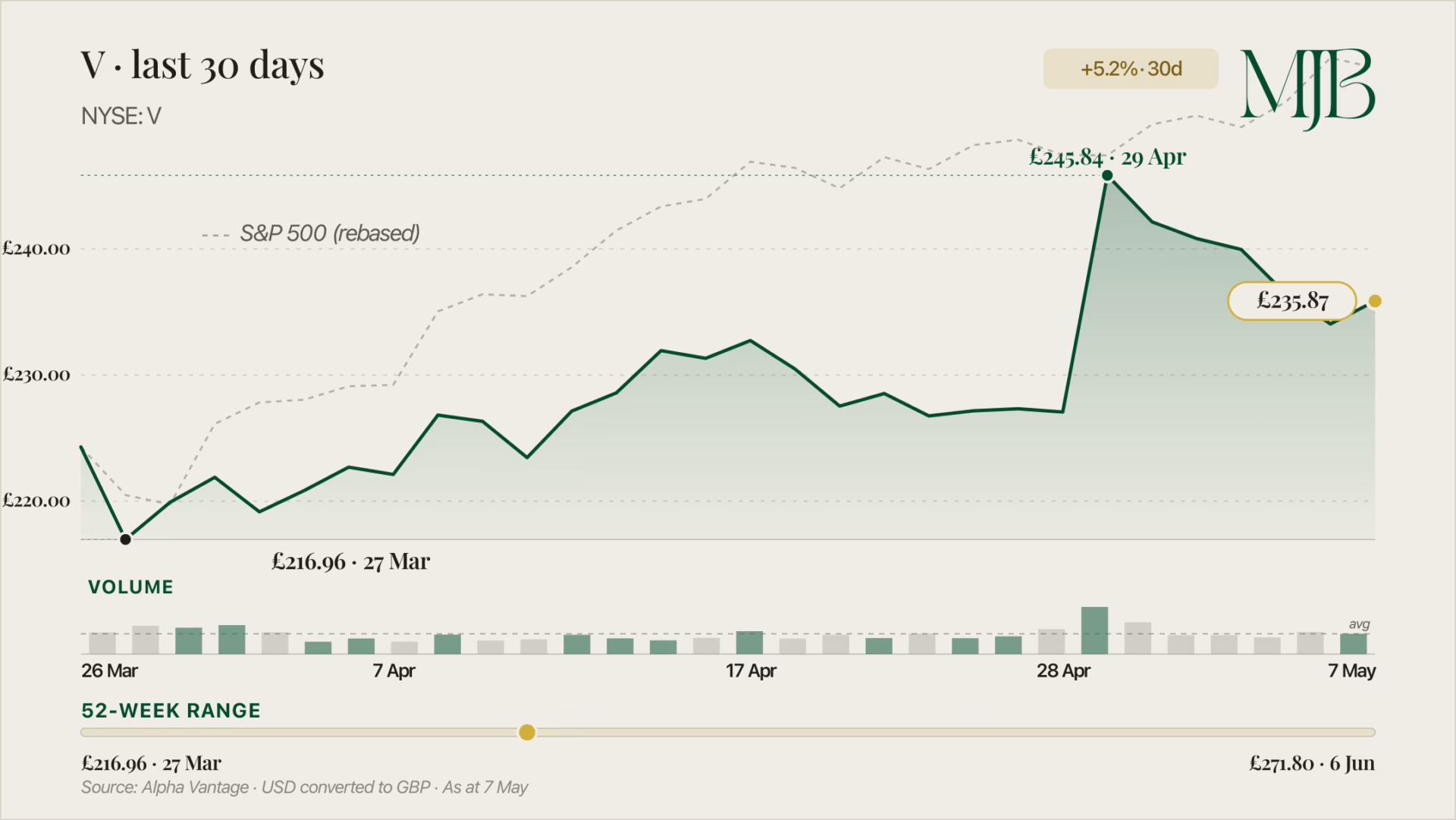
The evidence the transition is already underway: stablecoin transaction volumes have already surpassed Visa (NYSE: V) payments. That is not a future-state projection — that is current-state data. Lee also pointed to a Grayscale report that the $300 trillion (~£220.2tn) securities market will eventually migrate to blockchain rails as tokenized assets.
The networks hosting that activity capture the economic value. Lee’s view: “The networks that host a large share of tokenized activity are going to capture the economic value.” Translation — the chain wars matter again, this time for revenue, not narrative.
The JPMorgan vs Tether comparison
Lee’s killer comparison reframes the whole sector. JPMorgan (NYSE: JPM), projected to earn roughly $60 billion (~£44.0bn) this year with 300,000 employees, sits next to Tether (USDT) and trading firm Jane Street, which generate similar profit levels with a tiny fraction of the workforce.
Lee said: “Native digital companies using blockchain as settlement eliminate a lot of processes and people.”
The implication is structural, not headline. Just as internet companies displaced legacy media and telecom giants over the past two decades, crypto-native financial firms could increasingly resemble the same disruption pattern in finance.
His prediction: “In 10 years, half of the largest financial institutions in the world will be native digital.” That is a forecast about who runs global capital markets in 2036 — not just where bitcoin’s price lands at the end of May.
For investors still anchored to the late-2025 crypto crater (bitcoin dropped from $126,000 in October to $60,000 in February), the rebound has been easy to dismiss. Three positive months running is harder to argue with.

The Bottom Line
Don’t dismiss this as another bull-market call. Lee’s framework is concrete — three positive months, May above $76,000 — and bitcoin is $4,000 over the threshold with three weeks of trading left. Watch for the May 31 close — that’s your trigger. Still pricing in another crypto winter? You’re already late: tokenization and AI-agent rails go mainstream by 2027.
Want more like this? Sign up to The MJBurrows Briefing — our free weekly newsletter delivered every Monday morning.
FAQ
Why does $76,000 matter as a Bitcoin level?
The CoinDesk Bitcoin Price Index closed April at $76,300, so a close above $76,000 in May locks in a third consecutive monthly gain — Tom Lee’s specific marker for a confirmed bull market. Bitcoin has never closed three months up while still in a bear market, by his historical analysis.
What is Lee’s tokenization-and-AI thesis?
Lee argues two megatrends are reshaping finance: assets migrating onchain (tokenization), and AI agents using blockchain rails to move money autonomously. He cites stablecoin transaction volumes already surpassing Visa payments and a Grayscale projection that the $300 trillion (~£220.2tn) securities market will eventually migrate to blockchain.
How does Lee compare crypto-native firms to legacy banks?
Lee compared JPMorgan — projected to earn roughly $60 billion (~£44.0bn) this year with 300,000 employees — to Tether and trading firm Jane Street, which deliver similar profit levels with a tiny fraction of the workforce. His prediction: in 10 years, half of the largest financial institutions in the world will be native digital.



Disclosure & Editorial Standards
MJBurrows is not authorised or regulated by the Financial Conduct Authority (FCA). The content on this website — including articles, calculators, and tools — is for general informational and educational purposes only. It does not constitute personal financial, investment, tax, or legal advice and does not take into account your individual circumstances, financial situation, or objectives.
Nothing on this site is a personal recommendation to buy, sell, hold, or otherwise deal in any financial product, asset, or service. You should always conduct your own research and seek advice from a qualified, FCA-regulated financial adviser before making any financial decisions.
Our calculators produce estimates based on simplified models using HMRC-published rates for the current tax year. They cannot account for every individual circumstance and should not be relied upon as exact figures. Tax rules and rates may change — verify current rates with HMRC or a qualified tax adviser.
Projections are not guarantees. Where our tools show future values (investment growth, pension projections, compound interest), these are hypothetical illustrations based on assumed growth rates. Past performance does not guarantee future results. The value of investments can go down as well as up.
Market data displayed on this site is provided by third-party sources including Twelve Data, Yahoo Finance, and CoinGecko. We do not guarantee the accuracy, completeness, or timeliness of third-party data.
This content is designed for UK residents and reflects UK tax rules, thresholds, and legislation. It may not apply to other jurisdictions.
Using this website does not create a professional-client relationship of any kind. MJBurrows is not responsible for any financial loss, damage, or decision made based on the content presented. By using this site, you accept these terms.
This disclaimer may be updated from time to time without prior notice. Last reviewed: 23 April 2026.
MJBurrows is an independent UK personal finance publication, written and edited by Matthew Burrows. There is no parent company, no investor group, and no advertising sales team — decisions about what to cover and how to frame it are made by Matthew alone. Our full Editorial Policy sets out how the site operates in detail.
Commercial model. As of April 2026, MJBurrows generates no revenue. The site carries no display advertising, no affiliate links, no sponsored content, no paid product placements, and no pay-for-coverage arrangements. If this changes in future, it will be disclosed openly on the Editorial Policy page.
Sources. Articles and tools reference primary sources — HM Revenue & Customs (HMRC), gov.uk, the Bank of England, the Office for National Statistics (ONS), the Financial Conduct Authority (FCA), Companies House, and UK government departmental publications (DWP, Treasury). Calculator data uses HMRC-published rates for the 2026/27 tax year. Market data (tickers, asset prices) is provided by Twelve Data, Yahoo Finance, and CoinGecko.
Verification. Every published article is fact-checked before going live. Numerical claims are traced to their primary source, quotes are checked against the original speaker or document, and calculator outputs are tested against HMRC worked examples. See our verification and accuracy policy for the full process.
Corrections. If you spot an error, please report it via the Corrections page. A three-tier severity system commits to specific response times:
- Tier 1 — Urgent (material reader harm, defamatory statements, regulatory or legal issues): acknowledged within 24 hours, page actioned within 24 hours, correction published within 48 hours of confirmation.
- Tier 2 — High (significant factual errors that misinform readers): acknowledged within 3 working days, correction published within 7 working days of confirmation.
- Tier 3 — Standard (minor factual errors, dated references, missing context): acknowledged within 7 working days, correction published at the next regular content review (within the quarter).
Significant corrections are logged on the public Corrections log.
Updates and review cadence. Calculators are reviewed at least quarterly, plus event-driven updates when HMRC publishes new rates (Budget, Autumn Statement, new tax year). Guides are reviewed at least twice a year, with major rewrites whenever underlying regulation changes. Tax-year-sensitive content is prioritised for review at the April tax-year transition.
Get in touch. For editorial enquiries — corrections, story tips, reader questions — the address is contact@mjburrows.com. The contact page is at mjburrows.com/contact. Every email is read personally by Matthew.