
Forget the easy crypto-fad take. BlackRock (NYSE: BLK) just filed not one but two new tokenised fund products on Friday — a $7bn (~£5.1bn) Treasury liquidity fund moving onchain, plus a brand-new stablecoin reserve vehicle. The world’s biggest asset manager is voting with paperwork. The tokenised finance sector that just crossed $30bn (~£22.0bn) for the first time has its institutional anchor.
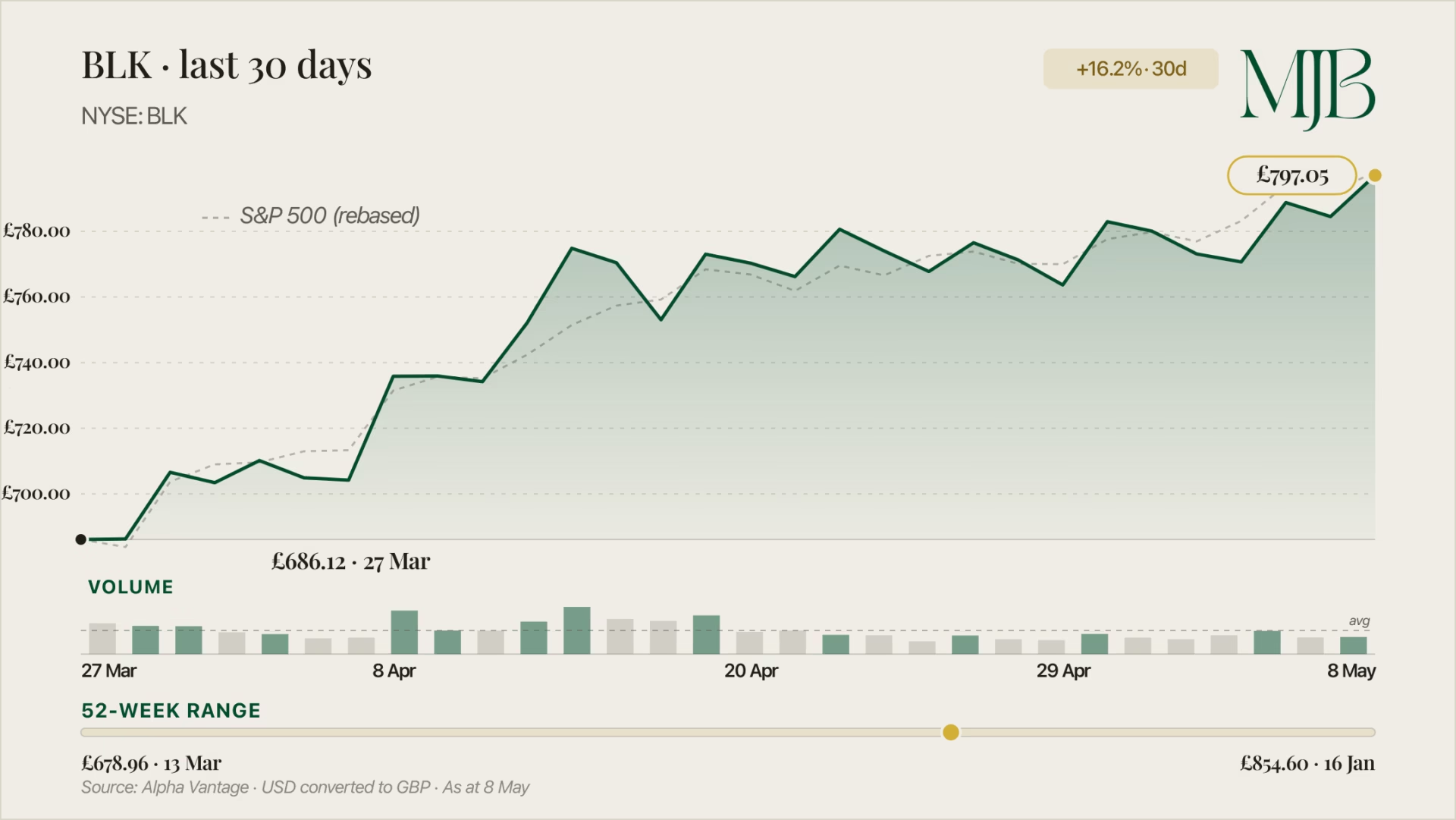
The $7bn number that just moved onchain
The Friday SEC filing outlines how BNY Mellon Investment Servicing, the fund’s transfer agent, will maintain official ownership records on Ethereum using ERC-20 token standards.
BlackRock’s Select Treasury Based Liquidity Fund — a traditional money-market fund with nearly $7bn (~£5.1bn) in assets under management — is getting an onchain share class. The Friday SEC filing outlines how BNY Mellon Investment Servicing, the fund’s transfer agent, will maintain official ownership records on Ethereum using ERC-20 token standards.
Translation: the same investors who own this fund today will, if the SEC clears the filing, see their ownership tracked on a public blockchain rather than a private back-office database. The fund itself stays a money-market fund. The recordkeeping plumbing just shifts onto Ethereum’s rails.
That’s not a token launch. It’s not a crypto pivot. It’s the world’s biggest asset manager rewiring the back-office of a $7bn (~£5.1bn) Treasury product to run on a public blockchain. The signal matters more than the mechanics — when BlackRock files paperwork like this, every traditional asset manager’s board reviews the same option fast.

The second filing nobody is talking about
The second SEC filing is the BlackRock Daily Reinvestment Stablecoin Reserve Vehicle — a brand-new fund that invests in cash, short-term US Treasury securities, and overnight repurchase agreements backed by Treasuries.
That product profile matters. It’s almost identical to what stablecoin issuers hold as reserves. Tether and Circle’s USDC are both backed primarily by short-term Treasuries and cash equivalents. BlackRock just filed a regulated fund product purpose-built to sit alongside — or underneath — that infrastructure.
If the SEC clears it, BlackRock is positioned to siphon the institutional back-end of the entire stablecoin economy. That’s a far bigger structural play than launching a tokenized fund — capturing reserve management for the stablecoin sector at BlackRock fee structures generates meaningful annual revenue from a single SEC approval, and binds stablecoin issuers’ fortunes to BlackRock’s regulated wrapper for years.

From BUIDL to today: BlackRock’s two-year arc
BlackRock’s tokenisation push isn’t new. In March 2024 it launched BUIDL — its first tokenised money-market fund — with Securitize as the tokenisation partner. BUIDL grew quickly, and BlackRock CEO Larry Fink has repeatedly framed tokenisation as the modernisation of financial infrastructure, not a crypto sideline.
The Friday filings are the next two products in that arc. Same partner (Securitize). Same chain (Ethereum). Higher AUM at risk ($7bn (~£5.1bn) versus BUIDL’s smaller starting base). And a new category — the stablecoin reserve vehicle — that didn’t exist in BlackRock’s playbook before this week.
The pattern smashes the experimental-tokenisation narrative. BlackRock’s $14tn (~£10.3tn) under management isn’t being deployed via headline-grabbing Bitcoin announcements. It’s being deployed via SEC paperwork that quietly rewires the rails of existing flagship products. Same playbook Larry Fink ran for ETFs in the 2010s, now applied to onchain finance.
What this means for UK retail investors
Tokenised finance as a sector has crossed $30bn (~£22.0bn) this year. That growth happened with niche crypto-native firms doing most of the heavy lifting. BlackRock filing two new products at $7bn (~£5.1bn)-plus scale flipped the centre of gravity decisively toward traditional asset managers.
UK retail investors should expect two structural shifts to follow. First, abrdn (LON: ABDN), M&G, and Legal & General (LON: LGEN) will face board pressure to file their own tokenised share classes — likely within 12 months. Each will struggle to justify NOT having an onchain product when BlackRock has set the standard.
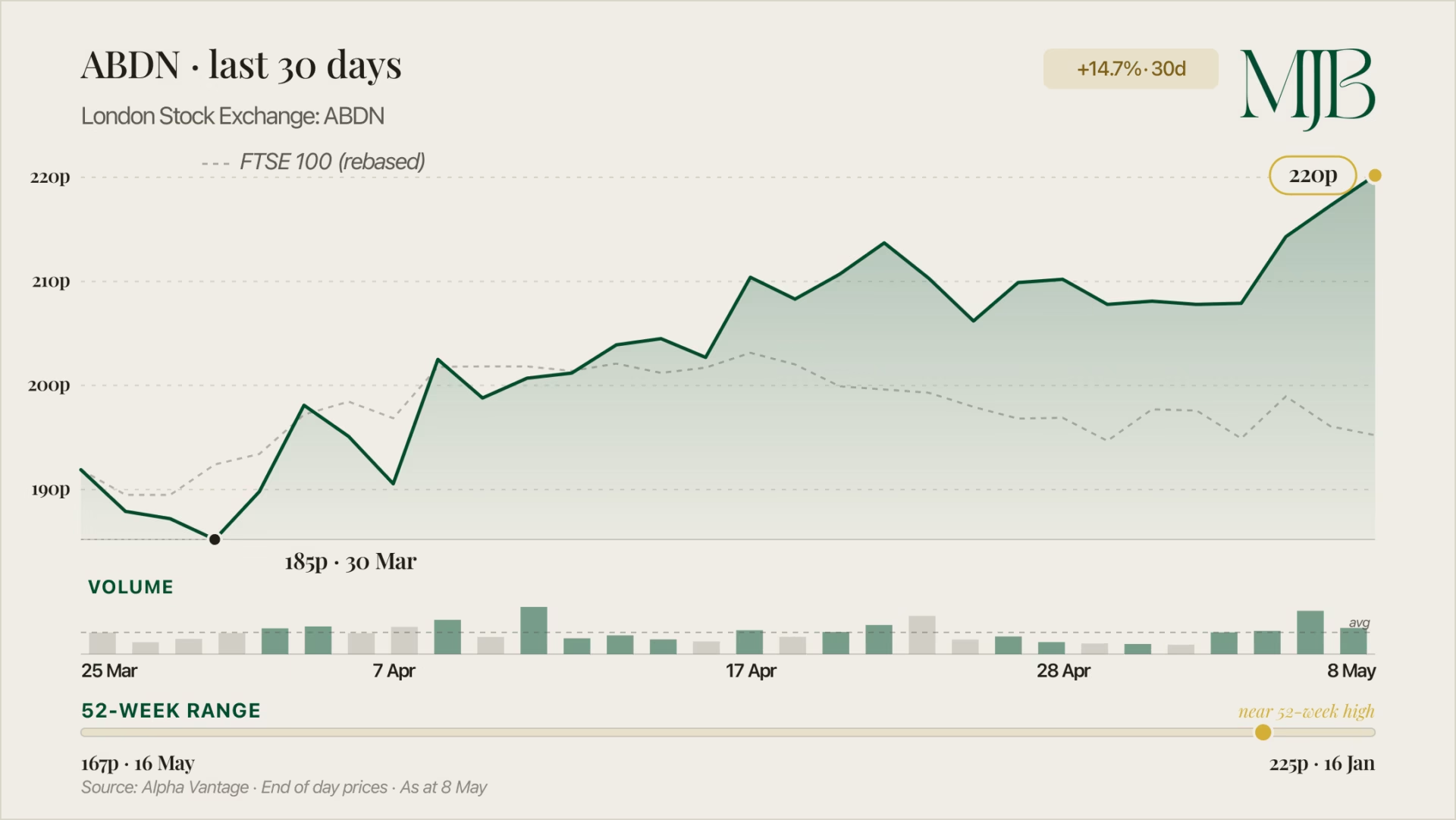
Second, existing UK-listed ETF wrappers tracking BlackRock’s BUIDL-adjacent products will see fresh inflows as the institutional thesis hardens from theoretical to filed. Retail flows tend to chase institutional signals on a six-to-nine-month lag — and the institutional signal just got filed, in writing, with the SEC.
The fad story is dead. The tokenisation sector is becoming infrastructure — and UK asset managers caught flat-footed will spend the rest of 2026 catching up.

The Bottom Line
Watch for the next BlackRock filing. If the BUIDL trajectory holds, by year-end 2026 we’ll see brand-name UK asset managers filing their own tokenised products. The institutional infrastructure for crypto-native finance is being built quietly, one SEC filing at a time. You’re either positioning for it or you’re already late.
Want more like this? Sign up to The MJBurrows Briefing — our free weekly newsletter delivered every Monday morning.
FAQ
What is BlackRock’s BUIDL fund?
BUIDL is BlackRock’s first tokenised money-market fund, launched in March 2024 with Securitize as partner. It records ownership on the Ethereum blockchain using ERC-20 token standards — the same approach now proposed for the $7bn (~£5.1bn) Select Treasury Based Liquidity Fund.
Does the onchain share class change how the fund works?
No — the underlying fund stays a regulated money-market fund holding Treasuries and cash; only the ownership-record plumbing moves from BNY Mellon’s private database to the public Ethereum ledger. Investors get blockchain transparency without the product itself changing.
Why does BlackRock care about stablecoin reserves?
Stablecoin issuers like Tether and Circle hold billions in short-term Treasuries to back their tokens. A regulated BlackRock fund purpose-built for that reserve profile positions BlackRock to capture the institutional back-end of the entire stablecoin economy — bigger than any single tokenised fund product.



Disclosure & Editorial Standards
MJBurrows is not authorised or regulated by the Financial Conduct Authority (FCA). The content on this website — including articles, calculators, and tools — is for general informational and educational purposes only. It does not constitute personal financial, investment, tax, or legal advice and does not take into account your individual circumstances, financial situation, or objectives.
Nothing on this site is a personal recommendation to buy, sell, hold, or otherwise deal in any financial product, asset, or service. You should always conduct your own research and seek advice from a qualified, FCA-regulated financial adviser before making any financial decisions.
Our calculators produce estimates based on simplified models using HMRC-published rates for the current tax year. They cannot account for every individual circumstance and should not be relied upon as exact figures. Tax rules and rates may change — verify current rates with HMRC or a qualified tax adviser.
Projections are not guarantees. Where our tools show future values (investment growth, pension projections, compound interest), these are hypothetical illustrations based on assumed growth rates. Past performance does not guarantee future results. The value of investments can go down as well as up.
Market data displayed on this site is provided by third-party sources including Twelve Data, Yahoo Finance, and CoinGecko. We do not guarantee the accuracy, completeness, or timeliness of third-party data.
This content is designed for UK residents and reflects UK tax rules, thresholds, and legislation. It may not apply to other jurisdictions.
Using this website does not create a professional-client relationship of any kind. MJBurrows is not responsible for any financial loss, damage, or decision made based on the content presented. By using this site, you accept these terms.
This disclaimer may be updated from time to time without prior notice. Last reviewed: 23 April 2026.
MJBurrows is an independent UK personal finance publication, written and edited by Matthew Burrows. There is no parent company, no investor group, and no advertising sales team — decisions about what to cover and how to frame it are made by Matthew alone. Our full Editorial Policy sets out how the site operates in detail.
Commercial model. As of April 2026, MJBurrows generates no revenue. The site carries no display advertising, no affiliate links, no sponsored content, no paid product placements, and no pay-for-coverage arrangements. If this changes in future, it will be disclosed openly on the Editorial Policy page.
Sources. Articles and tools reference primary sources — HM Revenue & Customs (HMRC), gov.uk, the Bank of England, the Office for National Statistics (ONS), the Financial Conduct Authority (FCA), Companies House, and UK government departmental publications (DWP, Treasury). Calculator data uses HMRC-published rates for the 2026/27 tax year. Market data (tickers, asset prices) is provided by Twelve Data, Yahoo Finance, and CoinGecko.
Verification. Every published article is fact-checked before going live. Numerical claims are traced to their primary source, quotes are checked against the original speaker or document, and calculator outputs are tested against HMRC worked examples. See our verification and accuracy policy for the full process.
Corrections. If you spot an error, please report it via the Corrections page. A three-tier severity system commits to specific response times:
- Tier 1 — Urgent (material reader harm, defamatory statements, regulatory or legal issues): acknowledged within 24 hours, page actioned within 24 hours, correction published within 48 hours of confirmation.
- Tier 2 — High (significant factual errors that misinform readers): acknowledged within 3 working days, correction published within 7 working days of confirmation.
- Tier 3 — Standard (minor factual errors, dated references, missing context): acknowledged within 7 working days, correction published at the next regular content review (within the quarter).
Significant corrections are logged on the public Corrections log.
Updates and review cadence. Calculators are reviewed at least quarterly, plus event-driven updates when HMRC publishes new rates (Budget, Autumn Statement, new tax year). Guides are reviewed at least twice a year, with major rewrites whenever underlying regulation changes. Tax-year-sensitive content is prioritised for review at the April tax-year transition.
Get in touch. For editorial enquiries — corrections, story tips, reader questions — the address is contact@mjburrows.com. The contact page is at mjburrows.com/contact. Every email is read personally by Matthew.