
Forget the war-spike narrative. TACO is back. Trump just paused the US military escort through the Strait of Hormuz, sending Brent crude tumbling from $115 to under $100 a barrel in two hours. The FTSE 100 jumped nearly 2%, Asian and European stocks rebounded, and the ‘Trump Always Chickens Out’ trade priced itself back into every macro book. The wartime $126 oil spike just hit reverse on a single Truth Social post.
How fast the market moved
The price action speaks for itself. Brent crude oil had been trading near $115 a barrel as Asian and European traders priced in another fortnight of escalation. Within two hours of Trump’s Truth Social post announcing the pause, the contract slipped under $100 a barrel — a move of roughly 13% on the headline price.
The FTSE 100 inched up by nearly 2% inside the first two hours of trading on the news. Asian and European indices rebounded in tandem. Currency desks logged sharp moves as the safe-haven bid unwound, and gilt yields softened as the imported-inflation outlook eased.
This is the textbook TACO trade in action: a maximalist threat from the White House drives oil and equity volatility wider, and the eventual climb-down hands traders one of the cleanest reverses in the macro calendar. Anyone who held short risk into the announcement and covered on the post — minted in two hours flat.

What Trump actually paused
Trump’s Truth Social post announced the pause of Project Freedom, the US military operation escorting commercial shipping through the Strait of Hormuz. Project Freedom had been the most visible American escalation of the past month — a direct response to Iranian threats against shipping in the chokepoint.
Two important footnotes. First, the blockade on Iranian ports remains in full force; only the escort operation has been paused. Second, US Secretary of State Marco Rubio confirmed that Operation Epic Fury — the broader offensive on Iran — has also ended as Washington pivots towards a negotiated agreement.
The trigger for the pause, per the post: the request of Pakistan and other countries, and what the White House calls “Great Progress” toward a “Complete and Final Agreement” with Iranian representatives. The French container line CMA CGM said one of its vessels was attacked in the Strait of Hormuz on Tuesday — a reminder that the chokepoint is still live, peace headlines or not.

TACO is the trade now
The TACO trade — short for “Trump Always Chickens Out” — has now priced itself in across multiple Iran-related cycles this year. Each cycle follows the same shape: maximalist threat, market spike, follow-up walkback, mean reversion. Today’s pause fits the pattern with such precision that traders are already trying to time the next iteration.
Neil Wilson, Saxo UK investor strategist, said: “There are three things certain in life — death, taxes and a TACO.”
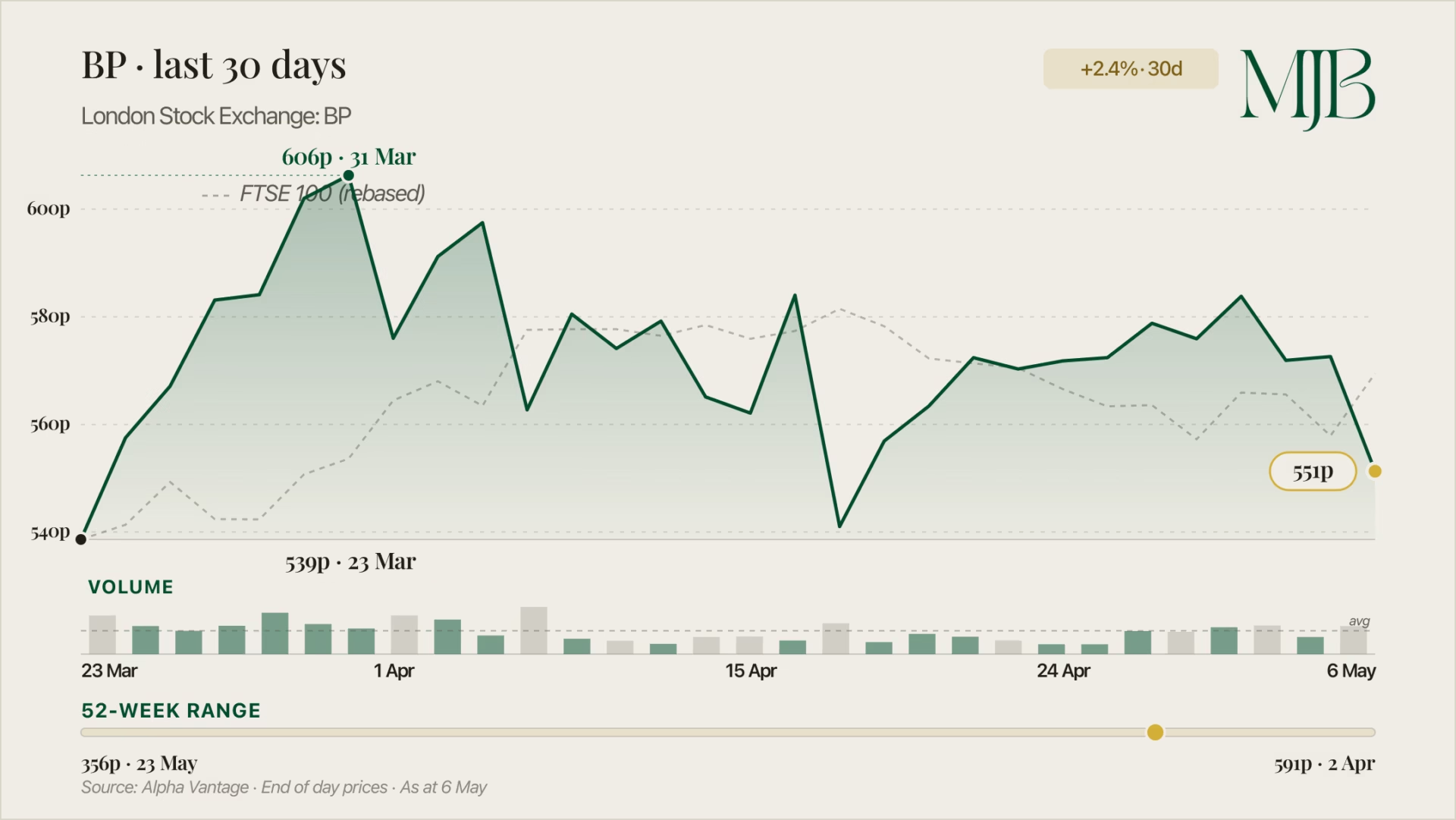
The reality for any trader running an Iran-exposed book is that the volatility itself is the trade. Brent has whipsawed from war-spike highs of $126 back through war-pause lows below $100 multiple times this cycle. For UK-listed energy names, the same volatility has flowed straight through to share prices — Shell (LON: SHEL), BP (LON: BP), and the wider FTSE 100 have all priced the macro signal cleanly.
The risk: TACO works until it doesn’t. One escalation that doesn’t reverse changes the trade overnight, and the asymmetric downside on long-oil-shorts at that point is enormous.
What this means for the FTSE 100, gilts, and Reeves
For UK markets, the immediate read is straight-line positive. A drop in oil cools the imported-inflation pressure that has been driving petrol prices and headline CPI through the past month. Gilt yields softened on the news, easing the borrowing cost pressure on the Treasury. Sterling firmed modestly against the dollar.
For Reeves, every TACO swing is a small fiscal mood ride. Lower oil and lower borrowing costs are the friendly direction — but the volatility itself complicates Budget arithmetic. Forecasting next year’s borrowing requirement against a Brent price that swings from $90 lows to $126 wartime highs and back inside a month is hard work, even before the wider Iran-war fiscal hit is layered on.
UK energy stocks like Shell and BP sit on the other side of the trade — every oil-down move clips their FTSE earnings outlook, even as the index itself rises on rate-cut hopes.
For the FTSE 100, Wednesday’s 2% bounce is welcome but conditional. The same trade that lifted shares this morning could reverse on the next Truth Social post. Investors looking at the index right now are not pricing peace — they are pricing the option of peace.

The Bottom Line
TACO trades return until they don’t — and the next maximalist Trump threat is one Truth Social post away.
Don’t pretend this is the end of the Iran story. TACO trades return until they don’t — and the next maximalist Trump threat is one Truth Social post away. If you’re running oil-exposed books or FTSE 100 names through this cycle, the volatility itself is the asset class now. Watch the next escalation closely. The peace dividend is provisional until the deal is signed.
Want more like this? Sign up to The MJBurrows Briefing — our free weekly newsletter delivered every Monday morning.
FAQ
Why is this called the TACO trade?
TACO stands for “Trump Always Chickens Out” — coined by market analysts who noticed that Trump’s most maximalist threats are usually walked back days or hours later. The pattern lets traders run the same playbook each cycle: short risk into the threat, cover the position when the climb-down arrives.
What is Project Freedom and why did it matter?
Project Freedom was the US military operation escorting commercial shipping through the Strait of Hormuz — the chokepoint pushing Brent to wartime highs when it launched. Pausing it has reversed that move; the blockade on Iranian ports stays in full force.
Why did the FTSE 100 specifically rebound on the news?
A drop in oil eases the imported-inflation pressure driving UK headline CPI through the past month — softer gilt yields, lower borrowing costs, supportive for FTSE 100 valuations across cyclical, financial, and consumer-facing sectors. The index’s 2% bounce reflects exactly that mechanism.



Disclosure & Editorial Standards
MJBurrows is not authorised or regulated by the Financial Conduct Authority (FCA). The content on this website — including articles, calculators, and tools — is for general informational and educational purposes only. It does not constitute personal financial, investment, tax, or legal advice and does not take into account your individual circumstances, financial situation, or objectives.
Nothing on this site is a personal recommendation to buy, sell, hold, or otherwise deal in any financial product, asset, or service. You should always conduct your own research and seek advice from a qualified, FCA-regulated financial adviser before making any financial decisions.
Our calculators produce estimates based on simplified models using HMRC-published rates for the current tax year. They cannot account for every individual circumstance and should not be relied upon as exact figures. Tax rules and rates may change — verify current rates with HMRC or a qualified tax adviser.
Projections are not guarantees. Where our tools show future values (investment growth, pension projections, compound interest), these are hypothetical illustrations based on assumed growth rates. Past performance does not guarantee future results. The value of investments can go down as well as up.
Market data displayed on this site is provided by third-party sources including Twelve Data, Yahoo Finance, and CoinGecko. We do not guarantee the accuracy, completeness, or timeliness of third-party data.
This content is designed for UK residents and reflects UK tax rules, thresholds, and legislation. It may not apply to other jurisdictions.
Using this website does not create a professional-client relationship of any kind. MJBurrows is not responsible for any financial loss, damage, or decision made based on the content presented. By using this site, you accept these terms.
This disclaimer may be updated from time to time without prior notice. Last reviewed: 23 April 2026.
MJBurrows is an independent UK personal finance publication, written and edited by Matthew Burrows. There is no parent company, no investor group, and no advertising sales team — decisions about what to cover and how to frame it are made by Matthew alone. Our full Editorial Policy sets out how the site operates in detail.
Commercial model. As of April 2026, MJBurrows generates no revenue. The site carries no display advertising, no affiliate links, no sponsored content, no paid product placements, and no pay-for-coverage arrangements. If this changes in future, it will be disclosed openly on the Editorial Policy page.
Sources. Articles and tools reference primary sources — HM Revenue & Customs (HMRC), gov.uk, the Bank of England, the Office for National Statistics (ONS), the Financial Conduct Authority (FCA), Companies House, and UK government departmental publications (DWP, Treasury). Calculator data uses HMRC-published rates for the 2026/27 tax year. Market data (tickers, asset prices) is provided by Twelve Data, Yahoo Finance, and CoinGecko.
Verification. Every published article is fact-checked before going live. Numerical claims are traced to their primary source, quotes are checked against the original speaker or document, and calculator outputs are tested against HMRC worked examples. See our verification and accuracy policy for the full process.
Corrections. If you spot an error, please report it via the Corrections page. A three-tier severity system commits to specific response times:
- Tier 1 — Urgent (material reader harm, defamatory statements, regulatory or legal issues): acknowledged within 24 hours, page actioned within 24 hours, correction published within 48 hours of confirmation.
- Tier 2 — High (significant factual errors that misinform readers): acknowledged within 3 working days, correction published within 7 working days of confirmation.
- Tier 3 — Standard (minor factual errors, dated references, missing context): acknowledged within 7 working days, correction published at the next regular content review (within the quarter).
Significant corrections are logged on the public Corrections log.
Updates and review cadence. Calculators are reviewed at least quarterly, plus event-driven updates when HMRC publishes new rates (Budget, Autumn Statement, new tax year). Guides are reviewed at least twice a year, with major rewrites whenever underlying regulation changes. Tax-year-sensitive content is prioritised for review at the April tax-year transition.
Get in touch. For editorial enquiries — corrections, story tips, reader questions — the address is contact@mjburrows.com. The contact page is at mjburrows.com/contact. Every email is read personally by Matthew.