
Rachel Reeves’ probably thought the winter fuel allowance cuts seemed like easy money. Well, the Chancellor just learned why “easy” and “government policy” don’t mix.
Rachel Reeves’ winter fuel allowance raid has backfired spectacularly, raising £1.3bn less than planned after Labour’s embarrassing U-turn. What was supposed to save £1.5bn will now scrape together just £227m – that’s roughly the price of a couple of decent Premier League strikers. Not exactly the fiscal win Reeves was banking on for her autumn budget preparations.
Here’s how Rachel Reeves’ simple cost-cutting measure turned into a Treasury headache, and what it means for the Chancellor’s upcoming fiscal challenges.
Why Rachel Reeves’ Winter Fuel Savings Disappeared
Originally targeting £1.5bn in savings, the policy now delivers a measly £227m – a shortfall that would make any CFO wince.
Two main culprits killed the savings:
The Backbench Rebellion: Labour MPs forced a U-turn that restored winter fuel payments to many pensioners. Nothing kills a money-saving scheme quite like your own party voting against it.
The Pension Credit Surge: The kicker – 181,100 retirees claimed pension credit last year, up 57,200 from the previous year. Since pension credit claimants automatically qualify for winter fuel allowance, each new claimant directly cuts into the Treasury’s projected savings.
Sir Steve Webb from LCP put it: “This surge in claims has put a further dent in the revenue from this ill-fated policy.”.

Rachel Reeves Budget 2025: Facing a £50bn Fiscal Black Hole
The winter fuel fiasco isn’t happening in isolation. Reeves is staring down what economists are calling a £50bn black hole – and that’s before accounting for her latest policy reversals.
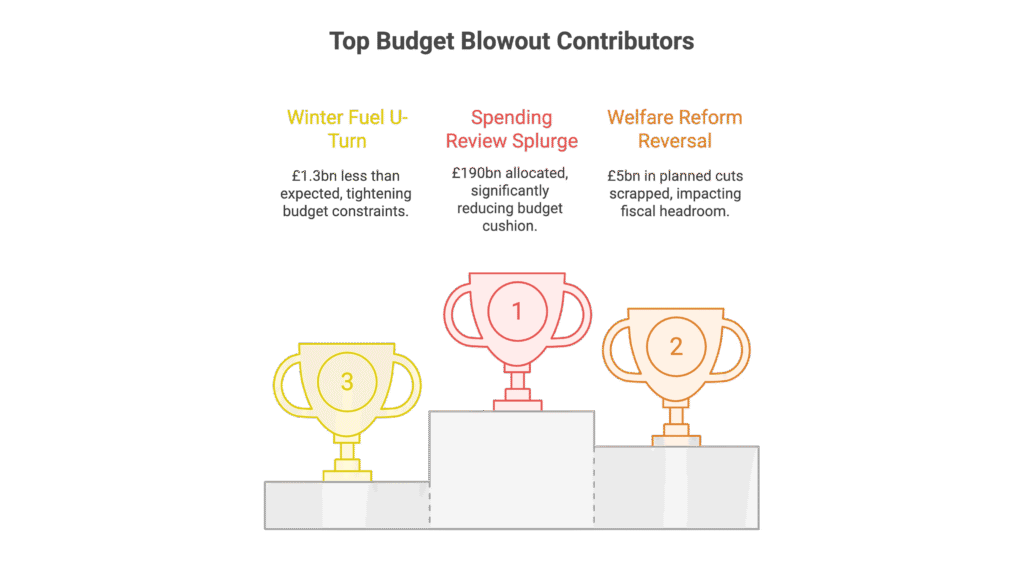
The Budget Blowout Breakdown
The Chancellor’s fiscal headroom is evaporating faster than morning frost:
- Winter fuel U-turn: £1.3bn less than expected
- Welfare reform reversal: £5bn in planned cuts scrapped
- Spending Review splurge: £190bn allocated, eating into the budget cushion
These setbacks have demolished the “wafer-thin fiscal headroom” Reeves carefully preserved at March’s Spring Statement. The National Institute for Social and Economic Research suggests she might need to raise taxes by £50bn to balance the books.
What’s Next for Rachel Reeves’ Autumn Budget Strategy
With the Autumn Budget 2025 approaching, all eyes are on how Rachel Reeves will plug these gaps. Enter Torsten Bell, the pensions minister who’s reportedly taking on expanded economic policy responsibilities.
Bell’s promotion from backbencher to key Budget architect in just seven months signals Labour’s scramble to find fresh solutions. Whether he can help Rachel Reeves navigate out of this fiscal maze remains the £50bn question ahead of the autumn budget.
Key Takeaways
Rachel Reeves learned an expensive lesson: in politics, even “simple” cost-cutting measures can explode in your face. The winter fuel allowance debacle showcases how policy U-turns and demographic shifts can obliterate Treasury projections.
With a potential £50bn shortfall looming, Rachel Reeves needs to find new revenue streams fast. The Autumn Budget 2025 will reveal whether Labour can balance fiscal responsibility with political reality – or if more policy reversals await the Chancellor.
FAQ
Q1: How much will the winter fuel allowance cuts actually save now?
A: Just £227m, down from the original £1.5bn target. The combination of political U-turns and rising pension credit claims destroyed most projected savings.
Q2: Why did pension credit claims surge so dramatically?
A: An additional 57,200 pensioners claimed pension credit last year, likely due to increased awareness and outreach. Since these claimants automatically qualify for winter fuel payments, each new claim reduces Treasury savings.
Q3: What does this mean for Rachel Reeves’ Autumn Budget 2024?
A: Rachel Reeves faces a much tighter fiscal situation with potentially £50bn in tax rises needed. The winter fuel shortfall adds pressure to find alternative revenue sources or spending cuts in the autumn budget.
Q4: Who is Torsten Bell and why does his role matter?
A: Bell is the pensions minister taking on expanded economic policy responsibilities for Budget preparations. His rapid rise from backbencher to key economic advisor suggests Labour is reshuffling its fiscal strategy team.
Q5: Could Labour reverse more policies before the Budget?
A: With mounting pressure from MPs and tight fiscal constraints, additional policy reversals remain possible. The party is clearly struggling to balance political promises with economic realities.
DISCLAIMER
Effective Date: 15th July 2025
The information provided on this website is for informational and educational purposes only and reflects the personal opinions of the author(s). It is not intended as financial, investment, tax, or legal advice.
We are not certified financial advisers. None of the content on this website constitutes a recommendation to buy, sell, or hold any financial product, asset, or service. You should not rely on any information provided here to make financial decisions.
We strongly recommend that you:
- Conduct your own research and due diligence
- Consult with a qualified financial adviser or professional before making any investment or financial decisions
While we strive to ensure that all information is accurate and up to date, we make no guarantees about the completeness, reliability, or suitability of any content on this site.
By using this website, you acknowledge and agree that we are not responsible for any financial loss, damage, or decisions made based on the content presented.
MORE NEWS








Disclosure & Editorial Standards
MJBurrows is not authorised or regulated by the Financial Conduct Authority (FCA). The content on this website — including articles, calculators, and tools — is for general informational and educational purposes only. It does not constitute personal financial, investment, tax, or legal advice and does not take into account your individual circumstances, financial situation, or objectives.
Nothing on this site is a personal recommendation to buy, sell, hold, or otherwise deal in any financial product, asset, or service. You should always conduct your own research and seek advice from a qualified, FCA-regulated financial adviser before making any financial decisions.
Our calculators produce estimates based on simplified models using HMRC-published rates for the current tax year. They cannot account for every individual circumstance and should not be relied upon as exact figures. Tax rules and rates may change — verify current rates with HMRC or a qualified tax adviser.
Projections are not guarantees. Where our tools show future values (investment growth, pension projections, compound interest), these are hypothetical illustrations based on assumed growth rates. Past performance does not guarantee future results. The value of investments can go down as well as up.
Market data displayed on this site is provided by third-party sources including Twelve Data, Yahoo Finance, and CoinGecko. We do not guarantee the accuracy, completeness, or timeliness of third-party data.
This content is designed for UK residents and reflects UK tax rules, thresholds, and legislation. It may not apply to other jurisdictions.
Using this website does not create a professional-client relationship of any kind. MJBurrows is not responsible for any financial loss, damage, or decision made based on the content presented. By using this site, you accept these terms.
This disclaimer may be updated from time to time without prior notice. Last reviewed: 23 April 2026.
MJBurrows is an independent UK personal finance publication, written and edited by Matthew Burrows. There is no parent company, no investor group, and no advertising sales team — decisions about what to cover and how to frame it are made by Matthew alone. Our full Editorial Policy sets out how the site operates in detail.
Commercial model. As of April 2026, MJBurrows generates no revenue. The site carries no display advertising, no affiliate links, no sponsored content, no paid product placements, and no pay-for-coverage arrangements. If this changes in future, it will be disclosed openly on the Editorial Policy page.
Sources. Articles and tools reference primary sources — HM Revenue & Customs (HMRC), gov.uk, the Bank of England, the Office for National Statistics (ONS), the Financial Conduct Authority (FCA), Companies House, and UK government departmental publications (DWP, Treasury). Calculator data uses HMRC-published rates for the 2026/27 tax year. Market data (tickers, asset prices) is provided by Twelve Data, Yahoo Finance, and CoinGecko.
Verification. Every published article is fact-checked before going live. Numerical claims are traced to their primary source, quotes are checked against the original speaker or document, and calculator outputs are tested against HMRC worked examples. See our verification and accuracy policy for the full process.
Corrections. If you spot an error, please report it via the Corrections page. A three-tier severity system commits to specific response times:
- Tier 1 — Urgent (material reader harm, defamatory statements, regulatory or legal issues): acknowledged within 24 hours, page actioned within 24 hours, correction published within 48 hours of confirmation.
- Tier 2 — High (significant factual errors that misinform readers): acknowledged within 3 working days, correction published within 7 working days of confirmation.
- Tier 3 — Standard (minor factual errors, dated references, missing context): acknowledged within 7 working days, correction published at the next regular content review (within the quarter).
Significant corrections are logged on the public Corrections log.
Updates and review cadence. Calculators are reviewed at least quarterly, plus event-driven updates when HMRC publishes new rates (Budget, Autumn Statement, new tax year). Guides are reviewed at least twice a year, with major rewrites whenever underlying regulation changes. Tax-year-sensitive content is prioritised for review at the April tax-year transition.
Get in touch. For editorial enquiries — corrections, story tips, reader questions — the address is contact@mjburrows.com. The contact page is at mjburrows.com/contact. Every email is read personally by Matthew.