

London’s housebuilding industry is teetering on the edge of collapse, and it’s about to get ugly. New data shows the capital’s housing delivery is in freefall, with bureaucratic red tape and sky-high costs choking off desperately needed homes.
Here’s why London’s housing crisis just went from bad to catastrophic — and what it means for anyone trying to buy or rent in the capital.
The Numbers Don’t Lie: London Housing Is Broken
Planning approvals have dropped 2% year-on-year, and only four boroughs hit their housing targets from the 2021 London Plan (which aimed for 52,000 homes). That’s not just missing the mark — that’s failing spectacularly.
Neil Jefferson, CEO of the Home Builders Federation, isn’t mincing words: “London has become a no-go zone for housing investment.”
What’s Killing New Builds?
The culprits are piling up faster than unpaid planning applications:
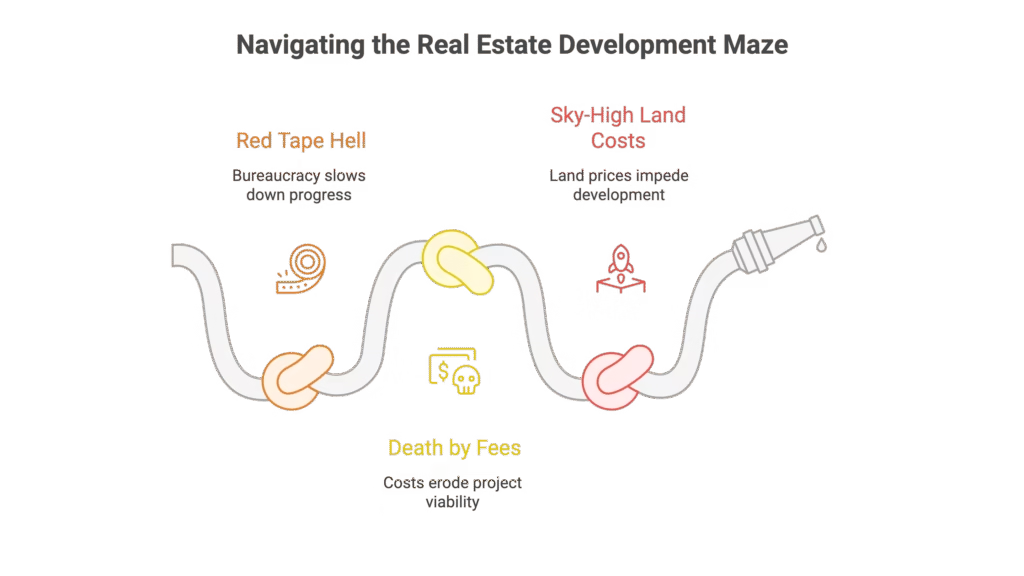
Red Tape Hell: The Building Safety Regulator, designed to prevent another Grenfell, has turned into a bureaucratic nightmare. Nearly 10,000 homes are stuck in the “Gateway Two” process for over six months. Projects that should take weeks are taking over a year.
Death by a Thousand Fees: Community Infrastructure Levy, Section 106 agreements, planning fees, plus stubborn interest rates are pushing developments past the point of viability.
Sky-High Land Costs: London is arguably the world’s most expensive city to build in, according to the Greater London Authority. When your foundation costs more than most people’s entire property budget, you’ve got problems.
Renters Are Getting Crushed
Private renters in London now spend 41.6% of their income on rent — up from 38% in 2023. That’s the highest since 2021, and it’s pushing England’s affordability ratio above the critical 30% threshold.
First-time buyers? They’re basically extinct. The average Londoner would need to save 50% of their discretionary income for over 13 years just to scrape together a deposit. And that deposit? It’s nearly seven times their annual income after bills.
Think about that for a second. Seven times your yearly take-home just for the privilege of getting a mortgage.
Labour’s Planning Reforms Won’t Save London
The government’s planning system overhaul might help elsewhere, but London’s unique cocktail of astronomical land prices and regulatory gridlock means the capital needs its own solution.
Jefferson’s call to action is clear: “If the government wants to hit its 1.5 million homes target, they need to prioritise reversing London’s housing delivery collapse.”
What Needs to Happen Now
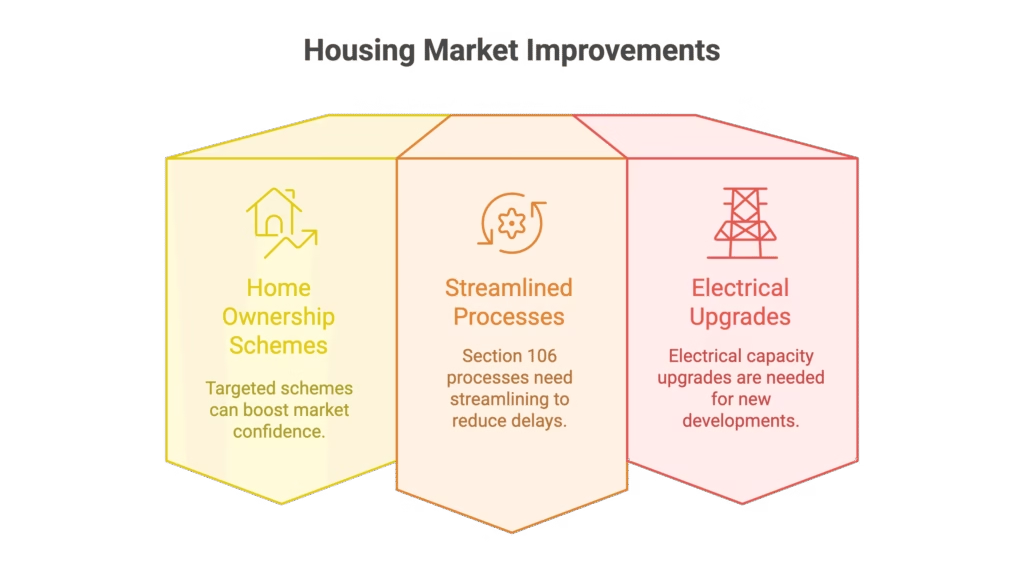
The Home Builders Federation wants three urgent fixes:
- Targeted home ownership schemes to restore market confidence
- Streamlined Section 106 processes to cut delays
- Electrical capacity upgrades to support new developments
Without intervention, London’s housing market isn’t just stalling — it’s heading for a complete breakdown.
The Bottom Line
London’s housing crisis has moved from “concerning” to “existential threat.” With builders fleeing the market and renters drowning in costs, the capital needs emergency action before its housing delivery collapses entirely.
Want to stay ahead of the UK’s property market chaos? Keep watching this space — because London’s housing meltdown is just getting started.
FAQ
Q1: Why is London’s housing market collapsing?
A: A perfect storm of bureaucratic delays, excessive fees, high interest rates, and astronomical land costs has made most developments financially unviable. The Building Safety Regulator alone has 10,000 homes stuck in approval limbo.
Q2: How bad is London’s affordability crisis?
A: Private renters now spend 41.6% of income on rent, and first-time buyers need to save for over 13 years just for a deposit that’s seven times their annual income. It’s the worst affordability crisis since records began.
Q3: Will Labour’s planning reforms help London?
A: Unlikely. While planning reforms might work elsewhere, London’s unique combination of sky-high land prices and regulatory gridlock requires targeted solutions specifically for the capital.
Q4: What’s the Gateway Two process?
A: It’s part of the Building Safety Regulator’s approval system that was supposed to take weeks but now takes over a year. Nearly 10,000 homes are currently stuck in this bureaucratic bottleneck.
Q5: How many homes is London actually building?
A: Far fewer than needed. Only four boroughs met their housing targets from the 2021 London Plan, which aimed for 52,000 homes annually. Planning approvals have dropped 2% year-on-year.
DISCLAIMER
Effective Date: 15th July 2025
The information provided on this website is for informational and educational purposes only and reflects the personal opinions of the author(s). It is not intended as financial, investment, tax, or legal advice.
We are not certified financial advisers. None of the content on this website constitutes a recommendation to buy, sell, or hold any financial product, asset, or service. You should not rely on any information provided here to make financial decisions.
We strongly recommend that you:
- Conduct your own research and due diligence
- Consult with a qualified financial adviser or professional before making any investment or financial decisions
While we strive to ensure that all information is accurate and up to date, we make no guarantees about the completeness, reliability, or suitability of any content on this site.
By using this website, you acknowledge and agree that we are not responsible for any financial loss, damage, or decisions made based on the content presented.
MORE NEWS








Disclosure & Editorial Standards
MJBurrows is not authorised or regulated by the Financial Conduct Authority (FCA). The content on this website — including articles, calculators, and tools — is for general informational and educational purposes only. It does not constitute personal financial, investment, tax, or legal advice and does not take into account your individual circumstances, financial situation, or objectives.
Nothing on this site is a personal recommendation to buy, sell, hold, or otherwise deal in any financial product, asset, or service. You should always conduct your own research and seek advice from a qualified, FCA-regulated financial adviser before making any financial decisions.
Our calculators produce estimates based on simplified models using HMRC-published rates for the current tax year. They cannot account for every individual circumstance and should not be relied upon as exact figures. Tax rules and rates may change — verify current rates with HMRC or a qualified tax adviser.
Projections are not guarantees. Where our tools show future values (investment growth, pension projections, compound interest), these are hypothetical illustrations based on assumed growth rates. Past performance does not guarantee future results. The value of investments can go down as well as up.
Market data displayed on this site is provided by third-party sources including Twelve Data, Yahoo Finance, and CoinGecko. We do not guarantee the accuracy, completeness, or timeliness of third-party data.
This content is designed for UK residents and reflects UK tax rules, thresholds, and legislation. It may not apply to other jurisdictions.
Using this website does not create a professional-client relationship of any kind. MJBurrows is not responsible for any financial loss, damage, or decision made based on the content presented. By using this site, you accept these terms.
This disclaimer may be updated from time to time without prior notice. Last reviewed: 23 April 2026.
MJBurrows is an independent UK personal finance publication, written and edited by Matthew Burrows. There is no parent company, no investor group, and no advertising sales team — decisions about what to cover and how to frame it are made by Matthew alone. Our full Editorial Policy sets out how the site operates in detail.
Commercial model. As of April 2026, MJBurrows generates no revenue. The site carries no display advertising, no affiliate links, no sponsored content, no paid product placements, and no pay-for-coverage arrangements. If this changes in future, it will be disclosed openly on the Editorial Policy page.
Sources. Articles and tools reference primary sources — HM Revenue & Customs (HMRC), gov.uk, the Bank of England, the Office for National Statistics (ONS), the Financial Conduct Authority (FCA), Companies House, and UK government departmental publications (DWP, Treasury). Calculator data uses HMRC-published rates for the 2026/27 tax year. Market data (tickers, asset prices) is provided by Twelve Data, Yahoo Finance, and CoinGecko.
Verification. Every published article is fact-checked before going live. Numerical claims are traced to their primary source, quotes are checked against the original speaker or document, and calculator outputs are tested against HMRC worked examples. See our verification and accuracy policy for the full process.
Corrections. If you spot an error, please report it via the Corrections page. A three-tier severity system commits to specific response times:
- Tier 1 — Urgent (material reader harm, defamatory statements, regulatory or legal issues): acknowledged within 24 hours, page actioned within 24 hours, correction published within 48 hours of confirmation.
- Tier 2 — High (significant factual errors that misinform readers): acknowledged within 3 working days, correction published within 7 working days of confirmation.
- Tier 3 — Standard (minor factual errors, dated references, missing context): acknowledged within 7 working days, correction published at the next regular content review (within the quarter).
Significant corrections are logged on the public Corrections log.
Updates and review cadence. Calculators are reviewed at least quarterly, plus event-driven updates when HMRC publishes new rates (Budget, Autumn Statement, new tax year). Guides are reviewed at least twice a year, with major rewrites whenever underlying regulation changes. Tax-year-sensitive content is prioritised for review at the April tax-year transition.
Get in touch. For editorial enquiries — corrections, story tips, reader questions — the address is contact@mjburrows.com. The contact page is at mjburrows.com/contact. Every email is read personally by Matthew.