

UK Retail Sales Jump 0.6% in July 2025: Breaking Down the Numbers
UK retail sales surged 0.6% in July 2025, smashing economist forecasts of just 0.2% growth. But here’s the twist: whilst July delivered a retail sales boost, British retailers are bracing for a brutal winter ahead.
The perfect storm of record July temperatures, the UEFA Women’s Euros 2025, and fresh summer collections drove this British retail growth. Yet retailers warn of store closures and job cuts as they shoulder £7 billion in new costs.
This analysis breaks down why UK retail sales beat forecasts in July, the ONS data controversies, and why the high street’s winter survival hangs in the balance.

July 2025 Retail Sales Results: The Numbers Behind the Growth
The Office for National Statistics delivered rare good news for UK retail sales July 2025, with volumes climbing 0.6% month-on-month – triple economists’ expectations.
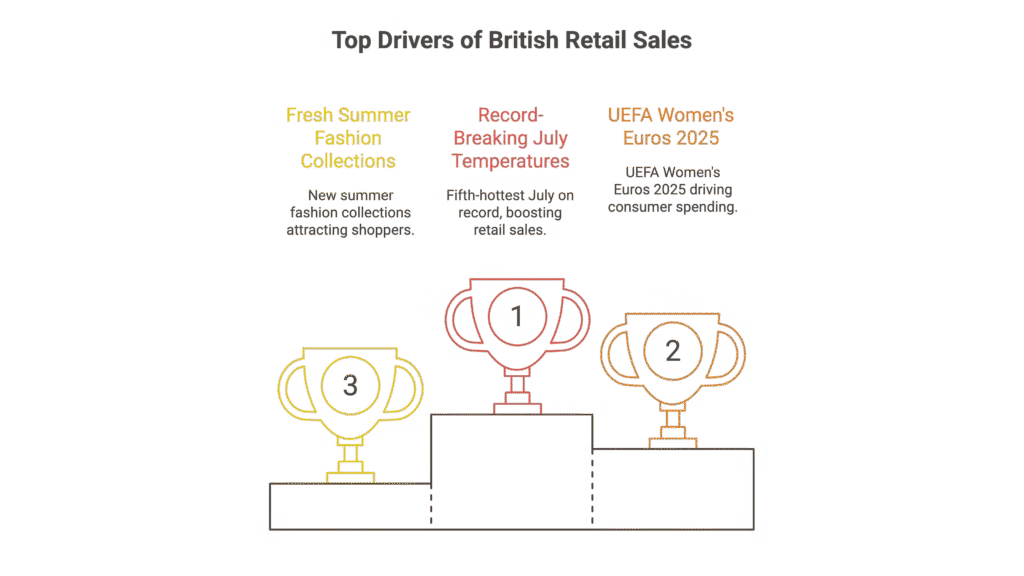
British retail sales benefited from three key drivers:
- Record-breaking July temperatures (fifth-hottest on record)
- UEFA Women’s Euros 2025 retail boost driving consumer spending
- Fresh summer fashion collections hitting stores
However, annual retail sales growth UK came in at 1.1% – below expectations and signalling underlying weakness in consumer spending patterns.
The retail sales forecast miss on annual figures suggests July’s monthly spike was more about timing than sustained recovery.
ONS Data Revisions Reveal UK Retail Sales Volatility Issues
The UK retail sales data release faced a two-week delay after the ONS discovered significant “quality failures” in their methodology.
The statistics body had been incorrectly measuring retail sales volatility, making monthly figures appear more unstable than reality. James Benford from ONS admitted: “Previous figures overstated monthly volatility in the first half of 2025.”
These UK retail sales revisions showed three-month growth actually fell 0.6%, ending four consecutive months of gains. The corrected data paints a less optimistic picture of British retail performance than previously reported.
British Retailers Face £7 Billion Cost Crisis Despite Sales Growth
Despite July’s UK retail sales boost, the British Retail Consortium warns of unprecedented challenges ahead.
British retail costs have exploded by £7 billion following last year’s Budget, with retailers drowning in new tax burdens despite the retail sales July 2025 uptick.
The consortium’s warning was stark: “No additional taxes in the next Budget, or expect price rises, store closures, and redundancies.”
July’s 2.5% cash spending increase barely dents this £7 billion mountain. UK retail sector challenges continue mounting despite short-term sales improvements.

UK Retail Sales Impact on GDP and Economic Outlook
These UK retail sales revisions will significantly impact GDP calculations when quarterly figures emerge later this month.
British economic data suggests less volatile but ultimately slower growth than previously calculated. The retail sales forecast implications extend beyond the high street to broader UK economic performance.
UK retail sales July 2025 tell a tale of temporary relief against structural challenges. Whilst the monthly boost provided respite, retailers face cost pressures that dwarf summer sales gains.
The upcoming Budget represents a critical juncture for British retail survival – additional tax burdens could trigger widespread store closures across the high street.
FAQ: UK Retail Sales July 2025 Analysis
Q1: What drove UK retail sales growth in July 2025?
A: UK retail sales July 2025 grew 0.6% due to record hot weather boosting summer clothing sales, increased spending during the UEFA Women’s Euros tournament, and new seasonal product launches. This retail sales boost significantly exceeded the 0.2% economist forecast.
Q2: Why were UK retail sales data delayed and revised?
A: The ONS delayed UK retail sales figures after discovering “quality failures” in seasonal adjustments. These retail sales revisions showed they’d overstated monthly volatility, making the market appear more unstable than actual British retail performance indicated.
Q3: How are new costs affecting British retailers despite sales growth?
A: British retailers face £7 billion in additional costs from recent Budget changes. Despite retail sales July 2025 gains, this massive cost burden threatens pricing decisions, store closures, and job cuts if further taxes are imposed.
Q4: Will UK retail sales growth continue into autumn 2025?
A: UK retail sales growth appears unsustainable. Three-month British retail growth fell 0.6%, ending consecutive monthly gains. Retail sales forecast suggests challenging conditions ahead due to cost pressures and economic headwinds.
Q5: How do retail sales revisions affect UK GDP calculations?
A: UK retail sales revisions will impact GDP data when quarterly accounts publish this month. The corrections suggest less volatile but slower British economic growth than previously reported, affecting overall economic performance metrics.
DISCLAIMER
Effective Date: 15th July 2025
The information provided on this website is for informational and educational purposes only and reflects the personal opinions of the author(s). It is not intended as financial, investment, tax, or legal advice.
We are not certified financial advisers. None of the content on this website constitutes a recommendation to buy, sell, or hold any financial product, asset, or service. You should not rely on any information provided here to make financial decisions.
We strongly recommend that you:
- Conduct your own research and due diligence
- Consult with a qualified financial adviser or professional before making any investment or financial decisions
While we strive to ensure that all information is accurate and up to date, we make no guarantees about the completeness, reliability, or suitability of any content on this site.
By using this website, you acknowledge and agree that we are not responsible for any financial loss, damage, or decisions made based on the content presented.
MORE NEWS








Disclosure & Editorial Standards
MJBurrows is not authorised or regulated by the Financial Conduct Authority (FCA). The content on this website — including articles, calculators, and tools — is for general informational and educational purposes only. It does not constitute personal financial, investment, tax, or legal advice and does not take into account your individual circumstances, financial situation, or objectives.
Nothing on this site is a personal recommendation to buy, sell, hold, or otherwise deal in any financial product, asset, or service. You should always conduct your own research and seek advice from a qualified, FCA-regulated financial adviser before making any financial decisions.
Our calculators produce estimates based on simplified models using HMRC-published rates for the current tax year. They cannot account for every individual circumstance and should not be relied upon as exact figures. Tax rules and rates may change — verify current rates with HMRC or a qualified tax adviser.
Projections are not guarantees. Where our tools show future values (investment growth, pension projections, compound interest), these are hypothetical illustrations based on assumed growth rates. Past performance does not guarantee future results. The value of investments can go down as well as up.
Market data displayed on this site is provided by third-party sources including Twelve Data, Yahoo Finance, and CoinGecko. We do not guarantee the accuracy, completeness, or timeliness of third-party data.
This content is designed for UK residents and reflects UK tax rules, thresholds, and legislation. It may not apply to other jurisdictions.
Using this website does not create a professional-client relationship of any kind. MJBurrows is not responsible for any financial loss, damage, or decision made based on the content presented. By using this site, you accept these terms.
This disclaimer may be updated from time to time without prior notice. Last reviewed: 23 April 2026.
MJBurrows is an independent UK personal finance publication, written and edited by Matthew Burrows. There is no parent company, no investor group, and no advertising sales team — decisions about what to cover and how to frame it are made by Matthew alone. Our full Editorial Policy sets out how the site operates in detail.
Commercial model. As of April 2026, MJBurrows generates no revenue. The site carries no display advertising, no affiliate links, no sponsored content, no paid product placements, and no pay-for-coverage arrangements. If this changes in future, it will be disclosed openly on the Editorial Policy page.
Sources. Articles and tools reference primary sources — HM Revenue & Customs (HMRC), gov.uk, the Bank of England, the Office for National Statistics (ONS), the Financial Conduct Authority (FCA), Companies House, and UK government departmental publications (DWP, Treasury). Calculator data uses HMRC-published rates for the 2026/27 tax year. Market data (tickers, asset prices) is provided by Twelve Data, Yahoo Finance, and CoinGecko.
Verification. Every published article is fact-checked before going live. Numerical claims are traced to their primary source, quotes are checked against the original speaker or document, and calculator outputs are tested against HMRC worked examples. See our verification and accuracy policy for the full process.
Corrections. If you spot an error, please report it via the Corrections page. A three-tier severity system commits to specific response times:
- Tier 1 — Urgent (material reader harm, defamatory statements, regulatory or legal issues): acknowledged within 24 hours, page actioned within 24 hours, correction published within 48 hours of confirmation.
- Tier 2 — High (significant factual errors that misinform readers): acknowledged within 3 working days, correction published within 7 working days of confirmation.
- Tier 3 — Standard (minor factual errors, dated references, missing context): acknowledged within 7 working days, correction published at the next regular content review (within the quarter).
Significant corrections are logged on the public Corrections log.
Updates and review cadence. Calculators are reviewed at least quarterly, plus event-driven updates when HMRC publishes new rates (Budget, Autumn Statement, new tax year). Guides are reviewed at least twice a year, with major rewrites whenever underlying regulation changes. Tax-year-sensitive content is prioritised for review at the April tax-year transition.
Get in touch. For editorial enquiries — corrections, story tips, reader questions — the address is contact@mjburrows.com. The contact page is at mjburrows.com/contact. Every email is read personally by Matthew.