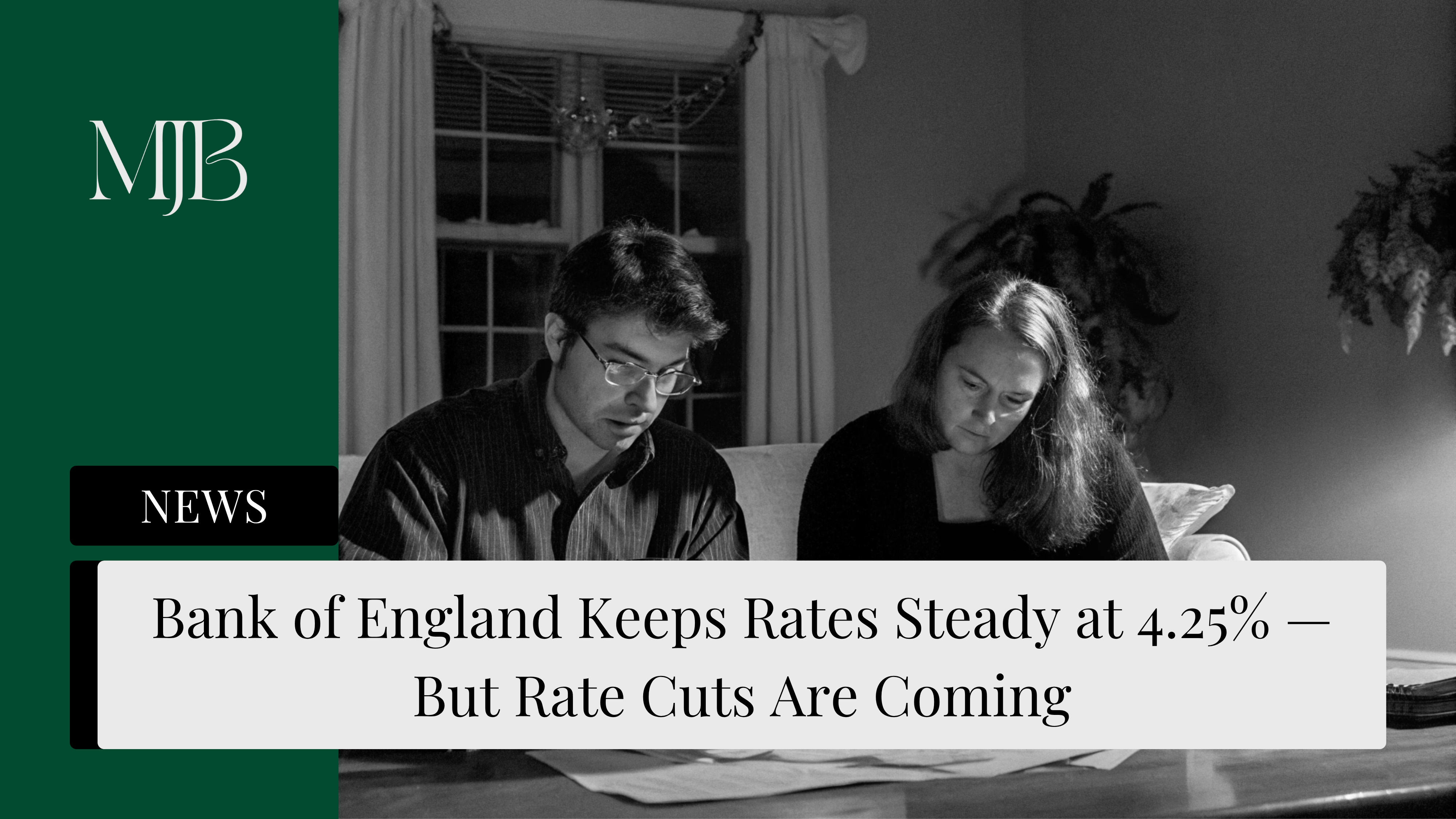
Remember when your mortgage payment felt like pocket change? Yeah, me neither. But here’s some good news, however hard we have to dig for it presently: the Bank of England just hinted that interest rate cuts could hit as early as August, even though they’re keeping rates frozen at 4.25% for now. Speculative I hear you say? Maybe not…
Why should you care anyway? Well, whether you’re eyeing a new home, managing credit card debt, or just trying to make your savings work harder for you, these decisions directly impact your wallet. Let’s break down what the Bank’s latest move means for your money — and why they’re playing it safe despite promising a “gradual downward path.”
Why the Bank of England Hit Pause on Rate Changes
Andrew Bailey and his delightful team at the Bank of England faced a classic “damned if you do, damned if you don’t” scenario this Thursday (my heart bleeds). With inflation sitting stubbornly at 3.4% — well above their cushy 2% target — they couldn’t exactly slash rates and throw a jolly.
But here’s where it gets interesting, well for some of you anyway. Clare Lombardelli, the Bank’s deputy governor, admitted they’re flying blind thanks to what she diplomatically called “uncertainty facing the economy.” Translation I hear you say? The Middle East situation has everyone sweating buckets about oil prices (although that situation has somewhat chilled… for the moment anyway). Rocket fuel, not rocket science.
The Oil Factor Nobody’s Talking About
Since the Bank’s cool rate-setters last cuddled up in May, oil prices have jumped 26%. Gas? Up 11%. That’s not just numbers on a screen — it’s real money coming out of your pocket every time you fill up your motor or pay your heating bill. Guess you’ll have to leave the Ferrari at home this weekend…
“We’ve seen oil prices increase since the attacks,” Lombardelli told the BBC, choosing her words carefully (as you would have to speaking to the BBC). The Israel-Iran tensions aren’t just tragic headlines; they’re economic wildcards that could send energy costs through the roof and drag inflation along for the ride.

What This Means for Your Mortgage (and Credit Cards)
Here’s the crunch: the Bank’s base rate is like the master switch for all other interest rates. When it moves, your mortgage rate, credit card APR, and savings account returns all follow suit.
Right now, at 4.25%, borrowers are still feeling the belt from years of rate hikes. But savers? They’re finally getting returns that beat a mattress stash. It’s a classic good news/bad news routine, depending on which side of the equation you’re on.
The August Promise: Real or Wishful Thinking?
Susannah Streeter from Hargreaves Lansdown is somewhat more direct: “Two interest rate cuts are still on the horizon” this year. Financial markets are betting heavily on an August cut, which would be the first sweet taste of relief borrowers have had in what feels like an eternity.
But (and there’s always a but), the Bank’s being cagey. Rascals. Governor Bailey promised rates would follow a “gradual downward path” while simultaneously warning that “the world is highly unpredictable.” Not exactly the ringing endorsement mortgage holders were hoping for. Someone in a position of authority saying something, without saying anything at all. Again.
UK Businesses Are Getting Creative — And Not in a Good Way
Here’s something that should cause everyone concern, sorry to bring the gloom: businesses are already trimming wages to cope with rising costs. The Bank’s survey revealed companies are facing a perfect storm:
- National Insurance hikes from April
- Minimum wage increases
- Overall wage bills up 10% thanks to Chancellor Rachel Reeves’ policy changes
Instead of kicking these costs along to consumers through higher prices however (which of course would fuel more inflation), many businesses are taking different approaches:
- Cutting pay rises for workers just above minimum wage
- Freezing hiring
- Taking hits to their profit margins
Hays, the recruitment behemoth, just witnessed its share price crater to a 30-year low after warning about falling profits. Their UK and Ireland fees are expected to drop 13%. That’s not just bad news for Hays — it’s a canary in the coal mine for the entire job market.

The Inflation Puzzle: Why 2025 Looks Better Than 2024
Current inflation sits at 3.4%, and the Bank expects it to climb to 3.5% before year-end. But here’s the silver lining (trying to find one) — they’re forecasting a drop to around 2.1% next year. That’s kissing distance from their 2% target. Maybe, they’ll earn their salaries next year…
The theory behind using interest rates to fight inflation is pretty straightforward: make borrowing expensive → people spend less → demand drops → prices stop rising so fast. It’s like using a sledgehammer to crack a nut and it seems to be the main (or sometimes only) tool central banks have.

The Growth Problem Nobody Wants to Address
While everyone’s focused on inflation (the invigorating subject it is), the UK economy is acting like a petulant teenager — moody and unpredictable. Strong growth at the start of 2025 was followed by a sharp contraction in April. The Bank diplomatically called underlying growth “weak,” which is banker-speak for “not great, chaps”.
Unemployment is slithering up, businesses are hesitant to hire, and wage growth is finally cooling off. Bailey noted they’re “seeing signs of softening in the labour market,” which sounds technical but basically means: fewer jobs, smaller raises. Nice…
What Should You Do Right Now?
So, some action to consider. If you’re sitting on variable-rate debt, August could bring some relief — but don’t bet the farm on it. Fixed-rate mortgage holders won’t see immediate benefits, but those coming up for renewal might want to start shopping around.
For savers, the party might be winding down. If you’ve been dragging your trotters on locking in a decent fixed-rate savings deal, now’s the time to move and groove. Once rate cuts start, those ‘juicy’ returns will disappear faster than the free cheese samples at M&S.
The smart money says prepare for rates to drop gradually (emphasis on gradually). The Bank of England isn’t about to slash rates dramatically when inflation is still running hot and global oil markets are doing their best impression of a rabbit under the influence.
Conclusion: Playing the Waiting Game
The Bank of England’s decision to hold rates steady at 4.25% might feel like a bit of a letdown if you were hoping for some immediate relief. But reading between the lines, as we always must, the message is clear: cuts are coming, just not today.
With inflation above target, Middle East tensions threatening energy prices, and businesses struggling with higher costs, the Bank’s playing it safe. Can you blame them? Maybe not this time. In this environment, one wrong move could send inflation spiraling again.
Your move? Stay informed, review your finances, and position yourself for the rate cuts that are (probably) coming. Whether that means refinancing debt, locking in savings rates, or just understanding how these changes affect your budget — knowledge will always be power, especially when it comes to your money.
Want to stay ahead of the curve on UK interest rates and what they mean for your finances? Soon you’ll be able to subscribe to our newsletter for weekly insights that actually make sense. Keep watch!
FAQ: Your Burning Questions About UK Interest Rates
Q1: When will the Bank of England actually cut interest rates?
Financial markets are betting on August 2025 for the first cut, with possibly two cuts total this year. However, this depends heavily on inflation data and global economic conditions — particularly energy prices. The Bank’s being deliberately vague to keep their options open.
Q2: How much could my mortgage payment drop if rates are cut?
A 0.25% rate cut typically translates to about £15-25 less per month on a £200,000 variable-rate mortgage. Not life-changing, but every bit helps. Fixed-rate mortgage holders won’t see any change until they remortgage.
Q3: Why is the Bank of England worried about oil prices?
Oil prices directly impact transportation and heating costs, which ripple through the entire economy. The recent 26% spike in oil prices could push inflation higher, forcing the Bank to keep rates elevated longer than planned. It’s all connected.
Q4: Should I wait for rate cuts before getting a mortgage?
Trying to time the market perfectly is like catching a falling knife — risky and often painful. If you need to buy now, focus on getting the best deal available today rather than gambling on future cuts that might not materialise as quickly as hoped.
Q5: How do UK interest rates compare to other countries?
At 4.25%, the UK sits between the US (around 5.25-5.5%) and the Eurozone (around 3.75%). This middle ground reflects the UK’s unique economic challenges — not as hot as the US economy, but dealing with stickier inflation than Europe.
DISCLAIMER
Effective Date: 15th July 2025
The information provided on this website is for informational and educational purposes only and reflects the personal opinions of the author(s). It is not intended as financial, investment, tax, or legal advice.
We are not certified financial advisers. None of the content on this website constitutes a recommendation to buy, sell, or hold any financial product, asset, or service. You should not rely on any information provided here to make financial decisions.
We strongly recommend that you:
- Conduct your own research and due diligence
- Consult with a qualified financial adviser or professional before making any investment or financial decisions
While we strive to ensure that all information is accurate and up to date, we make no guarantees about the completeness, reliability, or suitability of any content on this site.
By using this website, you acknowledge and agree that we are not responsible for any financial loss, damage, or decisions made based on the content presented.



Disclosure & Editorial Standards
MJBurrows is not authorised or regulated by the Financial Conduct Authority (FCA). The content on this website — including articles, calculators, and tools — is for general informational and educational purposes only. It does not constitute personal financial, investment, tax, or legal advice and does not take into account your individual circumstances, financial situation, or objectives.
Nothing on this site is a personal recommendation to buy, sell, hold, or otherwise deal in any financial product, asset, or service. You should always conduct your own research and seek advice from a qualified, FCA-regulated financial adviser before making any financial decisions.
Our calculators produce estimates based on simplified models using HMRC-published rates for the current tax year. They cannot account for every individual circumstance and should not be relied upon as exact figures. Tax rules and rates may change — verify current rates with HMRC or a qualified tax adviser.
Projections are not guarantees. Where our tools show future values (investment growth, pension projections, compound interest), these are hypothetical illustrations based on assumed growth rates. Past performance does not guarantee future results. The value of investments can go down as well as up.
Market data displayed on this site is provided by third-party sources including Twelve Data, Yahoo Finance, and CoinGecko. We do not guarantee the accuracy, completeness, or timeliness of third-party data.
This content is designed for UK residents and reflects UK tax rules, thresholds, and legislation. It may not apply to other jurisdictions.
Using this website does not create a professional-client relationship of any kind. MJBurrows is not responsible for any financial loss, damage, or decision made based on the content presented. By using this site, you accept these terms.
This disclaimer may be updated from time to time without prior notice. Last reviewed: 23 April 2026.
MJBurrows is an independent UK personal finance publication, written and edited by Matthew Burrows. There is no parent company, no investor group, and no advertising sales team — decisions about what to cover and how to frame it are made by Matthew alone. Our full Editorial Policy sets out how the site operates in detail.
Commercial model. As of April 2026, MJBurrows generates no revenue. The site carries no display advertising, no affiliate links, no sponsored content, no paid product placements, and no pay-for-coverage arrangements. If this changes in future, it will be disclosed openly on the Editorial Policy page.
Sources. Articles and tools reference primary sources — HM Revenue & Customs (HMRC), gov.uk, the Bank of England, the Office for National Statistics (ONS), the Financial Conduct Authority (FCA), Companies House, and UK government departmental publications (DWP, Treasury). Calculator data uses HMRC-published rates for the 2026/27 tax year. Market data (tickers, asset prices) is provided by Twelve Data, Yahoo Finance, and CoinGecko.
Verification. Every published article is fact-checked before going live. Numerical claims are traced to their primary source, quotes are checked against the original speaker or document, and calculator outputs are tested against HMRC worked examples. See our verification and accuracy policy for the full process.
Corrections. If you spot an error, please report it via the Corrections page. A three-tier severity system commits to specific response times:
- Tier 1 — Urgent (material reader harm, defamatory statements, regulatory or legal issues): acknowledged within 24 hours, page actioned within 24 hours, correction published within 48 hours of confirmation.
- Tier 2 — High (significant factual errors that misinform readers): acknowledged within 3 working days, correction published within 7 working days of confirmation.
- Tier 3 — Standard (minor factual errors, dated references, missing context): acknowledged within 7 working days, correction published at the next regular content review (within the quarter).
Significant corrections are logged on the public Corrections log.
Updates and review cadence. Calculators are reviewed at least quarterly, plus event-driven updates when HMRC publishes new rates (Budget, Autumn Statement, new tax year). Guides are reviewed at least twice a year, with major rewrites whenever underlying regulation changes. Tax-year-sensitive content is prioritised for review at the April tax-year transition.
Get in touch. For editorial enquiries — corrections, story tips, reader questions — the address is contact@mjburrows.com. The contact page is at mjburrows.com/contact. Every email is read personally by Matthew.