
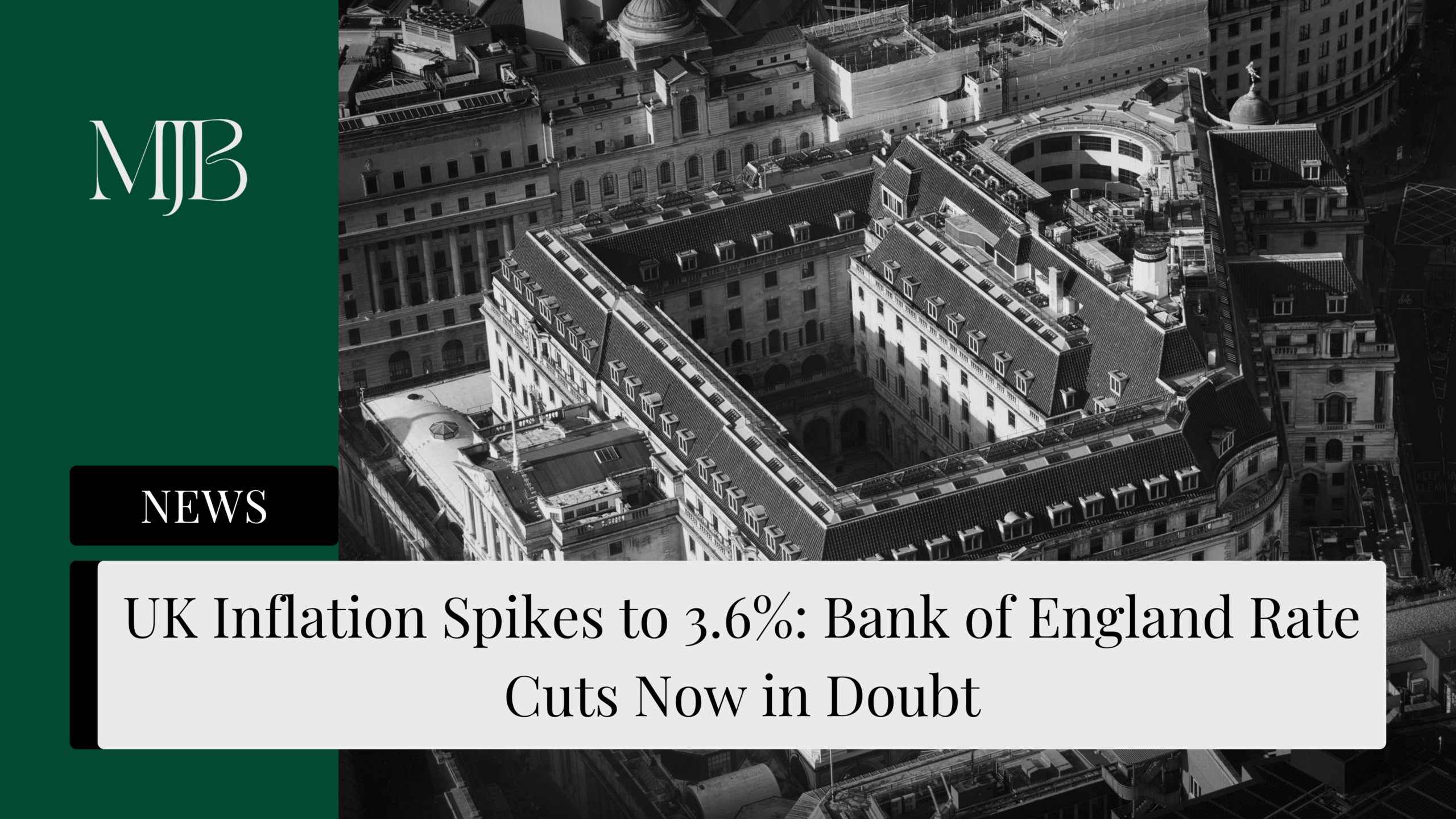
Here’s a wake-up call: UK inflation just pumped to 3.6% in June, crushing economist predictions of 3.4% and putting the Bank of England in a proper bind. That’s 80% higher than their 2% target, and it’s the third straight month above 3%.
With services inflation running hot at 4.7%, rate-setters are facing a classic dilemma. Cut rates to help the struggling economy, or hold firm to tackle stubborn price rises? The dreaded “stagflation” word is already being whispered…
Why Inflation Keeps Climbing Despite Economic Weakness
The ONS points to two main culprits driving prices higher: motor fuel costs and food inflation. But there’s more beneath the surface.
Rachel Reeves’ tax changes are still working through the system. Higher employer National Insurance contributions, minimum wage increases, and soaring utility bills all hit in April, creating a concoction for price pressures.
The uncomfortable truth? Companies are passing these costs straight to consumers. AJ Bell’s Dan Coatsworth warns we’re seeing “a real threat of stagflation as inflation moves higher and the economy is stuck in the mud.”
Bank of England’s Impossible Choice
Rate-setters are truly caught between a rock and a hard place. The economy needs stimulus, but inflation demands restraint.
At the last meeting, only three MPC members voted for a 25 basis point cut. Chief economist Huw Pill actually opposed cuts in May, arguing rates had fallen “too fast” and were fuelling inflation.
The market’s betting on cuts anyway. But with services inflation still running at 4.7%, don’t expect aggressive moves. Capital Economics predicts a “gradual pace” of cuts, potentially reaching 3% by end-2026.
Jobs Data Could Tip the Balance
Next week’s employment figures might be the deciding factor. Economists expect revisions showing fewer job losses in May (around 50,000 vs. the initial 109,000 estimate).
Governor Andrew Bailey has flagged concerns about labour market “softening” and emerging “slack.” If job losses accelerate, it could force the Bank’s hand despite inflation concerns.

What This Means for Your Money
For borrowers: Don’t expect rapid mortgage relief. The Bank’s likely to move slowly and cautiously.
For savers: Higher rates might stick around longer than expected, which isn’t necessarily bad news.
For everyone: Brace for continued price pressures this summer before any meaningful relief kicks in.
Chancellor Rachel Reeves acknowledges people are “still struggling with the cost of living” but insists government measures like minimum wage increases and free school breakfast clubs will help. The Bank’s latest forecast suggests inflation could hit 3.7% in September before gradually falling toward target.
Bottom Line: Patience Required
The UK’s inflation problem isn’t going away quickly. With the economy struggling and prices rising, the Bank of England’s facing one of its toughest periods in years.
Markets still expect gradual rate cuts, but the days of rapid monetary easing are over. For now, it’s a waiting game to see whether economic weakness or inflation pressures win out.
Want more UK economic insights? Soon you’ll be able to subscribe to our weekly market briefing for the latest Bank of England analysis and inflation forecasts.
FAQ
Q1: Will the Bank of England cut interest rates in August despite rising inflation?
A: Markets expect a cut, but it’s far from certain. With inflation at 3.6% and services prices rising 4.7%, rate-setters are increasingly cautious about aggressive moves.
Q2: What’s causing UK inflation to stay so high?
A: Motor fuel prices and food costs are the immediate drivers. But underlying pressure comes from higher employment taxes, minimum wage increases, and utility bill rises from Rachel Reeves’ policy changes.
Q3: Is the UK heading for stagflation?
A: There are warning signs. Rising inflation combined with economic stagnation fits the classic definition, but it’s too early to declare full stagflation.
Q4: When will inflation return to the 2% target?
A: The Bank of England forecasts inflation gradually falling to 2% over 12 months, but expects it to rise further to 3.7% in September first.
Q5: How do rising prices affect mortgage rates?
A: Higher inflation typically keeps mortgage rates elevated longer. Don’t expect significant relief in borrowing costs while inflation remains well above target.
DISCLAIMER
Effective Date: 15th July 2025
The information provided on this website is for informational and educational purposes only and reflects the personal opinions of the author(s). It is not intended as financial, investment, tax, or legal advice.
We are not certified financial advisers. None of the content on this website constitutes a recommendation to buy, sell, or hold any financial product, asset, or service. You should not rely on any information provided here to make financial decisions.
We strongly recommend that you:
- Conduct your own research and due diligence
- Consult with a qualified financial adviser or professional before making any investment or financial decisions
While we strive to ensure that all information is accurate and up to date, we make no guarantees about the completeness, reliability, or suitability of any content on this site.
By using this website, you acknowledge and agree that we are not responsible for any financial loss, damage, or decisions made based on the content presented.
MORE NEWS








Disclosure & Editorial Standards
MJBurrows is not authorised or regulated by the Financial Conduct Authority (FCA). The content on this website — including articles, calculators, and tools — is for general informational and educational purposes only. It does not constitute personal financial, investment, tax, or legal advice and does not take into account your individual circumstances, financial situation, or objectives.
Nothing on this site is a personal recommendation to buy, sell, hold, or otherwise deal in any financial product, asset, or service. You should always conduct your own research and seek advice from a qualified, FCA-regulated financial adviser before making any financial decisions.
Our calculators produce estimates based on simplified models using HMRC-published rates for the current tax year. They cannot account for every individual circumstance and should not be relied upon as exact figures. Tax rules and rates may change — verify current rates with HMRC or a qualified tax adviser.
Projections are not guarantees. Where our tools show future values (investment growth, pension projections, compound interest), these are hypothetical illustrations based on assumed growth rates. Past performance does not guarantee future results. The value of investments can go down as well as up.
Market data displayed on this site is provided by third-party sources including Twelve Data, Yahoo Finance, and CoinGecko. We do not guarantee the accuracy, completeness, or timeliness of third-party data.
This content is designed for UK residents and reflects UK tax rules, thresholds, and legislation. It may not apply to other jurisdictions.
Using this website does not create a professional-client relationship of any kind. MJBurrows is not responsible for any financial loss, damage, or decision made based on the content presented. By using this site, you accept these terms.
This disclaimer may be updated from time to time without prior notice. Last reviewed: 23 April 2026.
MJBurrows is an independent UK personal finance publication, written and edited by Matthew Burrows. There is no parent company, no investor group, and no advertising sales team — decisions about what to cover and how to frame it are made by Matthew alone. Our full Editorial Policy sets out how the site operates in detail.
Commercial model. As of April 2026, MJBurrows generates no revenue. The site carries no display advertising, no affiliate links, no sponsored content, no paid product placements, and no pay-for-coverage arrangements. If this changes in future, it will be disclosed openly on the Editorial Policy page.
Sources. Articles and tools reference primary sources — HM Revenue & Customs (HMRC), gov.uk, the Bank of England, the Office for National Statistics (ONS), the Financial Conduct Authority (FCA), Companies House, and UK government departmental publications (DWP, Treasury). Calculator data uses HMRC-published rates for the 2026/27 tax year. Market data (tickers, asset prices) is provided by Twelve Data, Yahoo Finance, and CoinGecko.
Verification. Every published article is fact-checked before going live. Numerical claims are traced to their primary source, quotes are checked against the original speaker or document, and calculator outputs are tested against HMRC worked examples. See our verification and accuracy policy for the full process.
Corrections. If you spot an error, please report it via the Corrections page. A three-tier severity system commits to specific response times:
- Tier 1 — Urgent (material reader harm, defamatory statements, regulatory or legal issues): acknowledged within 24 hours, page actioned within 24 hours, correction published within 48 hours of confirmation.
- Tier 2 — High (significant factual errors that misinform readers): acknowledged within 3 working days, correction published within 7 working days of confirmation.
- Tier 3 — Standard (minor factual errors, dated references, missing context): acknowledged within 7 working days, correction published at the next regular content review (within the quarter).
Significant corrections are logged on the public Corrections log.
Updates and review cadence. Calculators are reviewed at least quarterly, plus event-driven updates when HMRC publishes new rates (Budget, Autumn Statement, new tax year). Guides are reviewed at least twice a year, with major rewrites whenever underlying regulation changes. Tax-year-sensitive content is prioritised for review at the April tax-year transition.
Get in touch. For editorial enquiries — corrections, story tips, reader questions — the address is contact@mjburrows.com. The contact page is at mjburrows.com/contact. Every email is read personally by Matthew.