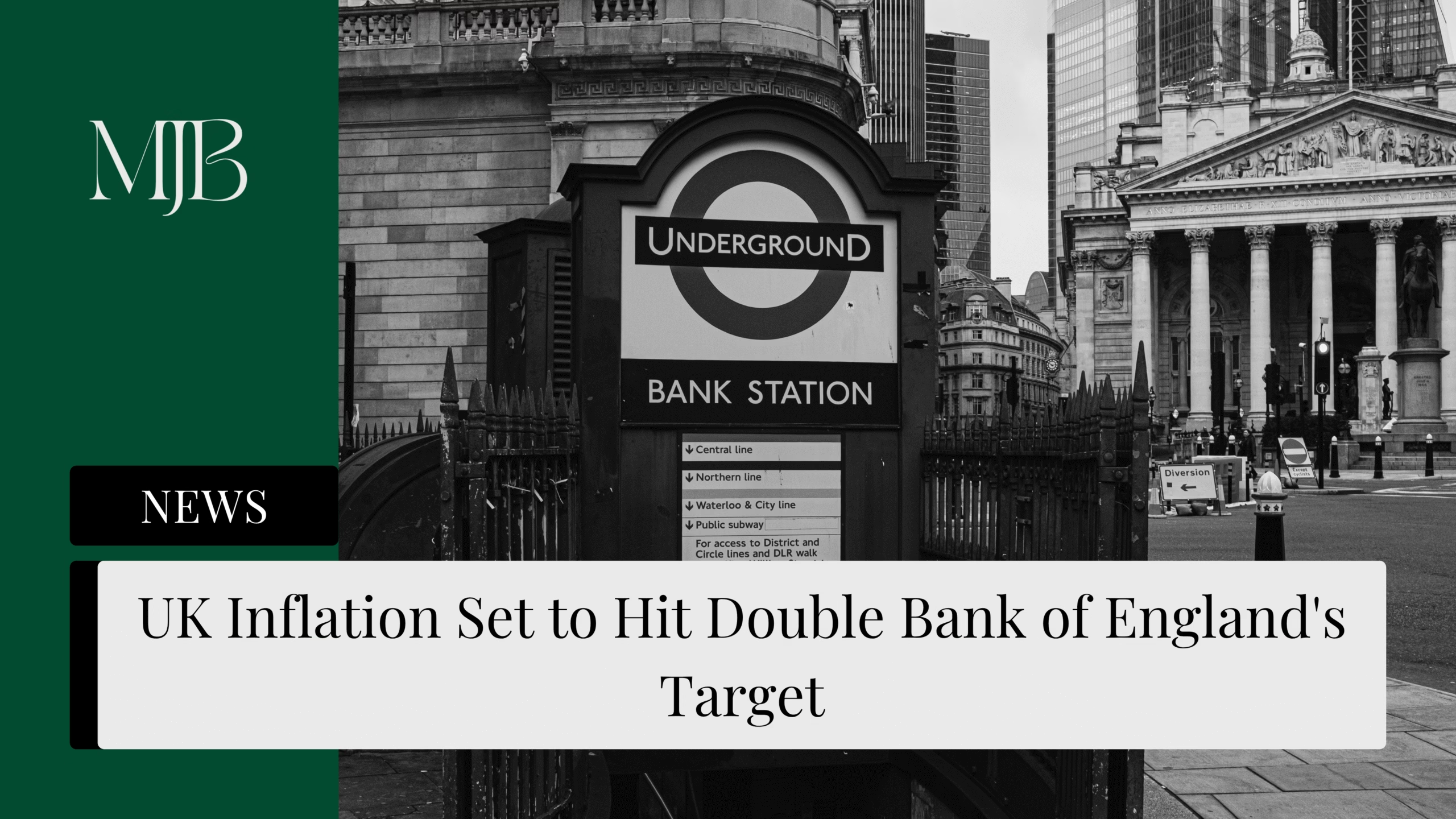
UK inflation is about to hit 4% — exactly double the Bank of England’s target. And unlike your gym membership, this one’s not getting cancelled anytime soon.
While other G7 countries are getting their inflation under control, the UK’s struggling to keep prices in check. Wednesday’s data is expected to confirm what economists have been dreading: we’re the odd one out, and not in a good way. This article breaks down why UK inflation keeps climbing, what’s driving it, and what it means for your wallet.
Why UK Inflation Keeps Climbing
The September consumer price index (CPI) inflation figure is forecast to reach 4%, doubling the Bank of England’s 2% target rate. It’s not just headline inflation either — core CPI (which strips out volatile food and energy prices) is expected to tick up from 3.6% to 3.7%.
The BoE saw this coming. Back in August, their central forecast predicted exactly this scenario. But knowing it’s coming doesn’t make it easier to swallow.
What’s really stinging? Both the IMF and OECD recently confirmed the UK will have higher inflation than every other G7 nation. The OECD went further, saying UK inflation would exceed the G20 average — a group that includes Argentina and Turkey, countries not exactly known for price stability.
What’s Driving Prices Up?
JP Morgan economist Allan Monks points to services inflation as the main culprit. Transport costs remain stubbornly high, petrol prices aren’t budging, and last year’s price drops are now working against us (economists call this “base effects,” but it just means year-on-year comparisons look worse).
There’s a slim chance communications prices and rent could come in softer than expected, potentially taking some edge off the numbers. But don’t bet your savings on it.

Energy Costs: The Gift That Keeps Taking
Goldman Sachs analysts are warning that energy inflation will stay elevated through Q4. That’s bad news for households already stretched thin — and worse news for Chancellor Rachel Reeves ahead of the Budget.
Energy costs are expected to remain volatile thanks to jumpy markets and higher network charges. Goldman’s James Moberly forecasts energy inflation will dip negative in early 2026, but bounce back into positive territory by mid-year.
Despite recent oil price drops, Goldman expects a larger Ofgem price cap increase in Q2 2026, driven by increased policy costs and network charges. Translation? Your energy bills aren’t getting cheaper anytime soon.
Reeves’ Inflation Headache
The Chancellor’s made tackling the cost of living a Cabinet priority. She’s pushing colleagues to focus on policies that actually lower prices — not just sound good in press releases.
Why the urgency? Lower inflation could convince bond markets to buy more short-term gilts, which would push yields down and prevent borrowing costs from spiking further. It’s financial dominoes, and Reeves is trying to keep them standing.
Rumours are swirling that she might strip VAT from household energy bills in the upcoming Budget. It’d cost the Treasury billions in lost tax revenue, but could win over voters and calm nervous bond markets. Sometimes you’ve got to spend money to save money — or at least to save your political skin.

What This Means for You
Double-target inflation isn’t just a statistic — it hits your wallet directly. Your pound buys less, savings lose value faster, and the Bank of England will think twice before cutting interest rates (which means mortgages and loans stay expensive).
The UK’s isolated inflation struggle suggests homegrown issues are at play. While global factors matter, our specific mix of energy policy, labour market tightness, and structural challenges is creating a uniquely British problem.
The Bottom Line
UK inflation hitting 4% confirms we’re in a different boat than our G7 peers — and it’s taking on water. Energy volatility, stubborn services inflation, and unfavourable base effects are creating a perfect storm. Reeves has her work cut out for her, and Wednesday’s figures will only add pressure ahead of the Budget.
Keep an eye on those energy bills, and maybe hold off on that big purchase until we see which way the wind blows.
FAQ
Q1: Why is UK inflation higher than other G7 countries?
A: The UK faces a unique combination of factors: persistent energy costs, tight labour markets pushing up wages, and structural issues in services sectors like transport. While global inflation has cooled, our homegrown challenges haven’t.
Q2: Will the Bank of England raise interest rates again?
A: Not immediately, but 4% inflation makes rate cuts far less likely. The BoE will want to see sustained progress toward the 2% target before considering any loosening. Higher-for-longer is the name of the game.
Q3: How does this affect my mortgage?
A: Elevated inflation keeps interest rates high, which means mortgage rates stay expensive. If you’re on a variable rate or remortgaging soon, brace for higher payments than you might have hoped.
Q4: Could removing VAT from energy bills really happen?
It’s being floated as a Budget option. It would provide immediate relief to households and could help calm inflation fears, but it’d cost the Treasury billions. Political pressure might make it happen.
Q5: When will UK inflation return to target?
A: The Bank of England’s forecast suggests it’ll take well into 2026, with energy volatility keeping things unpredictable. Don’t expect a quick fix — this is a marathon, not a sprint.
DISCLAIMER
Effective Date: 15th July 2025
The information provided on this website is for informational and educational purposes only and reflects the personal opinions of the author(s). It is not intended as financial, investment, tax, or legal advice.
We are not certified financial advisers. None of the content on this website constitutes a recommendation to buy, sell, or hold any financial product, asset, or service. You should not rely on any information provided here to make financial decisions.
We strongly recommend that you:
- Conduct your own research and due diligence
- Consult with a qualified financial adviser or professional before making any investment or financial decisions
While we strive to ensure that all information is accurate and up to date, we make no guarantees about the completeness, reliability, or suitability of any content on this site.
By using this website, you acknowledge and agree that we are not responsible for any financial loss, damage, or decisions made based on the content presented.








Disclosure & Editorial Standards
MJBurrows is not authorised or regulated by the Financial Conduct Authority (FCA). The content on this website — including articles, calculators, and tools — is for general informational and educational purposes only. It does not constitute personal financial, investment, tax, or legal advice and does not take into account your individual circumstances, financial situation, or objectives.
Nothing on this site is a personal recommendation to buy, sell, hold, or otherwise deal in any financial product, asset, or service. You should always conduct your own research and seek advice from a qualified, FCA-regulated financial adviser before making any financial decisions.
Our calculators produce estimates based on simplified models using HMRC-published rates for the current tax year. They cannot account for every individual circumstance and should not be relied upon as exact figures. Tax rules and rates may change — verify current rates with HMRC or a qualified tax adviser.
Projections are not guarantees. Where our tools show future values (investment growth, pension projections, compound interest), these are hypothetical illustrations based on assumed growth rates. Past performance does not guarantee future results. The value of investments can go down as well as up.
Market data displayed on this site is provided by third-party sources including Twelve Data, Yahoo Finance, and CoinGecko. We do not guarantee the accuracy, completeness, or timeliness of third-party data.
This content is designed for UK residents and reflects UK tax rules, thresholds, and legislation. It may not apply to other jurisdictions.
Using this website does not create a professional-client relationship of any kind. MJBurrows is not responsible for any financial loss, damage, or decision made based on the content presented. By using this site, you accept these terms.
This disclaimer may be updated from time to time without prior notice. Last reviewed: 23 April 2026.
MJBurrows is an independent UK personal finance publication, written and edited by Matthew Burrows. There is no parent company, no investor group, and no advertising sales team — decisions about what to cover and how to frame it are made by Matthew alone. Our full Editorial Policy sets out how the site operates in detail.
Commercial model. As of April 2026, MJBurrows generates no revenue. The site carries no display advertising, no affiliate links, no sponsored content, no paid product placements, and no pay-for-coverage arrangements. If this changes in future, it will be disclosed openly on the Editorial Policy page.
Sources. Articles and tools reference primary sources — HM Revenue & Customs (HMRC), gov.uk, the Bank of England, the Office for National Statistics (ONS), the Financial Conduct Authority (FCA), Companies House, and UK government departmental publications (DWP, Treasury). Calculator data uses HMRC-published rates for the 2026/27 tax year. Market data (tickers, asset prices) is provided by Twelve Data, Yahoo Finance, and CoinGecko.
Verification. Every published article is fact-checked before going live. Numerical claims are traced to their primary source, quotes are checked against the original speaker or document, and calculator outputs are tested against HMRC worked examples. See our verification and accuracy policy for the full process.
Corrections. If you spot an error, please report it via the Corrections page. A three-tier severity system commits to specific response times:
- Tier 1 — Urgent (material reader harm, defamatory statements, regulatory or legal issues): acknowledged within 24 hours, page actioned within 24 hours, correction published within 48 hours of confirmation.
- Tier 2 — High (significant factual errors that misinform readers): acknowledged within 3 working days, correction published within 7 working days of confirmation.
- Tier 3 — Standard (minor factual errors, dated references, missing context): acknowledged within 7 working days, correction published at the next regular content review (within the quarter).
Significant corrections are logged on the public Corrections log.
Updates and review cadence. Calculators are reviewed at least quarterly, plus event-driven updates when HMRC publishes new rates (Budget, Autumn Statement, new tax year). Guides are reviewed at least twice a year, with major rewrites whenever underlying regulation changes. Tax-year-sensitive content is prioritised for review at the April tax-year transition.
Get in touch. For editorial enquiries — corrections, story tips, reader questions — the address is contact@mjburrows.com. The contact page is at mjburrows.com/contact. Every email is read personally by Matthew.