Introduction
Here’s a stat that’ll make you wince: UK inflation just hit 3.8% in August, nearly double the Bank of England’s 2% target. That means your weekly shop, energy bills, and pretty much everything else keeps getting pricier while your paycheque stays the same.
With the Bank of England’s crucial interest rate decision looming this Thursday, economists are watching closely. The bad news? Food inflation climbed above 5% for the first time in 18 months. The worse news? This mess might not get sorted until 2027.
What’s Really Driving UK Inflation Right Now?
Food Prices Are the Real Villain
Food inflation jumped to 5.1% – the fifth consecutive monthly rise. That’s officially faster than wage growth, which means families are genuinely struggling to keep up.
Kris Hamer from the British Retail Consortium spoke on the issue: rising employment costs and poor harvests are hammering retailers, who’re passing those costs straight to us.
Services Inflation Offers Small Relief
There’s one tiny silver lining: services inflation dropped slightly to 4.7% from 5% the previous month. It’s progress, but hardly cause for celebration when it’s still more than double the target.

Why This Inflation Problem Feels Different
It’s Not Just About Interest Rates Anymore
Tom Clougherty from the Institute of Economic Affairs makes a crucial point: this isn’t the same inflation we saw during the pandemic (when money printing went wild).
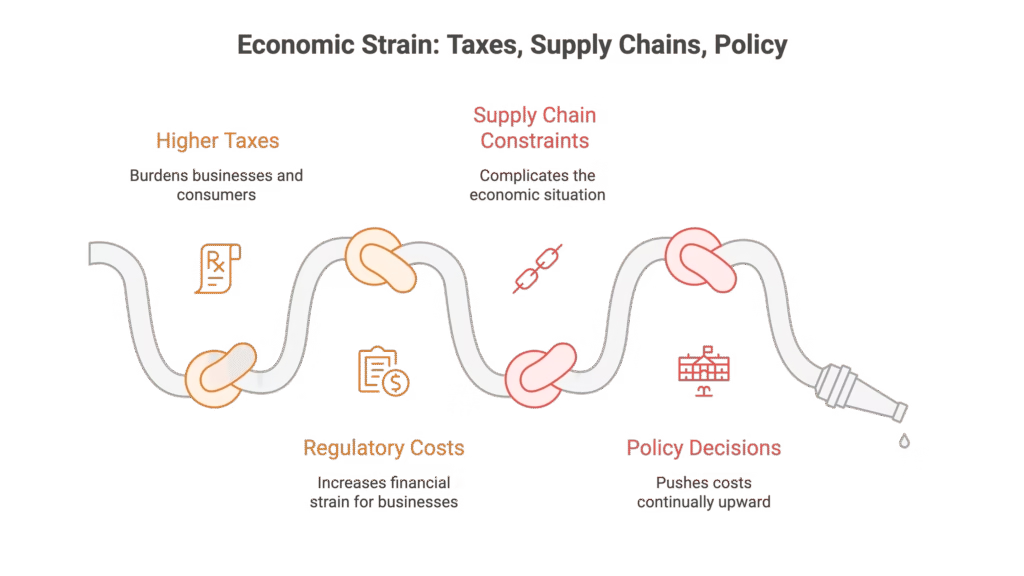
Today’s price rises stem from:
- Higher taxes and regulatory costs
- Supply chain constraints that never fully recovered
- Government policy decisions that keep pushing costs up
Translation? The Bank of England’s usual trick of raising interest rates might not fix this mess.
Politicians Point Fingers While Families Suffer
Chancellor Rachel Reeves is reportedly considering VAT exemptions on energy bills to ease the pressure. Meanwhile, Shadow Chancellor Mel Stride blames Labour’s £20bn employment tax raid for making things worse.
Here’s the reality: while politicians argue, your cost of living keeps climbing.
What Happens Next for UK Interest Rates?
Bank of England Faces Tough Choices
Most economists expect the Bank to hold rates steady on Thursday. City AM’s Shadow Monetary Policy Committee voted 8-1 to pause, with only one member pushing for a 25 basis point cut.
The thinking? With inflation this stubborn, cutting rates could pour fuel on the fire. But keeping them high risks choking an already struggling economy.
The 2027 Timeline Reality Check
JP Morgan’s Zara Nokes calls UK price growth “increasingly ugly,” and the Bank’s own forecasts suggest inflation won’t hit the 2% target until 2027. That’s three more years of this economic headache.
The Bottom Line
UK inflation at 3.8% isn’t just a number – it’s a real squeeze on family budgets. With food prices rising faster than wages and services inflation still elevated, Brits are paying for what experts call “years of poor economic management.”
The Bank of England’s interest rate decision Thursday will signal whether policymakers think monetary policy can solve this, or if we need broader economic reforms to break the cycle.
FAQ
Q1: Why is UK inflation so much higher than the 2% target?
A: It’s a mix of factors including rising food costs, higher taxes, regulatory expenses, and ongoing supply chain issues. Unlike pandemic-era inflation driven by money printing, today’s price rises stem more from government policy and structural economic problems.
Q2: Will the Bank of England cut interest rates this week?
A: Probably not. Most economists expect rates to stay put given stubborn inflation. An 8-1 vote by the Shadow Monetary Policy Committee suggests holding rates is the safer bet right now.
Q3: When will inflation actually come down?
A: The Bank of England forecasts inflation won’t hit the 2% target until 2027. That’s assuming no major economic shocks and gradual improvement in supply chains and government policy.
Q4: How does 5% food inflation affect my weekly shopping?
A: If you spent £100 on food last year, you’re now paying about £105 for the same items. With wages not keeping pace, many families are cutting back or switching to cheaper alternatives.
Q5: What can the government do besides interest rate changes?
A: Options include VAT cuts on energy bills (as Chancellor Reeves is reportedly considering), reducing regulatory costs on businesses, and addressing supply chain bottlenecks through economic liberalisation policies.
DISCLAIMER
Effective Date: 15th July 2025
The information provided on this website is for informational and educational purposes only and reflects the personal opinions of the author(s). It is not intended as financial, investment, tax, or legal advice.
We are not certified financial advisers. None of the content on this website constitutes a recommendation to buy, sell, or hold any financial product, asset, or service. You should not rely on any information provided here to make financial decisions.
We strongly recommend that you:
- Conduct your own research and due diligence
- Consult with a qualified financial adviser or professional before making any investment or financial decisions
While we strive to ensure that all information is accurate and up to date, we make no guarantees about the completeness, reliability, or suitability of any content on this site.
By using this website, you acknowledge and agree that we are not responsible for any financial loss, damage, or decisions made based on the content presented.
MORE NEWS








Disclosure & Editorial Standards
MJBurrows is not authorised or regulated by the Financial Conduct Authority (FCA). The content on this website — including articles, calculators, and tools — is for general informational and educational purposes only. It does not constitute personal financial, investment, tax, or legal advice and does not take into account your individual circumstances, financial situation, or objectives.
Nothing on this site is a personal recommendation to buy, sell, hold, or otherwise deal in any financial product, asset, or service. You should always conduct your own research and seek advice from a qualified, FCA-regulated financial adviser before making any financial decisions.
Our calculators produce estimates based on simplified models using HMRC-published rates for the current tax year. They cannot account for every individual circumstance and should not be relied upon as exact figures. Tax rules and rates may change — verify current rates with HMRC or a qualified tax adviser.
Projections are not guarantees. Where our tools show future values (investment growth, pension projections, compound interest), these are hypothetical illustrations based on assumed growth rates. Past performance does not guarantee future results. The value of investments can go down as well as up.
Market data displayed on this site is provided by third-party sources including Twelve Data, Yahoo Finance, and CoinGecko. We do not guarantee the accuracy, completeness, or timeliness of third-party data.
This content is designed for UK residents and reflects UK tax rules, thresholds, and legislation. It may not apply to other jurisdictions.
Using this website does not create a professional-client relationship of any kind. MJBurrows is not responsible for any financial loss, damage, or decision made based on the content presented. By using this site, you accept these terms.
This disclaimer may be updated from time to time without prior notice. Last reviewed: 23 April 2026.
MJBurrows is an independent UK personal finance publication, written and edited by Matthew Burrows. There is no parent company, no investor group, and no advertising sales team — decisions about what to cover and how to frame it are made by Matthew alone. Our full Editorial Policy sets out how the site operates in detail.
Commercial model. As of April 2026, MJBurrows generates no revenue. The site carries no display advertising, no affiliate links, no sponsored content, no paid product placements, and no pay-for-coverage arrangements. If this changes in future, it will be disclosed openly on the Editorial Policy page.
Sources. Articles and tools reference primary sources — HM Revenue & Customs (HMRC), gov.uk, the Bank of England, the Office for National Statistics (ONS), the Financial Conduct Authority (FCA), Companies House, and UK government departmental publications (DWP, Treasury). Calculator data uses HMRC-published rates for the 2026/27 tax year. Market data (tickers, asset prices) is provided by Twelve Data, Yahoo Finance, and CoinGecko.
Verification. Every published article is fact-checked before going live. Numerical claims are traced to their primary source, quotes are checked against the original speaker or document, and calculator outputs are tested against HMRC worked examples. See our verification and accuracy policy for the full process.
Corrections. If you spot an error, please report it via the Corrections page. A three-tier severity system commits to specific response times:
- Tier 1 — Urgent (material reader harm, defamatory statements, regulatory or legal issues): acknowledged within 24 hours, page actioned within 24 hours, correction published within 48 hours of confirmation.
- Tier 2 — High (significant factual errors that misinform readers): acknowledged within 3 working days, correction published within 7 working days of confirmation.
- Tier 3 — Standard (minor factual errors, dated references, missing context): acknowledged within 7 working days, correction published at the next regular content review (within the quarter).
Significant corrections are logged on the public Corrections log.
Updates and review cadence. Calculators are reviewed at least quarterly, plus event-driven updates when HMRC publishes new rates (Budget, Autumn Statement, new tax year). Guides are reviewed at least twice a year, with major rewrites whenever underlying regulation changes. Tax-year-sensitive content is prioritised for review at the April tax-year transition.
Get in touch. For editorial enquiries — corrections, story tips, reader questions — the address is contact@mjburrows.com. The contact page is at mjburrows.com/contact. Every email is read personally by Matthew.