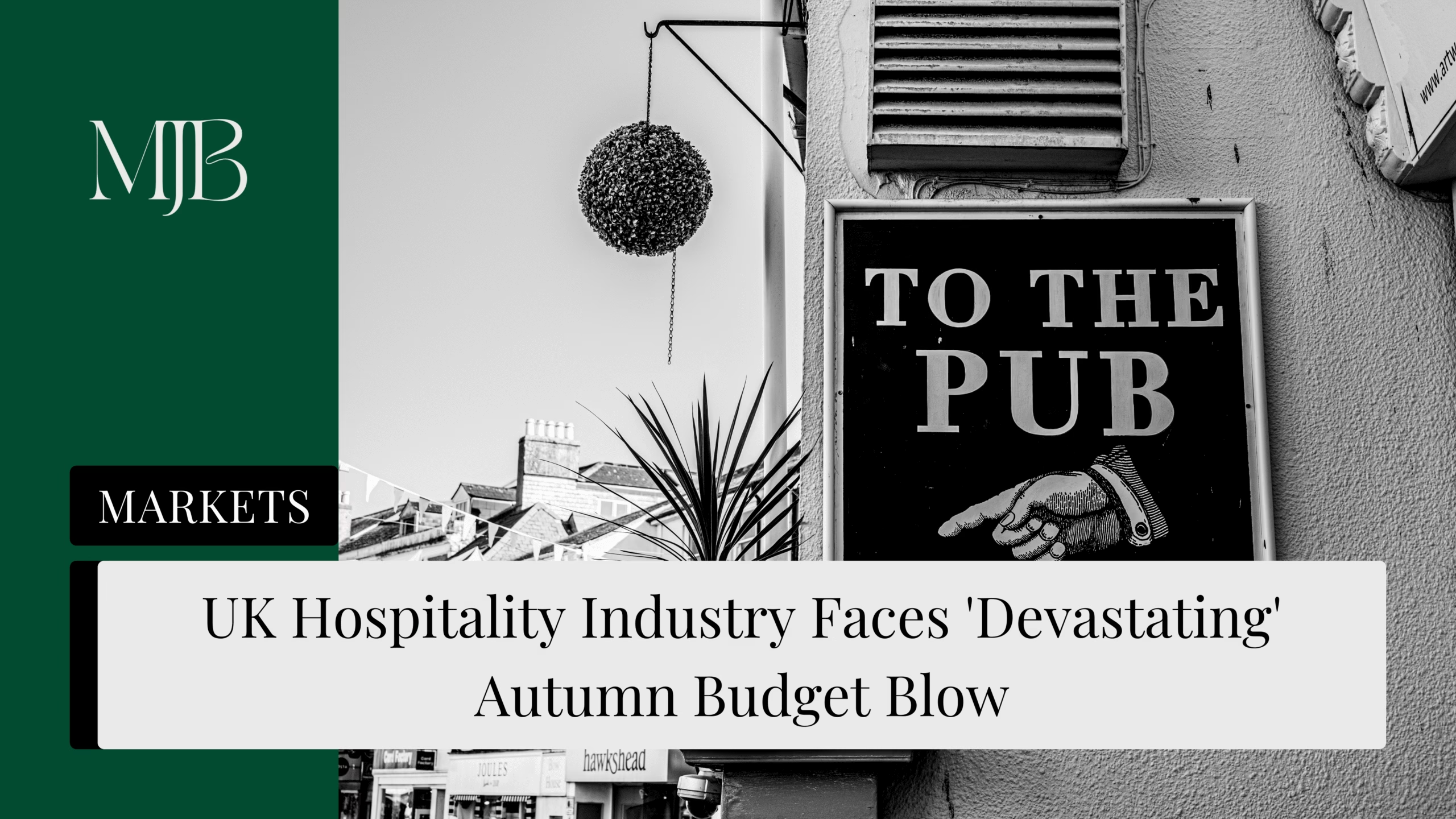
The UK’s hospitality industry just got hit with a budget that feels more like a kick in the teeth than a helping hand. With no VAT cuts, unchanged National Insurance, and business rates relief that’s been called “too little, too late,” pub landlords and distillers are bracing for what could be a brutal year ahead.
Here’s the reality: three in ten landlords reckon they’ll go bust within 12 months if costs keep climbing. The Autumn Budget hasn’t just failed to throw them a lifeline, it’s actively pushed struggling businesses closer to the edge. And with 111,000 hospitality jobs expected to vanish by month’s end, this isn’t just about spreadsheets. It’s about livelihoods.
What the Autumn Budget Actually Delivered (Spoiler: Not Much)
The hospitality sector had a wishlist: VAT cuts, lower National Insurance contributions, and meaningful business rates relief. What did they get? A modest business rates reduction that’ll likely be wiped out by next year’s inflation-linked revaluation.
“This is a sad day for the nation’s distillers, pubs and the wider hospitality sector,” said Karl Mason from the UK Spirits Alliance. He’s not exaggerating. The industry’s already been hammered by tax rises and plummeting consumer confidence—ONS data backs this up with those eye-watering job loss figures.
Chris Gamm, CEO at Springboard, put it bluntly: the lower business rates won’t even cover the losses from the higher minimum wage and frozen income tax thresholds. Translation? Expect fewer entry-level roles and more redundancies.

Pub Closures Hit Record Levels
If you needed proof that Britain’s pub industry is in crisis, here it is: pub closures reached a record high in the first 10 months of 2025—the worst in over two decades. That’s a 5% jump from last year and more than triple the 2015 figure.
Piers Skinner from hospitality-tech firm Telemetry stated: “Today’s budget squeezes the hospitality sector even further, with absolutely no relief provided to support. I fear it could be devastating.”
When your local’s closing faster than you can say “last orders,” you know something’s seriously wrong.
Tourist Tax: Adding Insult to Injury
Just when you thought it couldn’t get worse, Chancellor Reeves opened the door for regional mayors to slap a “modest” charge on hotel stays, B&Bs, and holiday lets. London’s Sadiq Khan and Manchester’s Andy Burnham are keen—but the hospitality industry? Not so much.
Kate Nicholls, chair of UKHospitality, called it a “shocking U-turn” that directly contradicts government promises made just two months ago. The potential damage? Up to £518 million in additional taxes passed straight onto consumers.
“Make no mistake—this cost will be passed directly onto consumers, drive inflation and undermine the Government’s aim to reduce the cost of living,” Nicholls warned.
Critics reckon the tourist tax will discourage domestic travel and pile even more pressure on an industry that’s already on its knees.
What This Means for Your Wallet (and Your Weekend Pint)
Here’s the uncomfortable truth: these costs don’t just disappear. They get passed on to you. Expect higher prices at pubs, restaurants, and hotels. That weekend break in Manchester? It’ll cost you more. Your Friday night pint? Same story.
The hospitality sector employs millions and props up local economies across the UK. When it struggles, communities feel the pinch—fewer jobs, shuttered high streets, and less choice for consumers.

The Bottom Line
The Autumn Budget has left Britain’s hospitality industry feeling abandoned. With no meaningful VAT relief, minimal business rates help that’ll likely get cancelled out, and a new tourist tax on the horizon, the sector’s facing a perfect storm.
Three in ten landlords fear closing within a year. Pub closures are at record highs. Job losses are mounting. And all of this is happening while the government talks about supporting working people and reducing the cost of living.
Want to support your local hospitality businesses? Now’s the time to spend your money where it matters most—before it’s too late.
FAQs
Q1: What changes did the Autumn Budget make for the UK hospitality industry?
A: The budget offered minimal business rates relief but no VAT cuts or National Insurance reductions. The limited support is expected to be offset by higher minimum wage costs and an inflation-linked revaluation of business rates next year.
Q2: How many pubs are closing in the UK?
A: Pub closures hit a record high in the first 10 months of 2025—the worst in over two decades. Closures rose 5% compared to last year and more than tripled since 2015.
Q3: What is the tourist tax and how will it affect travel costs?
A: The tourist tax is a charge that regional mayors can impose on hotel stays, B&Bs, and holiday lets. It could add up to £518 million in additional costs for UK travellers, making domestic holidays more expensive.
Q4: Why are hospitality businesses struggling so much?
A: The sector’s been hit by tax rises, falling consumer confidence, frozen income tax thresholds, higher minimum wage requirements, and now minimal budget support. Three in ten landlords fear going bust within 12 months.
Q5: Will hospitality prices go up after the Autumn Budget?
A: Yes, almost certainly. With rising costs and no meaningful government relief, businesses will pass these expenses onto consumers through higher prices for food, drinks, and accommodation.
DISCLAIMER
Effective Date: 15th July 2025
The information provided on this website is for informational and educational purposes only and reflects the personal opinions of the author(s). It is not intended as financial, investment, tax, or legal advice.
We are not certified financial advisers. None of the content on this website constitutes a recommendation to buy, sell, or hold any financial product, asset, or service. You should not rely on any information provided here to make financial decisions.
We strongly recommend that you:
- Conduct your own research and due diligence
- Consult with a qualified financial adviser or professional before making any investment or financial decisions
While we strive to ensure that all information is accurate and up to date, we make no guarantees about the completeness, reliability, or suitability of any content on this site.
By using this website, you acknowledge and agree that we are not responsible for any financial loss, damage, or decisions made based on the content presented.
MORE NEWS






Disclosure & Editorial Standards
MJBurrows is not authorised or regulated by the Financial Conduct Authority (FCA). The content on this website — including articles, calculators, and tools — is for general informational and educational purposes only. It does not constitute personal financial, investment, tax, or legal advice and does not take into account your individual circumstances, financial situation, or objectives.
Nothing on this site is a personal recommendation to buy, sell, hold, or otherwise deal in any financial product, asset, or service. You should always conduct your own research and seek advice from a qualified, FCA-regulated financial adviser before making any financial decisions.
Our calculators produce estimates based on simplified models using HMRC-published rates for the current tax year. They cannot account for every individual circumstance and should not be relied upon as exact figures. Tax rules and rates may change — verify current rates with HMRC or a qualified tax adviser.
Projections are not guarantees. Where our tools show future values (investment growth, pension projections, compound interest), these are hypothetical illustrations based on assumed growth rates. Past performance does not guarantee future results. The value of investments can go down as well as up.
Market data displayed on this site is provided by third-party sources including Twelve Data, Yahoo Finance, and CoinGecko. We do not guarantee the accuracy, completeness, or timeliness of third-party data.
This content is designed for UK residents and reflects UK tax rules, thresholds, and legislation. It may not apply to other jurisdictions.
Using this website does not create a professional-client relationship of any kind. MJBurrows is not responsible for any financial loss, damage, or decision made based on the content presented. By using this site, you accept these terms.
This disclaimer may be updated from time to time without prior notice. Last reviewed: 23 April 2026.
MJBurrows is an independent UK personal finance publication, written and edited by Matthew Burrows. There is no parent company, no investor group, and no advertising sales team — decisions about what to cover and how to frame it are made by Matthew alone. Our full Editorial Policy sets out how the site operates in detail.
Commercial model. As of April 2026, MJBurrows generates no revenue. The site carries no display advertising, no affiliate links, no sponsored content, no paid product placements, and no pay-for-coverage arrangements. If this changes in future, it will be disclosed openly on the Editorial Policy page.
Sources. Articles and tools reference primary sources — HM Revenue & Customs (HMRC), gov.uk, the Bank of England, the Office for National Statistics (ONS), the Financial Conduct Authority (FCA), Companies House, and UK government departmental publications (DWP, Treasury). Calculator data uses HMRC-published rates for the 2026/27 tax year. Market data (tickers, asset prices) is provided by Twelve Data, Yahoo Finance, and CoinGecko.
Verification. Every published article is fact-checked before going live. Numerical claims are traced to their primary source, quotes are checked against the original speaker or document, and calculator outputs are tested against HMRC worked examples. See our verification and accuracy policy for the full process.
Corrections. If you spot an error, please report it via the Corrections page. A three-tier severity system commits to specific response times:
- Tier 1 — Urgent (material reader harm, defamatory statements, regulatory or legal issues): acknowledged within 24 hours, page actioned within 24 hours, correction published within 48 hours of confirmation.
- Tier 2 — High (significant factual errors that misinform readers): acknowledged within 3 working days, correction published within 7 working days of confirmation.
- Tier 3 — Standard (minor factual errors, dated references, missing context): acknowledged within 7 working days, correction published at the next regular content review (within the quarter).
Significant corrections are logged on the public Corrections log.
Updates and review cadence. Calculators are reviewed at least quarterly, plus event-driven updates when HMRC publishes new rates (Budget, Autumn Statement, new tax year). Guides are reviewed at least twice a year, with major rewrites whenever underlying regulation changes. Tax-year-sensitive content is prioritised for review at the April tax-year transition.
Get in touch. For editorial enquiries — corrections, story tips, reader questions — the address is contact@mjburrows.com. The contact page is at mjburrows.com/contact. Every email is read personally by Matthew.