

The Problem: Britain’s Becoming a Startup Factory for Foreign Buyers
Here’s a stat that’ll make you spit out your morning coffee: nearly 80% of UK venture capital investors have never backed a unicorn (companies worth $1bn+). Meanwhile, American buyers are having a field day snapping up British firms at bargain-basement prices.
The UK’s got a serious problem. We’re brilliant at creating innovative startups, but we’re terrible at scaling them into global champions. Instead, we’re becoming what experts call an “incubator economy” – we nurture companies from birth, then watch helplessly as foreign investors swoop in and take them home.
Think of it like raising a prize-winning racehorse, only to sell it to your competitor right before the big race.
Why Foreign Buyers Can’t Resist “Bargain Britain”
The Numbers Don’t Lie
Foreign takeovers are set to push UK M&A volumes above £50bn this year, with American companies leading the charge. In just 24 hours recently, three major tech deals worth £6.3bn hit London’s market.
Some recent casualties include:
- Just Group: Snatched up by Canadian giant Brookfield Wealth Solutions
- Deliveroo: Going private in a £2.9bn takeover by US rival DoorDash
- Oxford Ionics: The UK quantum darling grabbed by New York’s IonQ
The Valuation Gap
British public companies are trading at massive discounts compared to their American counterparts. It’s like having a “50% off everything” sale that never ends – no wonder foreign buyers are queuing up.
Julia Hoggett, CEO of the London Stock Exchange stated: “We have no shortage of consequential companies scaling at pace. But we’ll do them a disservice if we don’t back them with domestic risk capital.”

The £1 Trillion Solution: Pension Power
Super Funds to the Rescue
The Purposeful Company think tank has a bold plan: create pension “super funds” that could unlock £1 trillion for the UK tech sector. The idea? Use our own pension money to back our own companies instead of letting them slip away to foreign buyers.
This isn’t just about keeping companies British – it’s about economic survival. As Will Hutton, co-chair of the Purposeful Company, warns: “Britain is at five minutes to midnight.”
What Needs to Change
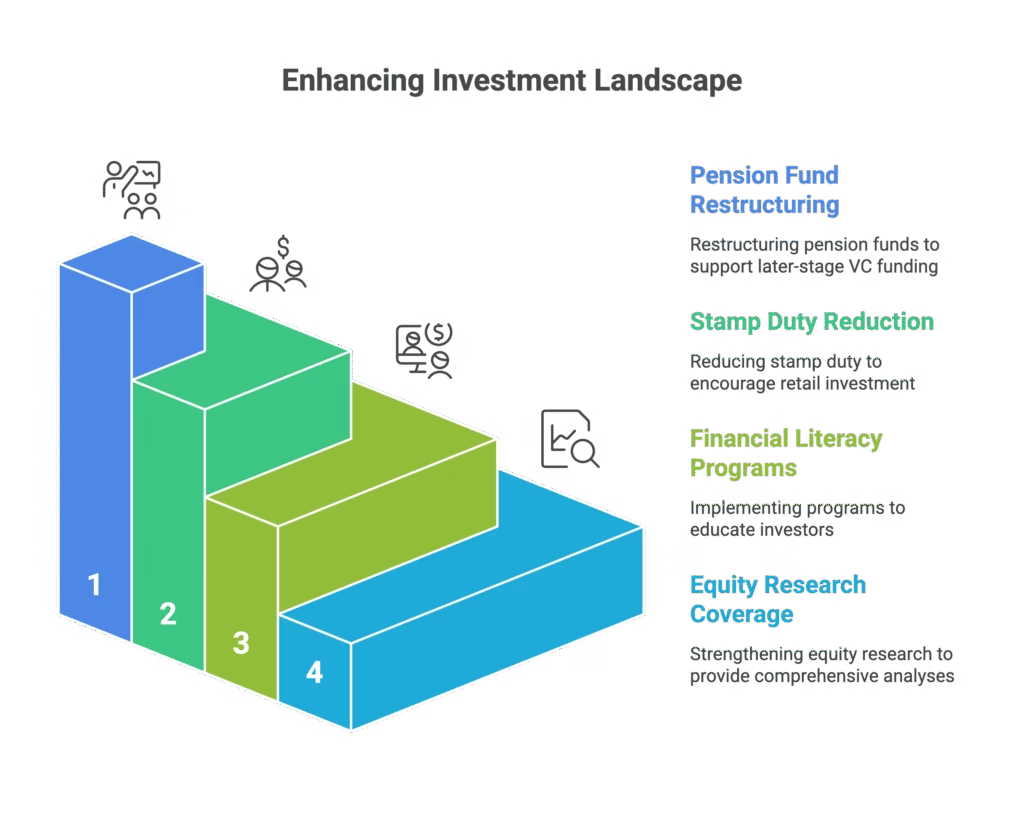
The proposed reforms include:
- Pension fund restructuring for later-stage VC funding
- Reduced stamp duty to boost retail investment
- Better financial literacy programs
- Stronger equity research coverage
The Clock’s Ticking on London’s Market
The UK’s financial watchdog has already sounded alarms about the “range of issues” weighing on Britain’s public markets. With over half of overseas buyers coming from the US, we’re essentially funding America’s next generation of tech giants with our own innovation.
Nick Lyons, chairman of Phoenix Group, sums up the urgency: “These proposals have been widely endorsed within the City of London. Now we need to implement at pace.”
What This Means for You
If you’re an investor, entrepreneur, or just someone who cares about Britain’s economic future, this trend should worry you. We’re not just losing companies – we’re losing the jobs, tax revenue, and innovation that comes with them.
The government needs to act fast, or we’ll continue watching our best companies get picked off like bargains at a closing-down sale.
The stakes couldn’t be higher. Keep watching policy announcements – they’ll determine whether Britain builds the next generation of global champions or remains Silicon Valley’s research department.
FAQ
Q1: What exactly is an “incubator economy”?
A: An incubator economy creates and nurtures innovative startups but lacks the infrastructure to scale them domestically. Instead, foreign investors buy these companies once they show promise, taking the long-term value elsewhere.
Q2: Why are UK companies so attractive to foreign buyers?
A: British firms are trading at significant discounts compared to American competitors, making them bargain purchases. The UK’s strong innovation ecosystem creates valuable companies that are undervalued by the market.
Q3: How would pension super funds help?
A: By pooling pension investments into larger funds focused on later-stage companies, the UK could provide domestic capital to keep successful firms from being forced into foreign takeovers due to lack of local funding.
Q4: What’s the £1 trillion figure referring to?
A: This represents the potential capital that could be unlocked through pension reforms and improved market structures, giving UK companies access to domestic funding instead of relying on foreign investors.
Q5: Is this trend reversible?
A: Yes, but it requires immediate policy action. Countries like France and Germany have successfully used pension reforms and market incentives to keep more companies domestic. The UK has the tools – it just needs the political will.
DISCLAIMER
Effective Date: 15th July 2025
The information provided on this website is for informational and educational purposes only and reflects the personal opinions of the author(s). It is not intended as financial, investment, tax, or legal advice.
We are not certified financial advisers. None of the content on this website constitutes a recommendation to buy, sell, or hold any financial product, asset, or service. You should not rely on any information provided here to make financial decisions.
We strongly recommend that you:
- Conduct your own research and due diligence
- Consult with a qualified financial adviser or professional before making any investment or financial decisions
While we strive to ensure that all information is accurate and up to date, we make no guarantees about the completeness, reliability, or suitability of any content on this site.
By using this website, you acknowledge and agree that we are not responsible for any financial loss, damage, or decisions made based on the content presented.
MORE NEWS








Disclosure & Editorial Standards
MJBurrows is not authorised or regulated by the Financial Conduct Authority (FCA). The content on this website — including articles, calculators, and tools — is for general informational and educational purposes only. It does not constitute personal financial, investment, tax, or legal advice and does not take into account your individual circumstances, financial situation, or objectives.
Nothing on this site is a personal recommendation to buy, sell, hold, or otherwise deal in any financial product, asset, or service. You should always conduct your own research and seek advice from a qualified, FCA-regulated financial adviser before making any financial decisions.
Our calculators produce estimates based on simplified models using HMRC-published rates for the current tax year. They cannot account for every individual circumstance and should not be relied upon as exact figures. Tax rules and rates may change — verify current rates with HMRC or a qualified tax adviser.
Projections are not guarantees. Where our tools show future values (investment growth, pension projections, compound interest), these are hypothetical illustrations based on assumed growth rates. Past performance does not guarantee future results. The value of investments can go down as well as up.
Market data displayed on this site is provided by third-party sources including Twelve Data, Yahoo Finance, and CoinGecko. We do not guarantee the accuracy, completeness, or timeliness of third-party data.
This content is designed for UK residents and reflects UK tax rules, thresholds, and legislation. It may not apply to other jurisdictions.
Using this website does not create a professional-client relationship of any kind. MJBurrows is not responsible for any financial loss, damage, or decision made based on the content presented. By using this site, you accept these terms.
This disclaimer may be updated from time to time without prior notice. Last reviewed: 23 April 2026.
MJBurrows is an independent UK personal finance publication, written and edited by Matthew Burrows. There is no parent company, no investor group, and no advertising sales team — decisions about what to cover and how to frame it are made by Matthew alone. Our full Editorial Policy sets out how the site operates in detail.
Commercial model. As of April 2026, MJBurrows generates no revenue. The site carries no display advertising, no affiliate links, no sponsored content, no paid product placements, and no pay-for-coverage arrangements. If this changes in future, it will be disclosed openly on the Editorial Policy page.
Sources. Articles and tools reference primary sources — HM Revenue & Customs (HMRC), gov.uk, the Bank of England, the Office for National Statistics (ONS), the Financial Conduct Authority (FCA), Companies House, and UK government departmental publications (DWP, Treasury). Calculator data uses HMRC-published rates for the 2026/27 tax year. Market data (tickers, asset prices) is provided by Twelve Data, Yahoo Finance, and CoinGecko.
Verification. Every published article is fact-checked before going live. Numerical claims are traced to their primary source, quotes are checked against the original speaker or document, and calculator outputs are tested against HMRC worked examples. See our verification and accuracy policy for the full process.
Corrections. If you spot an error, please report it via the Corrections page. A three-tier severity system commits to specific response times:
- Tier 1 — Urgent (material reader harm, defamatory statements, regulatory or legal issues): acknowledged within 24 hours, page actioned within 24 hours, correction published within 48 hours of confirmation.
- Tier 2 — High (significant factual errors that misinform readers): acknowledged within 3 working days, correction published within 7 working days of confirmation.
- Tier 3 — Standard (minor factual errors, dated references, missing context): acknowledged within 7 working days, correction published at the next regular content review (within the quarter).
Significant corrections are logged on the public Corrections log.
Updates and review cadence. Calculators are reviewed at least quarterly, plus event-driven updates when HMRC publishes new rates (Budget, Autumn Statement, new tax year). Guides are reviewed at least twice a year, with major rewrites whenever underlying regulation changes. Tax-year-sensitive content is prioritised for review at the April tax-year transition.
Get in touch. For editorial enquiries — corrections, story tips, reader questions — the address is contact@mjburrows.com. The contact page is at mjburrows.com/contact. Every email is read personally by Matthew.