

The UK defence training sector is getting a massive shake-up. With defence spending set to hit £70bn+ by 2027, the government just announced a £182m defence skills investment that’ll transform how Britain prepares workers for modern warfare and defence jobs.
Here’s the deal: five new “technical excellence colleges,” thousands of students fast-tracked into defence careers, and UK defence training programmes running at what officials call “wartime pace.” It’s the biggest defence workforce strategy in decades, targeting everything from submarine engineers to cyber warfare specialists.
New UK Defence Colleges and Training Programmes
Five Technical Excellence Colleges Launch by 2026
The government’s defence industrial strategy includes five new specialist colleges opening their doors in 2026. These defence training institutions will focus on high-demand skills like submarine engineering, cyber warfare, and advanced manufacturing for the defence sector.
Applications for these UK defence colleges go live by year-end, with the Ministry of Defence targeting rapid deployment to meet urgent skills shortages.
Defence STEM Programmes Target School Students
Regional STEM initiatives will reach “thousands” of school-age students over four years, creating pathways into lucrative defence careers. These defence education programmes aren’t just coding camps – they’re designed to funnel talent directly into national security roles.
The defence skills shortage has reached critical levels, making these youth programmes essential for long-term workforce planning.
Adult Defence Training and Reskilling
Already working in the defence industry? Targeted short courses will upgrade your skills without career breaks. The defence sector evolution demands rapid upskilling, and these programmes deliver exactly that.
Veterans also get priority access to defence job transition programmes, helping military experience translate into civilian defence roles.

£182M Defence Investment Breakdown
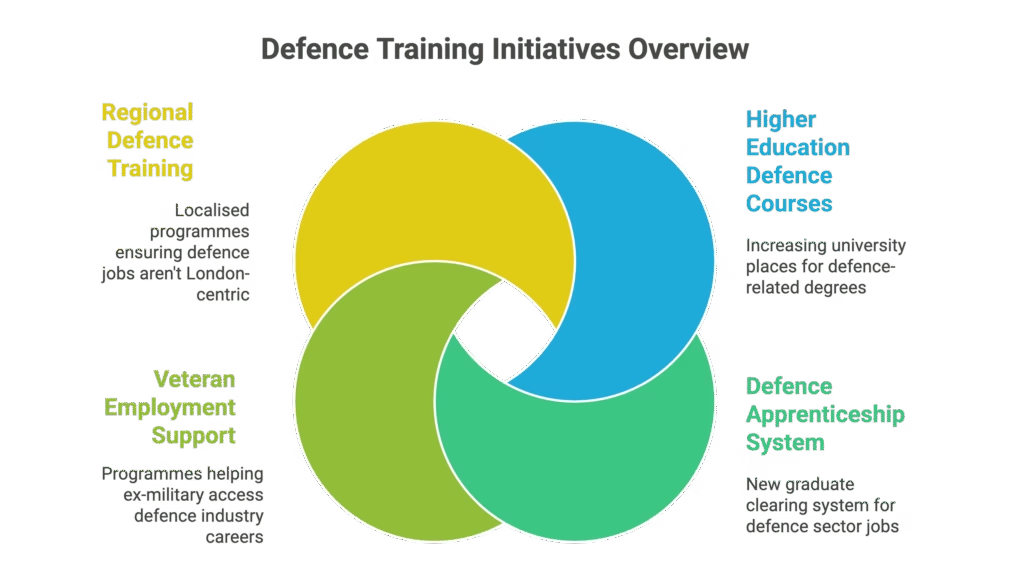
This isn’t just throwing money at the problem. The defence training funding targets specific areas:
- Higher Education Defence Courses: More university places for defence-related degrees and apprenticeships
- Defence Apprenticeship System: New graduate clearing system specifically for defence sector jobs
- Veteran Employment Support: Dedicated programmes helping ex-military access defence industry careers
- Regional Defence Training: Localised programmes ensuring defence jobs aren’t just London-centric
Defence Secretary John Healey called it “the biggest defence skills plan in decades,” while Education Secretary Bridget Phillipson emphasised breaking down barriers to defence career opportunities.
Why UK Defence Training Needs This Urgent Overhaul
With UK defence spending jumping £13.4bn annually by 2027, the skills gap has become critical. The government positions defence as “the engine room for national renewal,” but you can’t renew what you can’t staff.
The “wartime pace” language isn’t marketing spin – it reflects genuine urgency around defence readiness and the need for skilled defence workers who can innovate under pressure.
Modern defence challenges require workers who understand both traditional engineering and cutting-edge technology. These defence training programmes bridge that gap.

Impact on UK Defence Jobs Market
This defence strategy creates career pathways that didn’t exist before. Whether you’re 16 considering your options or 35 looking to pivot into the growing defence sector, these programmes open doors.
The real question? Whether these defence training initiatives can deliver skilled workers fast enough to meet evolving threats. Early indicators suggest the government is serious about results, not just announcements.
Ready to explore defence career opportunities? Monitor application deadlines and programme launches throughout 2025 for defence training opportunities.
Frequently Asked Questions About UK Defence Training
Q1: When do the new UK defence colleges actually open?
A: Defence college applications went live by the end of 2024, with successful institutions launching in 2026. The tight timeline reflects urgent defence skills shortages across the sector.
Q2: Who qualifies for these defence training programmes?
A: Everyone from school students (through STEM initiatives) to current workers (short courses), veterans (transition programmes), and graduates (apprenticeship clearing system). The defence sector needs diverse talent fast.
Q3: What specific defence jobs are being prioritised?
A: Submarine engineers, cyber warfare specialists, advanced manufacturing roles, and other high-tech defence positions. Think cutting-edge technology rather than traditional military roles.
Q4: How much is UK defence spending increasing?
A: Defence spending rises to over £70bn annually by 2027, up £13.4bn from current levels. This massive increase demands equally massive workforce expansion.
Q5: Are these defence programmes just about preparing for war?
A: While framed as “national renewal” and job creation, the “wartime pace” terminology suggests preparation for scenarios beyond peacetime operations. The defence industry offers stable, well-paid careers regardless.
DISCLAIMER
Effective Date: 15th July 2025
The information provided on this website is for informational and educational purposes only and reflects the personal opinions of the author(s). It is not intended as financial, investment, tax, or legal advice.
We are not certified financial advisers. None of the content on this website constitutes a recommendation to buy, sell, or hold any financial product, asset, or service. You should not rely on any information provided here to make financial decisions.
We strongly recommend that you:
- Conduct your own research and due diligence
- Consult with a qualified financial adviser or professional before making any investment or financial decisions
While we strive to ensure that all information is accurate and up to date, we make no guarantees about the completeness, reliability, or suitability of any content on this site.
By using this website, you acknowledge and agree that we are not responsible for any financial loss, damage, or decisions made based on the content presented.
MORE NEWS








Disclosure & Editorial Standards
MJBurrows is not authorised or regulated by the Financial Conduct Authority (FCA). The content on this website — including articles, calculators, and tools — is for general informational and educational purposes only. It does not constitute personal financial, investment, tax, or legal advice and does not take into account your individual circumstances, financial situation, or objectives.
Nothing on this site is a personal recommendation to buy, sell, hold, or otherwise deal in any financial product, asset, or service. You should always conduct your own research and seek advice from a qualified, FCA-regulated financial adviser before making any financial decisions.
Our calculators produce estimates based on simplified models using HMRC-published rates for the current tax year. They cannot account for every individual circumstance and should not be relied upon as exact figures. Tax rules and rates may change — verify current rates with HMRC or a qualified tax adviser.
Projections are not guarantees. Where our tools show future values (investment growth, pension projections, compound interest), these are hypothetical illustrations based on assumed growth rates. Past performance does not guarantee future results. The value of investments can go down as well as up.
Market data displayed on this site is provided by third-party sources including Twelve Data, Yahoo Finance, and CoinGecko. We do not guarantee the accuracy, completeness, or timeliness of third-party data.
This content is designed for UK residents and reflects UK tax rules, thresholds, and legislation. It may not apply to other jurisdictions.
Using this website does not create a professional-client relationship of any kind. MJBurrows is not responsible for any financial loss, damage, or decision made based on the content presented. By using this site, you accept these terms.
This disclaimer may be updated from time to time without prior notice. Last reviewed: 23 April 2026.
MJBurrows is an independent UK personal finance publication, written and edited by Matthew Burrows. There is no parent company, no investor group, and no advertising sales team — decisions about what to cover and how to frame it are made by Matthew alone. Our full Editorial Policy sets out how the site operates in detail.
Commercial model. As of April 2026, MJBurrows generates no revenue. The site carries no display advertising, no affiliate links, no sponsored content, no paid product placements, and no pay-for-coverage arrangements. If this changes in future, it will be disclosed openly on the Editorial Policy page.
Sources. Articles and tools reference primary sources — HM Revenue & Customs (HMRC), gov.uk, the Bank of England, the Office for National Statistics (ONS), the Financial Conduct Authority (FCA), Companies House, and UK government departmental publications (DWP, Treasury). Calculator data uses HMRC-published rates for the 2026/27 tax year. Market data (tickers, asset prices) is provided by Twelve Data, Yahoo Finance, and CoinGecko.
Verification. Every published article is fact-checked before going live. Numerical claims are traced to their primary source, quotes are checked against the original speaker or document, and calculator outputs are tested against HMRC worked examples. See our verification and accuracy policy for the full process.
Corrections. If you spot an error, please report it via the Corrections page. A three-tier severity system commits to specific response times:
- Tier 1 — Urgent (material reader harm, defamatory statements, regulatory or legal issues): acknowledged within 24 hours, page actioned within 24 hours, correction published within 48 hours of confirmation.
- Tier 2 — High (significant factual errors that misinform readers): acknowledged within 3 working days, correction published within 7 working days of confirmation.
- Tier 3 — Standard (minor factual errors, dated references, missing context): acknowledged within 7 working days, correction published at the next regular content review (within the quarter).
Significant corrections are logged on the public Corrections log.
Updates and review cadence. Calculators are reviewed at least quarterly, plus event-driven updates when HMRC publishes new rates (Budget, Autumn Statement, new tax year). Guides are reviewed at least twice a year, with major rewrites whenever underlying regulation changes. Tax-year-sensitive content is prioritised for review at the April tax-year transition.
Get in touch. For editorial enquiries — corrections, story tips, reader questions — the address is contact@mjburrows.com. The contact page is at mjburrows.com/contact. Every email is read personally by Matthew.