
Not so long ago, the aviation industry was bleeding jobs faster than a punctured fuel tank. Well, Swissport UK jobs growth just patched that hole. The ground handling powerhouse didn’t just bounce back—it absolutely soared in 2024, creating 900 new aviation jobs across the UK while profits rocketed from £10.5m to £39.8m. That’s a staggering 278% profit increase that’ll make your spreadsheet do a double-take.
Here’s why this UK aviation recovery story matters: Swissport’s job creation signals genuine recovery in UK air travel demand, not just wishful thinking from boardrooms.
Swissport Financial Results 2024: Record Revenue and Employment Growth
Swissport UK’s 2024 performance reads like a recovery playbook written in green ink. The aviation services company’s revenue climbed from £300.8m to £348.6m, while their UK workforce expanded from 6,200 to 7,100 employees across 20 UK airports.
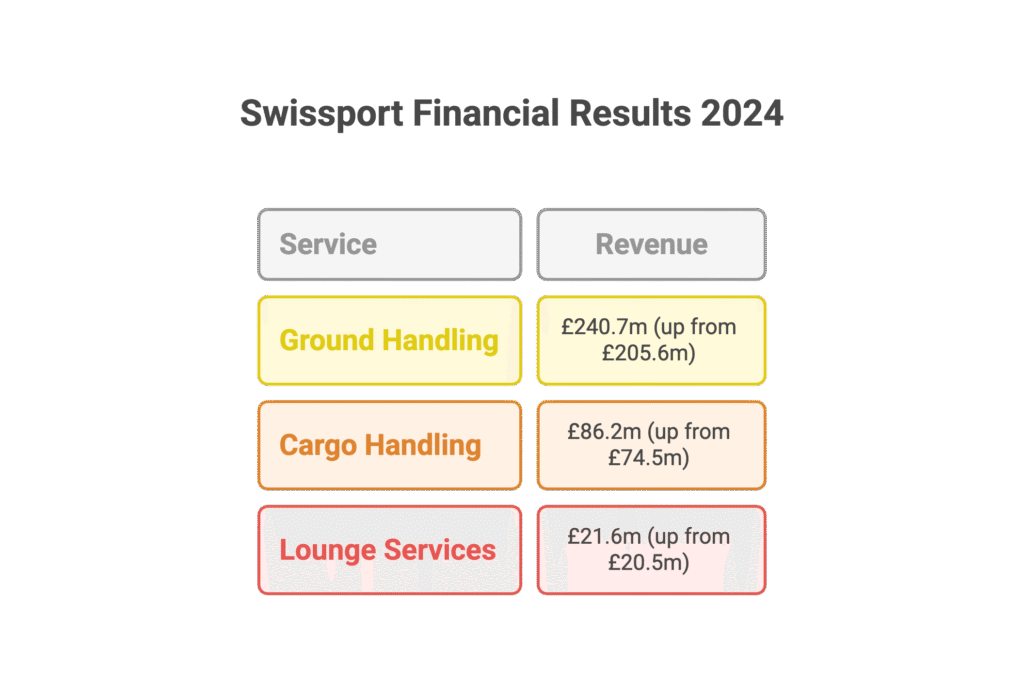
The breakdown tells an even sweeter story:
- Ground handling revenue: £240.7m (up from £205.6m)
- Cargo handling: £86.2m (up from £74.5m)
- Lounge services: £21.6m (up from £20.5m)
This marks Swissport UK’s second profitable year since 2018—demonstrating sustained aviation industry recovery after the pandemic downturn.
UK Aviation Jobs Market: Why Swissport’s Hiring Spree Matters
Creating 900 aviation jobs isn’t just good PR—it’s a bellwether for UK aviation industry health. When ground handling companies like Swissport are hiring aggressively, it means airlines are genuinely confident about passenger demand recovery, not just talking a good game.
Swissport’s UK employment surge follows 1,400 new hires in 2023, bringing total employment to levels that actually make sense for post-pandemic aviation operations. Sure, they’re still below their 2019 peak of 8,426 employees, but smart money says they’re building sustainably this time.

Aviation Industry Challenges 2025: Economic Headwinds Ahead
Swissport’s board is warning about aviation industry risks for 2025. Their official statement highlights key concerns: Ukraine war driving fuel costs up, Trump’s tariff threats creating market volatility, and UK interest rates at 5% squeezing consumer spending power.
Translation? Even successful aviation companies are nervous about recession risks hitting air travel demand in 2025.
Their solution? Flexibility through temporary staffing—they’re keeping one hand on the hiring accelerator and the other on the brake.
UK Aviation Recovery Outlook: What Swissport’s Success Means
Swissport’s financial performance suggests UK aviation isn’t just surviving—it’s finding its groove again. Ground handling profits don’t lie; they’re directly tied to actual planes moving actual passengers through UK airports.
The company’s cautious optimism (hire now, stay flexible later) probably reflects what most UK aviation executives are thinking: recovery is real, but fragile.
For aviation job seekers, this trend could signal broader hiring across the UK aviation sector. When the infrastructure companies are staffing up, airlines and airports typically follow.
FAQ
Q1: How does Swissport’s 278% profit increase compare to other UK aviation companies?
A: It’s exceptionally strong for ground handling services. Most UK aviation service companies are still rebuilding profit margins, making Swissport’s performance a genuine standout in the sector.
Q2: Why is Swissport concerned about UK aviation recession risks if they’re performing so well?
A: Ground handling is ultra-sensitive to passenger volume fluctuations. Even a 10-15% drop in UK air travel can quickly erode profits since their costs (staff, equipment) are largely fixed.
Q3: What does Swissport’s “temporary staffing” strategy mean for aviation job security?
A: It’s a mixed bag—more opportunities to get hired quickly in aviation, but potentially less job stability. Think gig economy meets aviation, designed to flex with seasonal and economic demand changes.
Q4: Is Swissport’s recovery representative of the whole UK aviation industry recovery?
A: Partially. Ground handling recovery typically leads airline profitability recovery by 6-12 months, so this could signal broader UK aviation sector strength ahead.
Q5: How significant is Swissport’s cargo handling revenue increase for UK aviation?
A: Very significant. Cargo handling is less passenger-dependent and more tied to global trade flows, suggesting Swissport is diversifying revenue streams smartly in the UK market.
DISCLAIMER
Effective Date: 15th July 2025
The information provided on this website is for informational and educational purposes only and reflects the personal opinions of the author(s). It is not intended as financial, investment, tax, or legal advice.
We are not certified financial advisers. None of the content on this website constitutes a recommendation to buy, sell, or hold any financial product, asset, or service. You should not rely on any information provided here to make financial decisions.
We strongly recommend that you:
- Conduct your own research and due diligence
- Consult with a qualified financial adviser or professional before making any investment or financial decisions
While we strive to ensure that all information is accurate and up to date, we make no guarantees about the completeness, reliability, or suitability of any content on this site.
By using this website, you acknowledge and agree that we are not responsible for any financial loss, damage, or decisions made based on the content presented.
MORE NEWS








Disclosure & Editorial Standards
MJBurrows is not authorised or regulated by the Financial Conduct Authority (FCA). The content on this website — including articles, calculators, and tools — is for general informational and educational purposes only. It does not constitute personal financial, investment, tax, or legal advice and does not take into account your individual circumstances, financial situation, or objectives.
Nothing on this site is a personal recommendation to buy, sell, hold, or otherwise deal in any financial product, asset, or service. You should always conduct your own research and seek advice from a qualified, FCA-regulated financial adviser before making any financial decisions.
Our calculators produce estimates based on simplified models using HMRC-published rates for the current tax year. They cannot account for every individual circumstance and should not be relied upon as exact figures. Tax rules and rates may change — verify current rates with HMRC or a qualified tax adviser.
Projections are not guarantees. Where our tools show future values (investment growth, pension projections, compound interest), these are hypothetical illustrations based on assumed growth rates. Past performance does not guarantee future results. The value of investments can go down as well as up.
Market data displayed on this site is provided by third-party sources including Twelve Data, Yahoo Finance, and CoinGecko. We do not guarantee the accuracy, completeness, or timeliness of third-party data.
This content is designed for UK residents and reflects UK tax rules, thresholds, and legislation. It may not apply to other jurisdictions.
Using this website does not create a professional-client relationship of any kind. MJBurrows is not responsible for any financial loss, damage, or decision made based on the content presented. By using this site, you accept these terms.
This disclaimer may be updated from time to time without prior notice. Last reviewed: 23 April 2026.
MJBurrows is an independent UK personal finance publication, written and edited by Matthew Burrows. There is no parent company, no investor group, and no advertising sales team — decisions about what to cover and how to frame it are made by Matthew alone. Our full Editorial Policy sets out how the site operates in detail.
Commercial model. As of April 2026, MJBurrows generates no revenue. The site carries no display advertising, no affiliate links, no sponsored content, no paid product placements, and no pay-for-coverage arrangements. If this changes in future, it will be disclosed openly on the Editorial Policy page.
Sources. Articles and tools reference primary sources — HM Revenue & Customs (HMRC), gov.uk, the Bank of England, the Office for National Statistics (ONS), the Financial Conduct Authority (FCA), Companies House, and UK government departmental publications (DWP, Treasury). Calculator data uses HMRC-published rates for the 2026/27 tax year. Market data (tickers, asset prices) is provided by Twelve Data, Yahoo Finance, and CoinGecko.
Verification. Every published article is fact-checked before going live. Numerical claims are traced to their primary source, quotes are checked against the original speaker or document, and calculator outputs are tested against HMRC worked examples. See our verification and accuracy policy for the full process.
Corrections. If you spot an error, please report it via the Corrections page. A three-tier severity system commits to specific response times:
- Tier 1 — Urgent (material reader harm, defamatory statements, regulatory or legal issues): acknowledged within 24 hours, page actioned within 24 hours, correction published within 48 hours of confirmation.
- Tier 2 — High (significant factual errors that misinform readers): acknowledged within 3 working days, correction published within 7 working days of confirmation.
- Tier 3 — Standard (minor factual errors, dated references, missing context): acknowledged within 7 working days, correction published at the next regular content review (within the quarter).
Significant corrections are logged on the public Corrections log.
Updates and review cadence. Calculators are reviewed at least quarterly, plus event-driven updates when HMRC publishes new rates (Budget, Autumn Statement, new tax year). Guides are reviewed at least twice a year, with major rewrites whenever underlying regulation changes. Tax-year-sensitive content is prioritised for review at the April tax-year transition.
Get in touch. For editorial enquiries — corrections, story tips, reader questions — the address is contact@mjburrows.com. The contact page is at mjburrows.com/contact. Every email is read personally by Matthew.