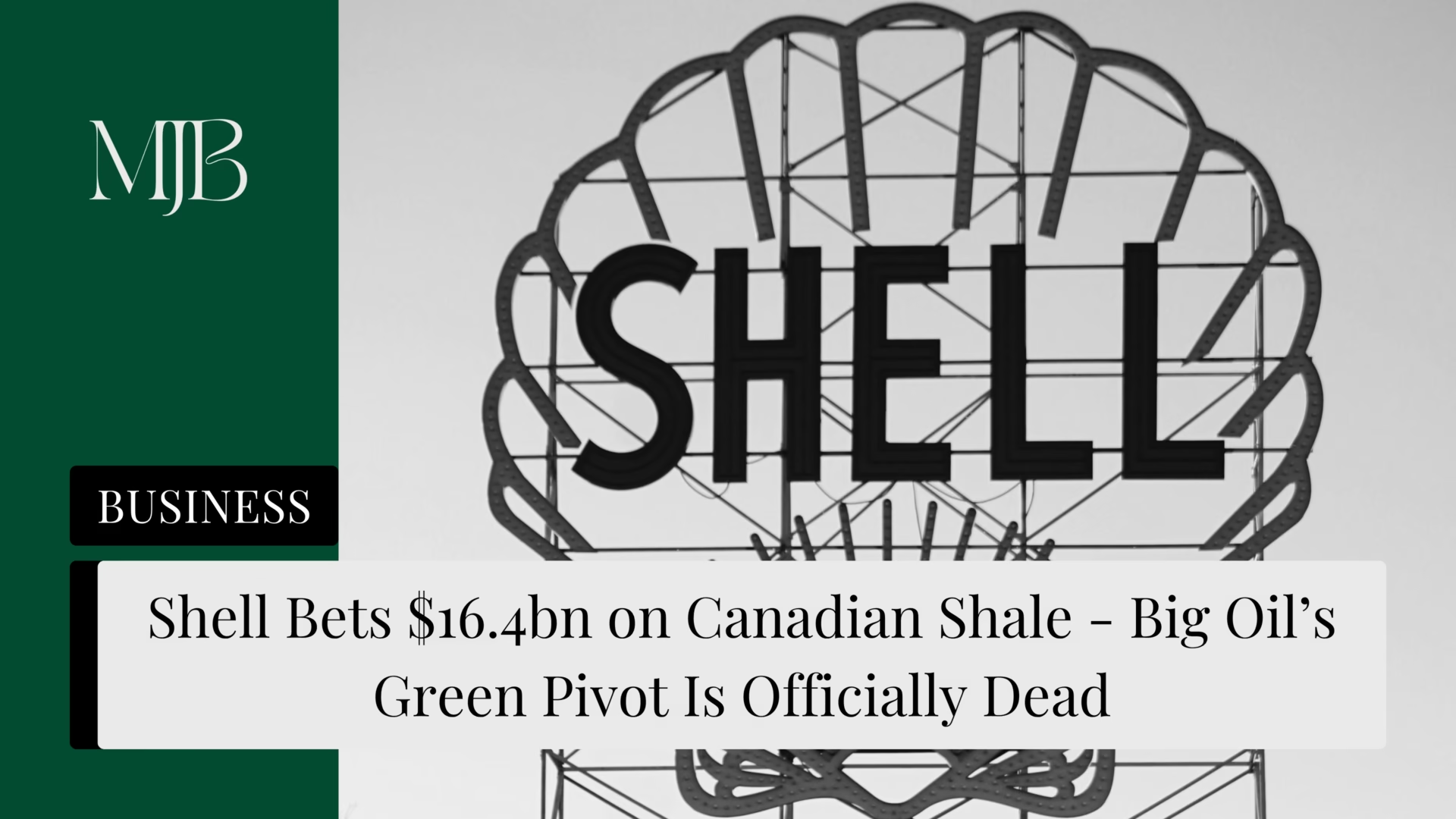
Picture Shell (LON: SHEL) three years ago: chasing wind farms, dabbling in hydrogen, telling investors it was on a journey to net zero. Now picture Shell today, signing a $16.4bn (~£12.1bn) cheque for a Canadian shale producer — its biggest deal in over a decade. That’s not a strategic refinement. That’s a complete vibe shift. The supermajor’s green pivot has quietly been declared dead, and the cheque has the signature to prove it. Here’s what’s actually in the ARC Resources deal, why CEO Wael Sawan pulled the trigger now, and what it tells you about where Big Oil’s next chapter is heading.
What’s Actually In The Deal
Here’s what’s actually in the ARC Resources deal, why CEO Wael Sawan pulled the trigger now, and what it tells you about where Big Oil’s next chapter is heading.
Shell will pay $16.4bn (~£12.1bn) for Canadian shale producer ARC Resources, structured as 25 per cent cash and 75 per cent shares — a 20 per cent premium to ARC’s 30-day average share price before the announcement. Both boards “unanimously supported” the transaction, with closing expected before the end of 2026 subject to ARC shareholder and regulatory approval.
The strategic logic is geography. ARC brings 1.5 million net acres of gas fields in Canada’s Montney region. Shell already has 440,000 acres in the same play. Stitching them together gives Shell what Sawan called “a heartland for Shell” — and on paper, the kind of long-life, low-cost gas reserves that justify the cheque.
The numbers Shell put behind it: 370,000 barrels of oil per day added to production, and double-digit returns on the deal itself. The target is 1.4 million barrels a day by 2030. The Montney basin matters because it sits in the lowest-cost quartile of North American gas plays — break-evens around the $2 per mmbtu mark, decades of drillable inventory, and direct LNG export optionality through the Canadian west coast. That’s exactly the kind of long-life, scaled gas resource Shell has openly wanted since Sawan took over.

Why Shell Just Killed Its Green Pivot
This is Sawan’s first big swing as CEO, and the message is unmistakable. His turnaround plan started conservative — cost cuts, balance-sheet shoring, getting out of underperforming side bets. The lubricant chain Jiffy Lube went. Several wind and hydrogen projects were quietly abandoned. Now the offence has started, and it’s pointing at hydrocarbons.
The pressure was real. Shareholders had been visibly impatient with Shell’s underperformance against US peers like ExxonMobil and Chevron, who never made the same green-detour Shell did. Reserves were ageing. Production growth was anaemic. The market wanted oil and gas tonnage, not transition theatre — and Sawan has now delivered.
What ties it together: Shell has formally raised its gas-output growth target to between 4 and 5 per cent annually by 2030, and total oil-and-gas output by 1 per cent. That’s not nothing. For a company that spent the late 2010s talking about “managing decline,” it’s a complete reversal of intent. The contrast with US peers is sharper than ever — ExxonMobil and Chevron never made the same green-detour Shell did, and have spent the last three years steadily acquiring shale assets while Shell was busy pitching wind farms. Sawan’s ARC deal is, in effect, Shell finally joining the same playbook the US majors never left.

What The Market Actually Did
Markets reacted in the textbook way. Shell shares closed 2 per cent lower on Monday — investors paying the acquirer’s discount. ARC shares jumped more than 20 per cent — the target gets the premium, the acquirer wears the dilution. Same pattern you see on every megadeal day.
The more interesting reaction came from analysts. AJ Bell’s Danni Hewsom flagged the elephant in the room: “Shell buying ARC puts to bed any hopes it will also buy BP (LON: BP) any time soon.” Shell-buying-BP rumours had been circulating for over a year — those are now off the table. Sawan can’t bed in a $16.4bn (~£12.1bn) Canadian acquisition AND launch a multi-billion-pound bid for a domestic rival in parallel. The capital, the management bandwidth, and the regulatory air cover all run out.
The wider context matters too. Shell’s stock is up 16 per cent since early February, when Donald Trump began sending warships to the Gulf. The Iran conflict has sent oil and gas prices higher, padding profits across the supermajor sector. In other words: Sawan is buying with strong currency.
What This Means For You
If you hold Shell shares, this is the moment the turnaround thesis becomes a real, measurable bet — and you can now hold it accountable to a number. Watch gas-output growth: the new 4-5 per cent target by 2030 is what the entire deal is staked on. If you hold ARC, you’ve just been handed a 20 per cent gift courtesy of the bidder’s premium. If you own a basket of UK energy, the read-through is that the BP-bid story is dead for now, which removes one upside driver from BP’s stock. And if you’ve been reading “Big Oil is going green” headlines for the last five years, treat this deal as the formal correction.

The Bottom Line
Shell’s $16.4bn (~£12.1bn) cheque for ARC Resources is the loudest signal in years that Big Oil’s pivot to renewables has been quietly buried — at least at the supermajor level. Sawan has made his first major bet, and it isn’t a wind farm. It’s Canadian shale. Investors who want to know whether the new strategy works should set one alarm: gas-output growth, 4-5 per cent annually by 2030. If Shell hits it, this deal looks brilliant. If it misses, this deal looks like the most expensive ego trip in recent oil-major history. Watch that number.
Want more like this? Sign up to The MJBurrows Briefing—our free weekly newsletter delivered every Monday morning.
FAQ
What is ARC Resources and why does Shell want it?
ARC Resources is a Canadian shale gas producer with 1.5 million net acres in the Montney region — one of North America’s most productive low-cost gas plays. Shell already operates 440,000 acres in the same area, so the acquisition consolidates a contiguous, scaled-up gas position rather than opening a new geography. The fit is unusually clean for a megadeal.
Why is Shell paying mostly in shares rather than cash?
A 25 per cent cash, 75 per cent shares structure protects Shell’s balance sheet and avoids loading the deal onto debt while interest rates are still elevated. It also ties ARC’s existing shareholders into Shell’s future — they don’t cash out, they ride along. The trade-off is dilution for existing Shell holders, which is partly why Shell shares dipped 2 per cent on the day.
What does this mean for the Shell-buys-BP rumours?
It puts them to bed for the foreseeable future. Sawan can’t realistically integrate a $16.4bn (~£12.1bn) Canadian acquisition AND launch a politically-charged bid for a domestic rival inside the same 18-24 month window. BP investors who were holding on the takeout-premium thesis will need a new reason to stay.
Is Shell still pursuing any green energy investments?
In name, yes — Shell hasn’t formally exited renewables. In practise, the centre of gravity has shifted hard. Sawan has cancelled or wound down several wind and hydrogen projects since taking over, and the 4-5 per cent gas growth target now sits at the centre of strategy. The renewable arm is no longer the headline story.
What’s the realistic risk this deal underperforms?
Two big ones. First, gas prices: if Henry Hub or LNG benchmarks soften meaningfully through 2027-28, the projected double-digit returns thin out fast. Second, integration risk — Shell hasn’t done a deal this big in over a decade, and operational frictions in scaling Canadian shale production are non-trivial. ARC’s 20 per cent share-price jump on the day suggests the market thinks Shell paid full price.


Disclosure & Editorial Standards
MJBurrows is not authorised or regulated by the Financial Conduct Authority (FCA). The content on this website — including articles, calculators, and tools — is for general informational and educational purposes only. It does not constitute personal financial, investment, tax, or legal advice and does not take into account your individual circumstances, financial situation, or objectives.
Nothing on this site is a personal recommendation to buy, sell, hold, or otherwise deal in any financial product, asset, or service. You should always conduct your own research and seek advice from a qualified, FCA-regulated financial adviser before making any financial decisions.
Our calculators produce estimates based on simplified models using HMRC-published rates for the current tax year. They cannot account for every individual circumstance and should not be relied upon as exact figures. Tax rules and rates may change — verify current rates with HMRC or a qualified tax adviser.
Projections are not guarantees. Where our tools show future values (investment growth, pension projections, compound interest), these are hypothetical illustrations based on assumed growth rates. Past performance does not guarantee future results. The value of investments can go down as well as up.
Market data displayed on this site is provided by third-party sources including Twelve Data, Yahoo Finance, and CoinGecko. We do not guarantee the accuracy, completeness, or timeliness of third-party data.
This content is designed for UK residents and reflects UK tax rules, thresholds, and legislation. It may not apply to other jurisdictions.
Using this website does not create a professional-client relationship of any kind. MJBurrows is not responsible for any financial loss, damage, or decision made based on the content presented. By using this site, you accept these terms.
This disclaimer may be updated from time to time without prior notice. Last reviewed: 23 April 2026.
MJBurrows is an independent UK personal finance publication, written and edited by Matthew Burrows. There is no parent company, no investor group, and no advertising sales team — decisions about what to cover and how to frame it are made by Matthew alone. Our full Editorial Policy sets out how the site operates in detail.
Commercial model. As of April 2026, MJBurrows generates no revenue. The site carries no display advertising, no affiliate links, no sponsored content, no paid product placements, and no pay-for-coverage arrangements. If this changes in future, it will be disclosed openly on the Editorial Policy page.
Sources. Articles and tools reference primary sources — HM Revenue & Customs (HMRC), gov.uk, the Bank of England, the Office for National Statistics (ONS), the Financial Conduct Authority (FCA), Companies House, and UK government departmental publications (DWP, Treasury). Calculator data uses HMRC-published rates for the 2026/27 tax year. Market data (tickers, asset prices) is provided by Twelve Data, Yahoo Finance, and CoinGecko.
Verification. Every published article is fact-checked before going live. Numerical claims are traced to their primary source, quotes are checked against the original speaker or document, and calculator outputs are tested against HMRC worked examples. See our verification and accuracy policy for the full process.
Corrections. If you spot an error, please report it via the Corrections page. A three-tier severity system commits to specific response times:
- Tier 1 — Urgent (material reader harm, defamatory statements, regulatory or legal issues): acknowledged within 24 hours, page actioned within 24 hours, correction published within 48 hours of confirmation.
- Tier 2 — High (significant factual errors that misinform readers): acknowledged within 3 working days, correction published within 7 working days of confirmation.
- Tier 3 — Standard (minor factual errors, dated references, missing context): acknowledged within 7 working days, correction published at the next regular content review (within the quarter).
Significant corrections are logged on the public Corrections log.
Updates and review cadence. Calculators are reviewed at least quarterly, plus event-driven updates when HMRC publishes new rates (Budget, Autumn Statement, new tax year). Guides are reviewed at least twice a year, with major rewrites whenever underlying regulation changes. Tax-year-sensitive content is prioritised for review at the April tax-year transition.
Get in touch. For editorial enquiries — corrections, story tips, reader questions — the address is contact@mjburrows.com. The contact page is at mjburrows.com/contact. Every email is read personally by Matthew.