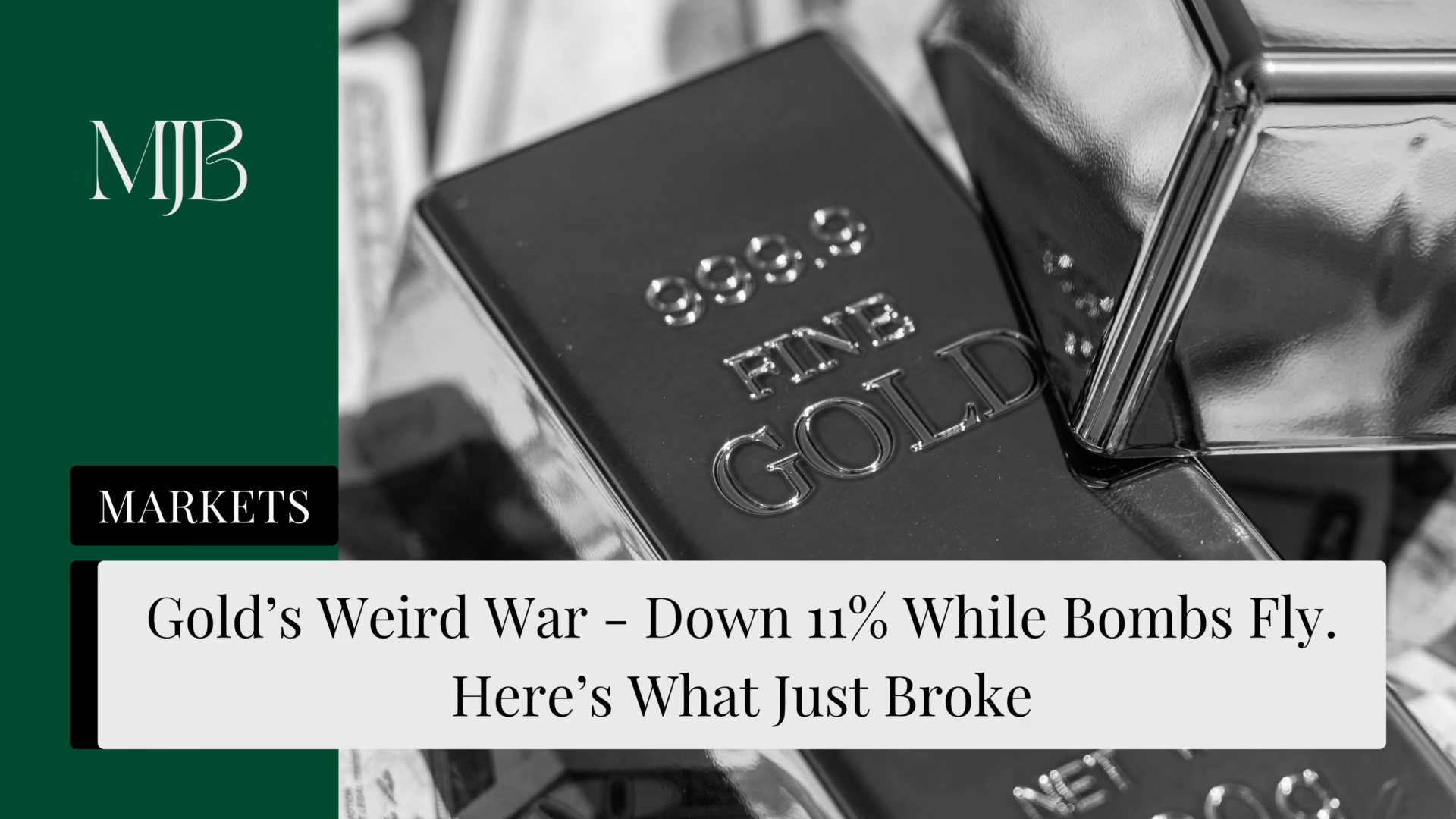
Wars are supposed to be good for gold. The narrative is older than the modern dollar: bombs fly, oil spikes, smart money runs to bullion, gold rallies. Except this time, gold isn’t reading the script. Two months into the Iran-US war, with the Strait of Hormuz blocked and energy prices surging, spot gold sits near $4,697 an ounce — down roughly 11% since the conflict began at the end of February. The “crisis hedge” story everyone has invoked since 1971 just broke in front of our eyes. Here’s what’s actually moving the price, the deal Iran just put on the table, and what this week’s central bank decisions could do to the trade.
The Numbers Tell A Strange Story
Spot gold was up 0.3% to $4,697.49 an ounce by Tuesday morning Singapore time, after slipping 0.6% on Monday. That sounds like ordinary price action — but zoom out and the picture is uncomfortable. Gold has lost about 11% since the conflict started at the end of February. That’s not a rally being interrupted. That’s a sustained slide while the war intensifies.
The wider precious metals complex has been mixed. Silver rose 0.7% to $76.03 an ounce, with platinum and palladium also advancing. The Bloomberg Dollar Spot Stock Index" tabindex="0" role="button" aria-label="Stock Index definition">Index — a gauge of the US currency — was marginally lower after dipping 0.1% on Monday. So the dollar isn’t the story here either. The disconnect is gold-specific: the asset that should be benefitting most from war and inflation is the one underperforming the rest of the basket.
That breaks a half-century pattern. Through the 1973 oil shock, the 1979 Iranian revolution, the 1990 Gulf War, and the 2003 Iraq invasion, gold rallied while bombs fell. The current divergence is what makes this market interesting. Either gold has lost its safe-haven status, or something else is suppressing it harder than war is lifting it. The evidence points firmly to option two.

Why Gold Isn’t Rallying — The Rate-Hike Trap
Gold pays no yield, so when central banks hold rates high — or worse, hike them — bullion looks expensive next to a 5% money-market account.
The “something else” is interest rates. Gold pays no yield, so when central banks hold rates high — or worse, hike them — bullion looks expensive next to a 5% money-market account. The Iran war’s energy-supply shock has revived inflation. That’s pushed traders to price in a longer-for-higher rate path from the Fed, ECB and Bank of England, exactly the opposite of what gold needs to rally.
Marc Loeffert, a trader at Heraeus Precious Metals, framed it cleanly. “The indefinite extension of the ceasefire, with Hormuz still blocked, prolongs market uncertainty,” he said in a recent client note. “In the long run, the combination of economic stagnation and rising prices could provide fertile ground for the gold bull market to continue.” The first half is what’s hurting gold today. The second half is the bull case for tomorrow — but only if rate-hike risk recedes.
The rates story matters this week, specifically. The Fed, ECB, Bank of Japan, Bank of England and Bank of Canada all have policy decisions in the next five trading sessions. If even one of them hikes, the rate-hike thesis gets validated and gold loses more ground. If they all hold or cut despite inflation, the safe-haven trade gets a green light again. That’s the binary all gold positioning is now hostage to.

The Hormuz Trade — Iran’s Interim Offer
The diplomatic plot is also moving. Tehran has reportedly proposed an interim deal: reopen the Strait of Hormuz in exchange for Washington ending its blockade of ships moving to and from Iranian ports. The standoff has reduced daily transits via the strategic waterway to near zero, choking off flows of crude, natural gas and oil products. If the deal happens, the energy shock unwinds, inflation expectations cool, and the rate-hike risk above this whole gold trade evaporates.
Donald Trump convened a meeting of national security officials to discuss the proposal but maintained “red lines” on any deal to end the conflict, White House Press Secretary Karoline Leavitt said. The Iranian offer also explicitly postpones more complex negotiations over the country’s nuclear programme, which is the harder ask. So this is a tactical de-escalation pitch — not a peace deal — designed to reopen the world’s most important oil chokepoint without resolving the deeper conflict.
If accepted, the oil-price relief feeds straight through to inflation expectations and rate paths, and gold’s headwind eases. If rejected, the war’s energy disruption continues, central banks stay defensive on inflation, and gold’s slide can extend further. The asymmetry favours watching for any signal of acceptance — that’s the catalyst that flips the gold trade back to bullish.

What This Means For You
If you hold gold or a gold ETF, the next five trading days carry outsized risk. Two binary catalysts — central bank decisions and any movement on the Iran proposal — could move the price 5% either way. If you don’t hold gold, the read-through is broader: the “crisis hedge” framing being tested in real time means defensive portfolio allocations need rethinking. Gold’s correlation with crisis isn’t as reliable as the textbooks claim. And if you’re watching from the sidelines, this is one of the more interesting setups bullion has offered in years — strong fundamentals on the upside (inflation, geopolitical risk) running into a hard ceiling from rate policy.
The Bottom Line
The “crisis hedge” play stopped working — at least for now. Gold’s 11% slide while a real war rages tells you the market has decided rate-hike risk beats safe-haven demand. Watch one signal this week: if the Fed, ECB and Bank of England all hold or cut despite inflation, gold’s bull thesis comes back fast. If even one hikes, gold goes lower. You’ll know which trade is alive within five trading days — set the alarm now.
Want more like this? Sign up to The MJBurrows Briefing—our free weekly newsletter delivered every Monday morning.
FAQ
Why is gold down when there’s a war happening?
Because interest-rate expectations are dominating safe-haven demand. The energy-supply shock from the Iran war has lifted inflation, which makes central banks more likely to hold rates high or hike. Gold pays no yield, so high rates are a direct headwind. Wars usually rally gold; this war is being out-muscled by the rate path it created.
What’s the Strait of Hormuz and why does it matter?
A narrow waterway between Iran and Oman through which roughly 20% of global crude oil and a third of seaborne LNG normally flows. The Iran conflict has reduced daily transits to near zero, choking energy supplies into Asia and Europe. Reopening it is the single biggest lever to unwind the inflation shock — which is why Iran’s offer to reopen it is the most market-relevant news this week.
How much should I read into gold’s 11% drop?
Less than the headline suggests. The 11% covers two months — annualised, that’s a meaningful move but not catastrophic. The bigger signal is the divergence: silver, platinum and palladium are advancing while gold isn’t. That tells you the move is rate-driven, not safety-driven. Industrial metals (silver/platinum) benefit from inflation differently than monetary gold does.
What would make gold rally again?
Three things, any one of which would help: the Fed/ECB/BoE all hold or cut despite inflation, Iran and the US strike the interim Hormuz deal, OR a clear sign that inflation is rolling over despite oil. The first two are this week’s binary catalysts. The third is a longer story that won’t resolve before the autumn data.
What about silver and other precious metals?
Silver, platinum and palladium are all up while gold isn’t. That’s because they have meaningful industrial demand — cars, solar panels, electronics — so they benefit from the “growth holds up despite war” thesis. Gold is more purely monetary. If you want to play the broader precious-metals complex without the rate-hike risk, silver has been the cleaner trade through this cycle.

Disclosure & Editorial Standards
MJBurrows is not authorised or regulated by the Financial Conduct Authority (FCA). The content on this website — including articles, calculators, and tools — is for general informational and educational purposes only. It does not constitute personal financial, investment, tax, or legal advice and does not take into account your individual circumstances, financial situation, or objectives.
Nothing on this site is a personal recommendation to buy, sell, hold, or otherwise deal in any financial product, asset, or service. You should always conduct your own research and seek advice from a qualified, FCA-regulated financial adviser before making any financial decisions.
Our calculators produce estimates based on simplified models using HMRC-published rates for the current tax year. They cannot account for every individual circumstance and should not be relied upon as exact figures. Tax rules and rates may change — verify current rates with HMRC or a qualified tax adviser.
Projections are not guarantees. Where our tools show future values (investment growth, pension projections, compound interest), these are hypothetical illustrations based on assumed growth rates. Past performance does not guarantee future results. The value of investments can go down as well as up.
Market data displayed on this site is provided by third-party sources including Twelve Data, Yahoo Finance, and CoinGecko. We do not guarantee the accuracy, completeness, or timeliness of third-party data.
This content is designed for UK residents and reflects UK tax rules, thresholds, and legislation. It may not apply to other jurisdictions.
Using this website does not create a professional-client relationship of any kind. MJBurrows is not responsible for any financial loss, damage, or decision made based on the content presented. By using this site, you accept these terms.
This disclaimer may be updated from time to time without prior notice. Last reviewed: 23 April 2026.
MJBurrows is an independent UK personal finance publication, written and edited by Matthew Burrows. There is no parent company, no investor group, and no advertising sales team — decisions about what to cover and how to frame it are made by Matthew alone. Our full Editorial Policy sets out how the site operates in detail.
Commercial model. As of April 2026, MJBurrows generates no revenue. The site carries no display advertising, no affiliate links, no sponsored content, no paid product placements, and no pay-for-coverage arrangements. If this changes in future, it will be disclosed openly on the Editorial Policy page.
Sources. Articles and tools reference primary sources — HM Revenue & Customs (HMRC), gov.uk, the Bank of England, the Office for National Statistics (ONS), the Financial Conduct Authority (FCA), Companies House, and UK government departmental publications (DWP, Treasury). Calculator data uses HMRC-published rates for the 2026/27 tax year. Market data (tickers, asset prices) is provided by Twelve Data, Yahoo Finance, and CoinGecko.
Verification. Every published article is fact-checked before going live. Numerical claims are traced to their primary source, quotes are checked against the original speaker or document, and calculator outputs are tested against HMRC worked examples. See our verification and accuracy policy for the full process.
Corrections. If you spot an error, please report it via the Corrections page. A three-tier severity system commits to specific response times:
- Tier 1 — Urgent (material reader harm, defamatory statements, regulatory or legal issues): acknowledged within 24 hours, page actioned within 24 hours, correction published within 48 hours of confirmation.
- Tier 2 — High (significant factual errors that misinform readers): acknowledged within 3 working days, correction published within 7 working days of confirmation.
- Tier 3 — Standard (minor factual errors, dated references, missing context): acknowledged within 7 working days, correction published at the next regular content review (within the quarter).
Significant corrections are logged on the public Corrections log.
Updates and review cadence. Calculators are reviewed at least quarterly, plus event-driven updates when HMRC publishes new rates (Budget, Autumn Statement, new tax year). Guides are reviewed at least twice a year, with major rewrites whenever underlying regulation changes. Tax-year-sensitive content is prioritised for review at the April tax-year transition.
Get in touch. For editorial enquiries — corrections, story tips, reader questions — the address is contact@mjburrows.com. The contact page is at mjburrows.com/contact. Every email is read personally by Matthew.