Introduction
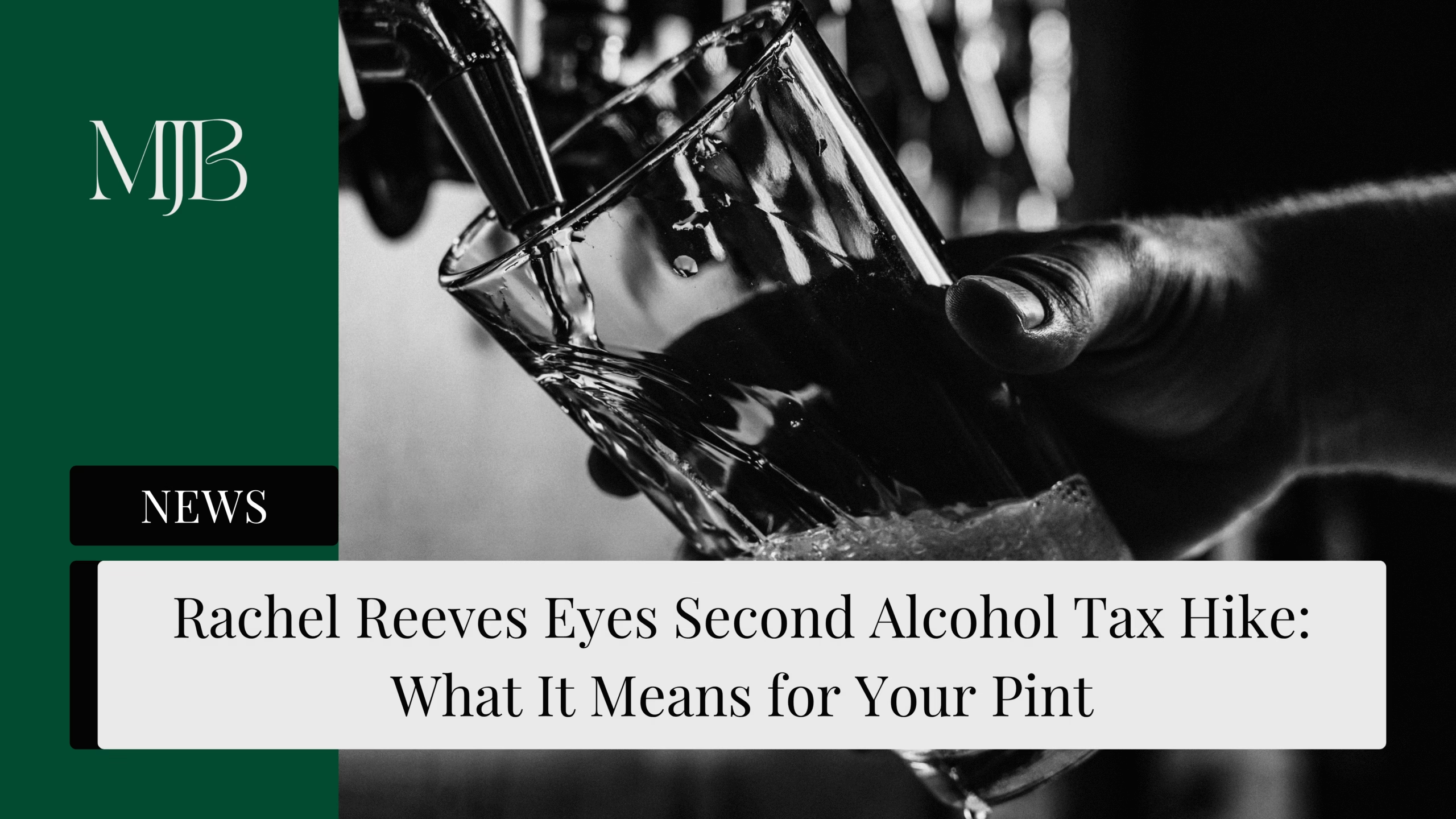
Your Friday night pint might be about to get pricier. Again. Chancellor Rachel Reeves is reportedly considering another alcohol duty increase—this time by 4.5%—to help plug a £30bn budget hole. Sound familiar? That’s because we saw this exact move last year, when duties jumped 3.6% and added up to 54p to wine and spirits. Now pubs are sounding the alarm, inflation’s giving the Treasury ideas, and your wallet’s caught in the middle. Here’s what’s actually going on.
Why Another Booze Tax?
The £30bn Problem
Reeves is staring down an estimated £30bn fiscal shortfall, and alcohol duties are back on the chopping block. The plan? Hike duties in line with the Retail Prices Index (RPI), which hit 4.5% in September—notably higher than the more common Consumer Prices Index (CPI) at 3.8%.
Last year’s 3.6% increase already pushed wine and gin prices up by as much as 54p per bottle. Beer got a slight reprieve with some duty reductions, but the overall trend is clear: drinking’s getting more expensive.
RPI vs CPI: Why It Matters
The government’s leaning on RPI rather than CPI, and that’s not accidental. RPI typically runs higher than CPI, which means bigger tax hikes. For the Treasury, it’s a straightforward revenue boost. For consumers and businesses? Not so much.

The Pub Industry Pushes Back
Closures on the Horizon
The British Beer and Pubs Association are clear in their words: they’re projecting one pub closure per day throughout 2025 if current trends continue. UK Hospitality has echoed these concerns, warning of mass job losses across the sector.
Labour and Conservative MPs have both told broadcasters that further alcohol tax hikes risk accelerating pub closures, particularly in struggling communities where local pubs are already hanging by a thread.
Lib Dems Propose Alternative: Cut VAT Instead
The Liberal Democrats are pushing a different approach—a 5% VAT cut for pubs and restaurants, funded by a windfall tax on banks that could raise £30bn over five years.
Deputy leader Daisy Cooper framed it as protecting “small joys” like Friday fish and chips or weekend cinema trips, which are becoming luxuries for cash-strapped families dealing with high bills and food inflation.
Industry Lobbying Intensifies
Scotch Whisky Calls for Duty Freeze
Trade bodies representing Scotch whisky have written directly to Reeves, urging a spirits duty freeze. Liz Camero from the Scottish Chambers of Commerce called it “an investment in British business, British exports, and British jobs”—not a handout.
It’s a fair point. Scotch whisky is one of the UK’s most successful export industries, and higher duties don’t just hit domestic drinkers—they affect international competitiveness too.
The Numbers Don’t Always Add Up
OBR Forecast Errors
The Office for Budget Responsibility (OBR) has a track record of overestimating sin tax receipts. Between 2022 and 2023, their forecasts for excise and fuel duties consistently came in too high.
That means the government might not actually raise as much revenue from these hikes as they hope—especially if consumers cut back or shift to cheaper alternatives.
Sin Taxes Are Shrinking
Analysis by UHY Hacker Young shows sin taxes have dropped from 4.3% to 2.8% of total government revenue. Translation? These levies aren’t the cash cow they used to be.
Even proposed gambling tax increases—floated by Gordon Brown as a way to scrap the two-child benefit cap—might not hit the £3bn target some politicians are citing.

What Happens Next?
The Treasury has declined to comment on budget speculation, which is standard practice ahead of the Autumn Budget. But the signs are pointing towards another duty increase, barring a last-minute policy shift.
For pub-goers, that means higher prices. For the industry, it means tighter margins and tougher decisions. And for Reeves, it’s a balancing act between raising revenue and not throttling an already fragile sector.
Conclusion
Another alcohol tax hike might help Reeves fill short-term budget gaps, but the long-term consequences for pubs and jobs are real. With closures already climbing and industry bodies pushing back hard, the government faces a tough call. Keep an eye on the Autumn Budget—your next round depends on it.
FAQ
Q1: Will beer prices go up if the alcohol tax increases?
A: Likely, yes. Last year’s 3.6% duty hike pushed up wine and spirits significantly, though some beer categories saw small reductions. This time, the proposed 4.5% increase would probably hit most alcohol types, including beer.
Q2: Why is the government using RPI instead of CPI for alcohol duties?
A: RPI tends to run higher than CPI, which means bigger tax increases and more revenue for the Treasury. It’s not the measure most economists prefer, but it’s more lucrative for government coffers.
Q3: How many pubs are actually closing?
A: The British Beer and Pubs Association estimates one pub per day will close in 2025 based on current trends. Rising costs, lower footfall, and higher taxes are all contributing factors.
Q4: Could the proposed Lib Dem VAT cut actually happen?
A: It’s unlikely in the short term. The proposal would require a windfall tax on banks to fund it, which hasn’t gained traction with Labour or the Conservatives. It’s more of a positioning statement than imminent policy.
Q5: Do sin taxes actually raise the revenue governments expect?
A: Not always. The OBR has consistently overestimated excise duty receipts in recent years, and sin taxes now make up a smaller share of total revenue than before. Higher duties can backfire if people simply drink less or switch to cheaper options.
DISCLAIMER
Effective Date: 15th July 2025
The information provided on this website is for informational and educational purposes only and reflects the personal opinions of the author(s). It is not intended as financial, investment, tax, or legal advice.
We are not certified financial advisers. None of the content on this website constitutes a recommendation to buy, sell, or hold any financial product, asset, or service. You should not rely on any information provided here to make financial decisions.
We strongly recommend that you:
- Conduct your own research and due diligence
- Consult with a qualified financial adviser or professional before making any investment or financial decisions
While we strive to ensure that all information is accurate and up to date, we make no guarantees about the completeness, reliability, or suitability of any content on this site.
By using this website, you acknowledge and agree that we are not responsible for any financial loss, damage, or decisions made based on the content presented.
MORE NEWS







Disclosure & Editorial Standards
MJBurrows is not authorised or regulated by the Financial Conduct Authority (FCA). The content on this website — including articles, calculators, and tools — is for general informational and educational purposes only. It does not constitute personal financial, investment, tax, or legal advice and does not take into account your individual circumstances, financial situation, or objectives.
Nothing on this site is a personal recommendation to buy, sell, hold, or otherwise deal in any financial product, asset, or service. You should always conduct your own research and seek advice from a qualified, FCA-regulated financial adviser before making any financial decisions.
Our calculators produce estimates based on simplified models using HMRC-published rates for the current tax year. They cannot account for every individual circumstance and should not be relied upon as exact figures. Tax rules and rates may change — verify current rates with HMRC or a qualified tax adviser.
Projections are not guarantees. Where our tools show future values (investment growth, pension projections, compound interest), these are hypothetical illustrations based on assumed growth rates. Past performance does not guarantee future results. The value of investments can go down as well as up.
Market data displayed on this site is provided by third-party sources including Twelve Data, Yahoo Finance, and CoinGecko. We do not guarantee the accuracy, completeness, or timeliness of third-party data.
This content is designed for UK residents and reflects UK tax rules, thresholds, and legislation. It may not apply to other jurisdictions.
Using this website does not create a professional-client relationship of any kind. MJBurrows is not responsible for any financial loss, damage, or decision made based on the content presented. By using this site, you accept these terms.
This disclaimer may be updated from time to time without prior notice. Last reviewed: 23 April 2026.
MJBurrows is an independent UK personal finance publication, written and edited by Matthew Burrows. There is no parent company, no investor group, and no advertising sales team — decisions about what to cover and how to frame it are made by Matthew alone. Our full Editorial Policy sets out how the site operates in detail.
Commercial model. As of April 2026, MJBurrows generates no revenue. The site carries no display advertising, no affiliate links, no sponsored content, no paid product placements, and no pay-for-coverage arrangements. If this changes in future, it will be disclosed openly on the Editorial Policy page.
Sources. Articles and tools reference primary sources — HM Revenue & Customs (HMRC), gov.uk, the Bank of England, the Office for National Statistics (ONS), the Financial Conduct Authority (FCA), Companies House, and UK government departmental publications (DWP, Treasury). Calculator data uses HMRC-published rates for the 2026/27 tax year. Market data (tickers, asset prices) is provided by Twelve Data, Yahoo Finance, and CoinGecko.
Verification. Every published article is fact-checked before going live. Numerical claims are traced to their primary source, quotes are checked against the original speaker or document, and calculator outputs are tested against HMRC worked examples. See our verification and accuracy policy for the full process.
Corrections. If you spot an error, please report it via the Corrections page. A three-tier severity system commits to specific response times:
- Tier 1 — Urgent (material reader harm, defamatory statements, regulatory or legal issues): acknowledged within 24 hours, page actioned within 24 hours, correction published within 48 hours of confirmation.
- Tier 2 — High (significant factual errors that misinform readers): acknowledged within 3 working days, correction published within 7 working days of confirmation.
- Tier 3 — Standard (minor factual errors, dated references, missing context): acknowledged within 7 working days, correction published at the next regular content review (within the quarter).
Significant corrections are logged on the public Corrections log.
Updates and review cadence. Calculators are reviewed at least quarterly, plus event-driven updates when HMRC publishes new rates (Budget, Autumn Statement, new tax year). Guides are reviewed at least twice a year, with major rewrites whenever underlying regulation changes. Tax-year-sensitive content is prioritised for review at the April tax-year transition.
Get in touch. For editorial enquiries — corrections, story tips, reader questions — the address is contact@mjburrows.com. The contact page is at mjburrows.com/contact. Every email is read personally by Matthew.