
Remember when “buying local” was just a feel-good slogan? With UK employment sliding and unemployment hitting a four-year high of 4.7%, Rachel Reeves is telling government departments to prioritise British jobs in public contracts.
The timing’s telling – someone needs to take the wheel before this economic slide gets worse.
The Cabinet Memo That’s Got Everyone Talking
Reeves and Pat McFadden (Chancellor to the Duchy of Lancaster – yes, that’s a real job) fired off a letter to cabinet ministers with a simple message: make every government pound work for British workers.
Their game plan? Use the billions spent on transport and infrastructure projects as a jobs creation machine. They want departments to “ensure the creation of British jobs, productivity-enhancing opportunities, and skills are prioritised in every major contract.”
Translation: if you’re bidding for government work, you better show how you’ll boost UK employment.
Small Firms Get a Lifeline
The duo also wants more spending funneled to smaller companies. Makes sense – these firms often struggle to compete against established giants who’ve mastered the art of winning government contracts while their coffee’s still hot.
“Every department needs to be pulling this procurement lever to support economic growth,” they wrote. It’s like turning government spending into a Swiss Army knife for job creation.

The Numbers Don’t Lie (And They’re Not Pretty)
Here’s where things get uncomfortable. The Office for National Statistics just released some brutal figures:
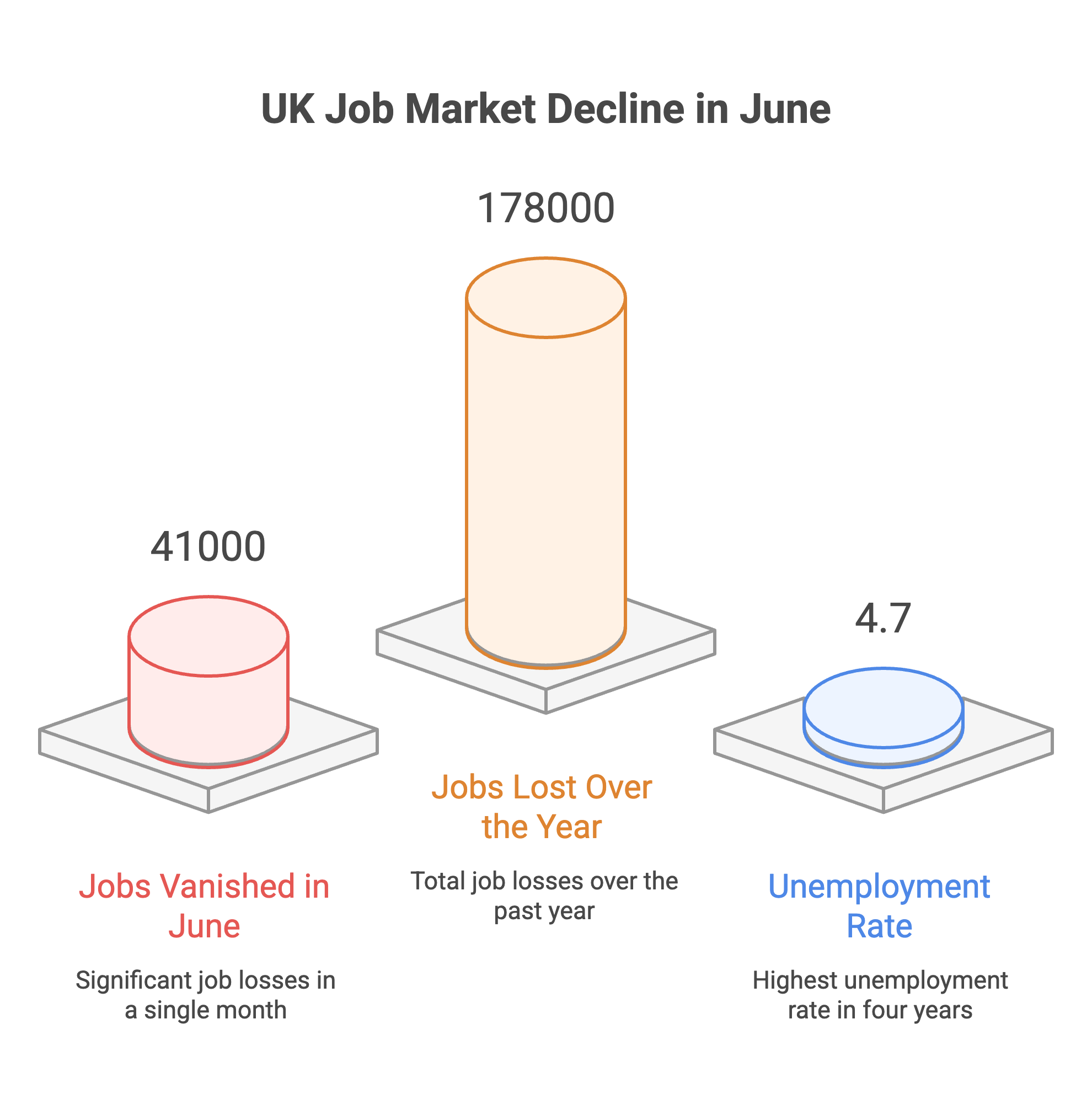
- 41,000 jobs vanished from payrolls in June alone
- 178,000 people lost work over the year to June
- Unemployment rate climbed to 4.7% – the highest in four years
Economists are pointing fingers at Reeves’ £20bn tax raid from her Autumn Budget. Companies faced with higher costs did what companies do – they cut jobs and raised prices. Inflation? Up 3.6% year-on-year.
It’s like watching a slow-motion economic domino effect.
When Growth Goes in Reverse
Remember all that talk about economic growth? Yeah, about that. The UK economy actually shrank 0.1% in June when economists expected it to grow. This followed April’s 0.3% contraction.
Reeves’ growth agenda isn’t just stalling – it’s running backwards. That’s got to sting when your whole political brand is built on being the “growth Chancellor.”
The Procurement Revolution
McFadden’s pushing for an overhaul of public procurement rules that would let government bodies prioritise companies proving they’ll create British jobs. Think of it as affirmative action for employment.
This applies to major transport projects, hospital construction, school building – basically anywhere the government writes big checks. And before you ask, yes, this can be done within existing trade agreements. Other countries already do it.

What This Actually Means
This isn’t just political theatre. When you’re haemorrhaging jobs and growth is flatlining, government procurement becomes one of the few levers left to pull. It’s economic jujitsu – using the government’s buying power to create the jobs the private sector isn’t delivering.
The Bottom Line
Reeves is betting big on government spending to fix what her tax hikes broke. With unemployment climbing and growth in reverse, this procurement push could be a lifeline for British workers. Whether it works fast enough to stop the economic slide remains the £20bn question.
Want to stay ahead of UK economic policy changes? Keep watching how this procurement overhaul plays out – it could reshape how government contracts work for years to come.
FAQ
Q1: Is this “Buy British” policy legal under international trade rules?
A: Yes, according to Reeves and McFadden. They specifically noted this can be done “within our trade agreements, as other countries do.” The key is structuring contracts to prioritise job creation rather than explicitly excluding foreign companies.
Q2: How much government spending are we talking about?
A: The letter mentions “billions in public spending on transport and infrastructure projects.” While exact figures weren’t specified, UK government procurement typically runs into tens of billions annually across all departments.
Q3: Will this actually create jobs given the current economic climate?
A: That remains to be seen. With 178,000 jobs lost in the past year and companies still adjusting to tax increases, even prioritising British jobs in contracts might not offset broader economic headwinds.
Q4: What types of projects will be affected?
A: Major transport projects, hospital construction, school building, and other large infrastructure schemes. Essentially any significant government contract where job creation can be measured and prioritised.
Q5: How quickly could we see results from this policy?
A: Government contracts often take months to negotiate and award, then more time to create actual jobs. Don’t expect immediate relief from current unemployment figures, but impacts could be visible within 6-12 months.
DISCLAIMER
Effective Date: 15th July 2025
The information provided on this website is for informational and educational purposes only and reflects the personal opinions of the author(s). It is not intended as financial, investment, tax, or legal advice.
We are not certified financial advisers. None of the content on this website constitutes a recommendation to buy, sell, or hold any financial product, asset, or service. You should not rely on any information provided here to make financial decisions.
We strongly recommend that you:
- Conduct your own research and due diligence
- Consult with a qualified financial adviser or professional before making any investment or financial decisions
While we strive to ensure that all information is accurate and up to date, we make no guarantees about the completeness, reliability, or suitability of any content on this site.
By using this website, you acknowledge and agree that we are not responsible for any financial loss, damage, or decisions made based on the content presented.
MORE NEWS








Disclosure & Editorial Standards
MJBurrows is not authorised or regulated by the Financial Conduct Authority (FCA). The content on this website — including articles, calculators, and tools — is for general informational and educational purposes only. It does not constitute personal financial, investment, tax, or legal advice and does not take into account your individual circumstances, financial situation, or objectives.
Nothing on this site is a personal recommendation to buy, sell, hold, or otherwise deal in any financial product, asset, or service. You should always conduct your own research and seek advice from a qualified, FCA-regulated financial adviser before making any financial decisions.
Our calculators produce estimates based on simplified models using HMRC-published rates for the current tax year. They cannot account for every individual circumstance and should not be relied upon as exact figures. Tax rules and rates may change — verify current rates with HMRC or a qualified tax adviser.
Projections are not guarantees. Where our tools show future values (investment growth, pension projections, compound interest), these are hypothetical illustrations based on assumed growth rates. Past performance does not guarantee future results. The value of investments can go down as well as up.
Market data displayed on this site is provided by third-party sources including Twelve Data, Yahoo Finance, and CoinGecko. We do not guarantee the accuracy, completeness, or timeliness of third-party data.
This content is designed for UK residents and reflects UK tax rules, thresholds, and legislation. It may not apply to other jurisdictions.
Using this website does not create a professional-client relationship of any kind. MJBurrows is not responsible for any financial loss, damage, or decision made based on the content presented. By using this site, you accept these terms.
This disclaimer may be updated from time to time without prior notice. Last reviewed: 23 April 2026.
MJBurrows is an independent UK personal finance publication, written and edited by Matthew Burrows. There is no parent company, no investor group, and no advertising sales team — decisions about what to cover and how to frame it are made by Matthew alone. Our full Editorial Policy sets out how the site operates in detail.
Commercial model. As of April 2026, MJBurrows generates no revenue. The site carries no display advertising, no affiliate links, no sponsored content, no paid product placements, and no pay-for-coverage arrangements. If this changes in future, it will be disclosed openly on the Editorial Policy page.
Sources. Articles and tools reference primary sources — HM Revenue & Customs (HMRC), gov.uk, the Bank of England, the Office for National Statistics (ONS), the Financial Conduct Authority (FCA), Companies House, and UK government departmental publications (DWP, Treasury). Calculator data uses HMRC-published rates for the 2026/27 tax year. Market data (tickers, asset prices) is provided by Twelve Data, Yahoo Finance, and CoinGecko.
Verification. Every published article is fact-checked before going live. Numerical claims are traced to their primary source, quotes are checked against the original speaker or document, and calculator outputs are tested against HMRC worked examples. See our verification and accuracy policy for the full process.
Corrections. If you spot an error, please report it via the Corrections page. A three-tier severity system commits to specific response times:
- Tier 1 — Urgent (material reader harm, defamatory statements, regulatory or legal issues): acknowledged within 24 hours, page actioned within 24 hours, correction published within 48 hours of confirmation.
- Tier 2 — High (significant factual errors that misinform readers): acknowledged within 3 working days, correction published within 7 working days of confirmation.
- Tier 3 — Standard (minor factual errors, dated references, missing context): acknowledged within 7 working days, correction published at the next regular content review (within the quarter).
Significant corrections are logged on the public Corrections log.
Updates and review cadence. Calculators are reviewed at least quarterly, plus event-driven updates when HMRC publishes new rates (Budget, Autumn Statement, new tax year). Guides are reviewed at least twice a year, with major rewrites whenever underlying regulation changes. Tax-year-sensitive content is prioritised for review at the April tax-year transition.
Get in touch. For editorial enquiries — corrections, story tips, reader questions — the address is contact@mjburrows.com. The contact page is at mjburrows.com/contact. Every email is read personally by Matthew.