
Planning to withdraw your tax-free pension lump sum? Chancellor Rachel Reeves is reportedly considering slashing the tax-free pension withdrawal limit from £268,000 to just £40,000 as part of Labour’s autumn budget 2025. This pension tax change could affect millions of UK savers trying to plug a £50bn fiscal black hole.
The proposed pension lump sum cuts would reduce your tax-free allowance by 85% – potentially costing retirees thousands in additional tax bills.
Here’s everything you need to know about Labour’s potential pension tax raid and how these UK pension changes could impact your retirement planning.
Why UK Pension Tax Rules Are Changing in 2025
Labour’s autumn budget faces unprecedented pressure to raise revenue without breaking manifesto promises. Current pension tax relief allows you to withdraw 25% of your pension pot tax-free, up to £268,000 – but this generous allowance is now under threat.
The proposed pension lump sum reduction to £40,000 would generate over £2bn for the Treasury. For context, someone with a £200,000 pension pot currently withdraws £50,000 tax-free. Under the new rules, they’d only get £40,000 tax-free, paying income tax on the additional £10,000.
This isn’t just about immediate revenue – it’s about Labour’s fiscal credibility and meeting strict borrowing rules by 2029-30.
What Other Tax Changes Are Coming?
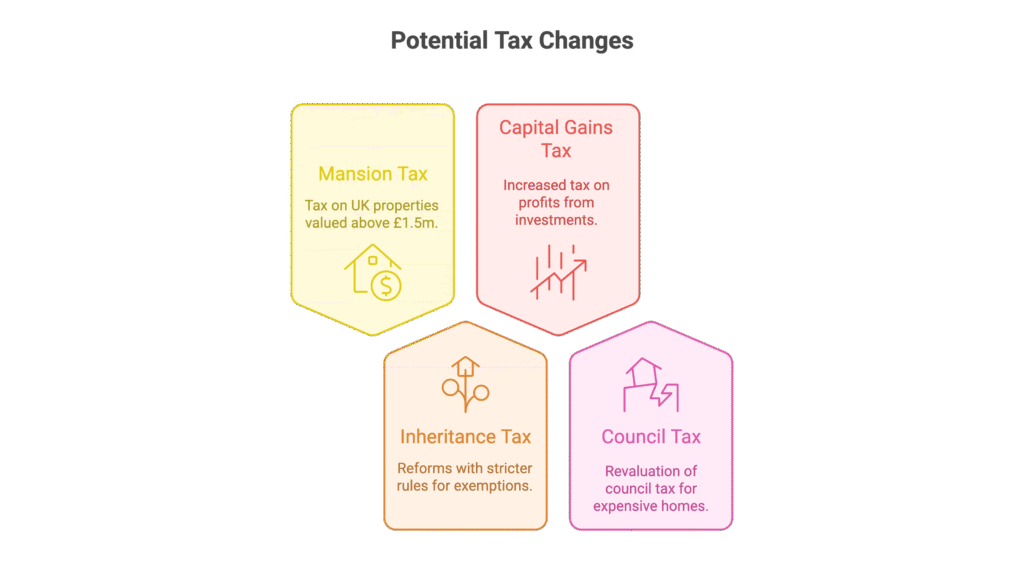
The pension tax changes aren’t happening in isolation. Rachel Reeves is considering multiple tax rises for the October 2024 budget, including:
- Mansion tax on UK properties worth over £1.5m
- Inheritance tax reforms with tighter exemption rules
- Capital gains tax increases on investment profits
- Council tax revaluation for higher-value homes
These measures reflect Labour’s challenge: they promised not to increase income tax, National Insurance, or VAT on “working people” during the election campaign. Pension tax changes and wealth taxes offer alternative revenue streams without technically breaking those manifesto commitments.
The £50bn Budget Reality: Why These Changes Matter
Economic forecasts from the National Institute of Economic and Social Research paint a stark picture. The UK government needs to raise £50bn in additional tax revenue to meet its fiscal rules by 2029-30, while maintaining just £9.9bn in fiscal headroom.
Professor Stephen Millard, NIESR’s deputy director, warns that “fiddling at the edges is not going to do it” – indicating that significant tax rises are inevitable across multiple areas.
The scale of this challenge explains why pension tax relief, currently costing the Treasury around £40bn annually, has become such an attractive target for reform. Even modest changes to pension tax benefits could generate billions in additional revenue.
How Pension Lump Sum Changes Could Affect You
If you’re approaching retirement or already accessing your pension, these potential changes deserve serious consideration. Here’s what different scenarios might look like:
Current rules: £200k pension = £50k tax-free + £150k taxable
Proposed rules: £200k pension = £40k tax-free + £160k taxable
The additional £10k would be taxed at your marginal rate – potentially 20%, 40%, or 45% depending on your total income. For higher-rate taxpayers, that’s an extra £4,000 in tax on the same withdrawal.
Key consideration: If you’re eligible to access your pension now (age 55+, rising to 57 from 2028), you might want to review your withdrawal strategy before any autumn budget changes take effect.

The Bottom Line on UK Pension Tax Changes
While the Treasury describes pension tax reforms as “unlikely,” the pressure to raise revenue makes some form of pension tax changes increasingly probable. The autumn budget 2025 will reveal whether these pension lump sum cuts become reality.
For now, the best approach is to understand your current pension tax benefits and consider whether early withdrawal makes sense for your situation.
FAQ
Q1: When might these pension changes take effect?
A: The autumn budget will likely reveal the timeline. If approved, changes could happen relatively quickly – possibly within the next tax year.
Q2: Will this affect all pension types?
A: The proposed cuts would primarily impact defined contribution pensions and SIPPs. Final salary pensions work differently and may not be directly affected.
Q3: Can I withdraw my tax-free lump sum before any changes?
A: You typically need to be 55+ (rising to 57 from 2028) to access pension funds. If you’re eligible, it might be worth considering your options sooner rather than later.
Q4: How does this compare to other countries’ pension tax rules?
A: The UK’s current 25% tax-free allowance is actually quite generous internationally. Many countries offer lower percentages or smaller caps.
Q5: What alternatives might the government consider instead?
A: Other options include hiking capital gains tax, reforming council tax bands, or introducing new wealth taxes – though all come with their own political challenges.
DISCLAIMER
Effective Date: 15th July 2025
The information provided on this website is for informational and educational purposes only and reflects the personal opinions of the author(s). It is not intended as financial, investment, tax, or legal advice.
We are not certified financial advisers. None of the content on this website constitutes a recommendation to buy, sell, or hold any financial product, asset, or service. You should not rely on any information provided here to make financial decisions.
We strongly recommend that you:
- Conduct your own research and due diligence
- Consult with a qualified financial adviser or professional before making any investment or financial decisions
While we strive to ensure that all information is accurate and up to date, we make no guarantees about the completeness, reliability, or suitability of any content on this site.
By using this website, you acknowledge and agree that we are not responsible for any financial loss, damage, or decisions made based on the content presented.
MORE NEWS








Disclosure & Editorial Standards
MJBurrows is not authorised or regulated by the Financial Conduct Authority (FCA). The content on this website — including articles, calculators, and tools — is for general informational and educational purposes only. It does not constitute personal financial, investment, tax, or legal advice and does not take into account your individual circumstances, financial situation, or objectives.
Nothing on this site is a personal recommendation to buy, sell, hold, or otherwise deal in any financial product, asset, or service. You should always conduct your own research and seek advice from a qualified, FCA-regulated financial adviser before making any financial decisions.
Our calculators produce estimates based on simplified models using HMRC-published rates for the current tax year. They cannot account for every individual circumstance and should not be relied upon as exact figures. Tax rules and rates may change — verify current rates with HMRC or a qualified tax adviser.
Projections are not guarantees. Where our tools show future values (investment growth, pension projections, compound interest), these are hypothetical illustrations based on assumed growth rates. Past performance does not guarantee future results. The value of investments can go down as well as up.
Market data displayed on this site is provided by third-party sources including Twelve Data, Yahoo Finance, and CoinGecko. We do not guarantee the accuracy, completeness, or timeliness of third-party data.
This content is designed for UK residents and reflects UK tax rules, thresholds, and legislation. It may not apply to other jurisdictions.
Using this website does not create a professional-client relationship of any kind. MJBurrows is not responsible for any financial loss, damage, or decision made based on the content presented. By using this site, you accept these terms.
This disclaimer may be updated from time to time without prior notice. Last reviewed: 23 April 2026.
MJBurrows is an independent UK personal finance publication, written and edited by Matthew Burrows. There is no parent company, no investor group, and no advertising sales team — decisions about what to cover and how to frame it are made by Matthew alone. Our full Editorial Policy sets out how the site operates in detail.
Commercial model. As of April 2026, MJBurrows generates no revenue. The site carries no display advertising, no affiliate links, no sponsored content, no paid product placements, and no pay-for-coverage arrangements. If this changes in future, it will be disclosed openly on the Editorial Policy page.
Sources. Articles and tools reference primary sources — HM Revenue & Customs (HMRC), gov.uk, the Bank of England, the Office for National Statistics (ONS), the Financial Conduct Authority (FCA), Companies House, and UK government departmental publications (DWP, Treasury). Calculator data uses HMRC-published rates for the 2026/27 tax year. Market data (tickers, asset prices) is provided by Twelve Data, Yahoo Finance, and CoinGecko.
Verification. Every published article is fact-checked before going live. Numerical claims are traced to their primary source, quotes are checked against the original speaker or document, and calculator outputs are tested against HMRC worked examples. See our verification and accuracy policy for the full process.
Corrections. If you spot an error, please report it via the Corrections page. A three-tier severity system commits to specific response times:
- Tier 1 — Urgent (material reader harm, defamatory statements, regulatory or legal issues): acknowledged within 24 hours, page actioned within 24 hours, correction published within 48 hours of confirmation.
- Tier 2 — High (significant factual errors that misinform readers): acknowledged within 3 working days, correction published within 7 working days of confirmation.
- Tier 3 — Standard (minor factual errors, dated references, missing context): acknowledged within 7 working days, correction published at the next regular content review (within the quarter).
Significant corrections are logged on the public Corrections log.
Updates and review cadence. Calculators are reviewed at least quarterly, plus event-driven updates when HMRC publishes new rates (Budget, Autumn Statement, new tax year). Guides are reviewed at least twice a year, with major rewrites whenever underlying regulation changes. Tax-year-sensitive content is prioritised for review at the April tax-year transition.
Get in touch. For editorial enquiries — corrections, story tips, reader questions — the address is contact@mjburrows.com. The contact page is at mjburrows.com/contact. Every email is read personally by Matthew.