
Ever wondered what it’s like when a law firm has a really good year? Just ask Linklaters partners – they’re about to find out firsthand.
The magic circle law firm just smashed through the £1bn profit barrier for the first time in its 187-year history. That’s not just a milestone; it’s a statement. With pre-tax profits hitting £1.08bn (up 14% year-on-year), Linklaters is proving that high-stakes legal work still pays handsomely.
Here’s what’s driving this profit surge and why it matters for the broader legal market.
Partners Hit the Jackpot with £2.2m Payouts
Let’s cut straight to the number everyone wants to know: partner pay.
Linklaters partners are set to pocket an average of £2.2m each – a sweet 15% bump from last year. That’s the kind of raise that makes other professionals wonder if they picked the wrong career path.
The firm’s revenue also climbed 11% to £2.32bn, showing this isn’t just about squeezing margins. They’re genuinely growing the pie, not just slicing it differently.
Geographic Breakdown: US Steals the Show
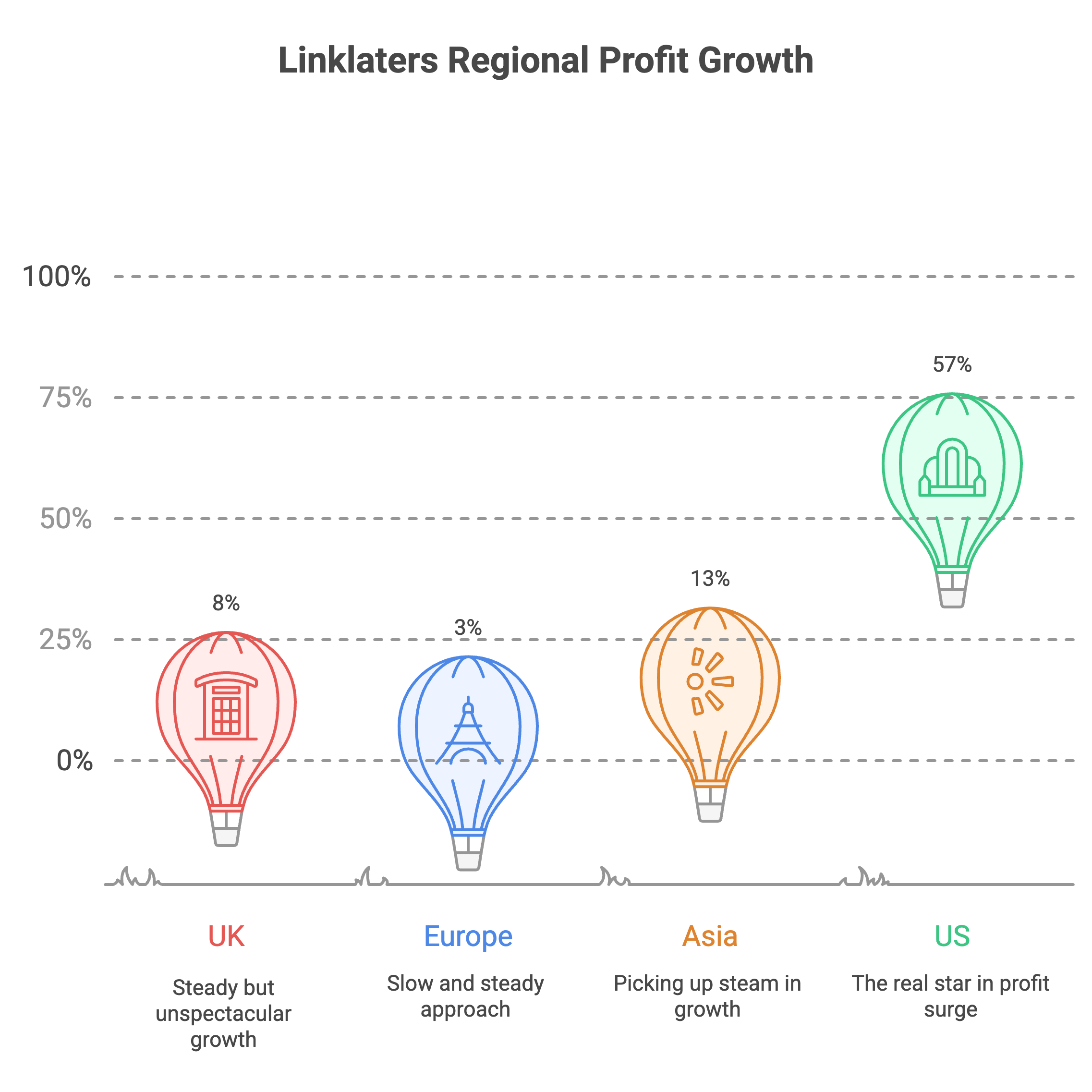
While Linklaters saw solid growth across all regions, the numbers tell a story:
- UK: 8% profit increase (steady but unspectacular)
- Europe: 3% growth (the tortoise approach)
- Asia: 13% jump (picking up steam)
- US: 57% surge (the real star)
That US number isn’t a typo. American legal work is where the firm’s seeing explosive growth, reflecting the ongoing transatlantic M&A boom and complex cross-border deals.
Deal-Making Machine: $211bn in Transactions
Linklaters’ corporate practice handled some serious firepower in 2024.
The firm advised on $211bn worth of deals, including heavyweight transactions like Dow’s $6bn partnership with Macquarie Asset Management and Volkswagen’s $5.8bn joint venture with Rivian. They also guided Carrier through its $3bn fire business sale and helped Unilever carve out its ice cream division.
These aren’t just big numbers – they’re the kind of complex, cross-border mandates that separate magic circle firms from the pack.
Strategic Expansion: 61 New Partners
Linklaters didn’t just grow profits; they grew their partnership too. The firm made 27 lateral partner hires and elected 34 new partners globally.
That’s aggressive expansion by law firm standards, suggesting they’re betting big on continued growth rather than just milking existing client relationships.
Managing partner Paul Lewis called it part of their “clear vision” to win the most complex mandates for leading corporates and financial sponsors. Translation: they’re doubling down on being the go-to firm for deals that make headlines.

What This Means for the Legal Market
Linklaters’ record year reflects broader trends in the legal industry. Complex regulatory environments, cross-border M&A activity, and high-stakes corporate restructuring are creating premium demand for top-tier legal advice.
The firm’s geographic performance also highlights where the action is: US markets are driving growth, while traditional European strongholds are growing more steadily.
For other magic circle firms, Linklaters just raised the bar. Expect similar profit announcements as competitors report their own results.
FAQ
Q1: What makes Linklaters a “magic circle” law firm?
A: The magic circle refers to London’s five most prestigious law firms: Linklaters, Allen & Overy, Clifford Chance, Freshfields, and Slaughter and May. They’re known for handling the biggest, most complex international deals and commanding premium fees.
Q2: How does £2.2m partner pay compare to other top law firms?
A: It’s competitive but not the highest. Some US firms pay equity partners $3m+, but Linklaters’ figure represents strong performance for a UK-headquartered firm with global reach.
Q3: Why did US profits surge 57% while other regions grew more modestly?
A: The US market has seen intense M&A activity, complex regulatory deals, and high-value corporate restructuring. American clients also tend to pay premium rates for specialised legal work.
Q4: What types of deals drive the highest profits for magic circle firms?
A: Cross-border M&A, complex financing arrangements, regulatory investigations, and major corporate restructuring typically generate the highest fees. These require specialised expertise and carry significant client risk.
Q5: Is Linklaters’ growth sustainable given economic uncertainty?
A: While economic headwinds could impact deal flow, complex legal work often increases during uncertain times as companies navigate regulatory changes, restructuring, and defensive strategies.
DISCLAIMER
Effective Date: 15th July 2025
The information provided on this website is for informational and educational purposes only and reflects the personal opinions of the author(s). It is not intended as financial, investment, tax, or legal advice.
We are not certified financial advisers. None of the content on this website constitutes a recommendation to buy, sell, or hold any financial product, asset, or service. You should not rely on any information provided here to make financial decisions.
We strongly recommend that you:
- Conduct your own research and due diligence
- Consult with a qualified financial adviser or professional before making any investment or financial decisions
While we strive to ensure that all information is accurate and up to date, we make no guarantees about the completeness, reliability, or suitability of any content on this site.
By using this website, you acknowledge and agree that we are not responsible for any financial loss, damage, or decisions made based on the content presented.
MORE NEWS








Disclosure & Editorial Standards
MJBurrows is not authorised or regulated by the Financial Conduct Authority (FCA). The content on this website — including articles, calculators, and tools — is for general informational and educational purposes only. It does not constitute personal financial, investment, tax, or legal advice and does not take into account your individual circumstances, financial situation, or objectives.
Nothing on this site is a personal recommendation to buy, sell, hold, or otherwise deal in any financial product, asset, or service. You should always conduct your own research and seek advice from a qualified, FCA-regulated financial adviser before making any financial decisions.
Our calculators produce estimates based on simplified models using HMRC-published rates for the current tax year. They cannot account for every individual circumstance and should not be relied upon as exact figures. Tax rules and rates may change — verify current rates with HMRC or a qualified tax adviser.
Projections are not guarantees. Where our tools show future values (investment growth, pension projections, compound interest), these are hypothetical illustrations based on assumed growth rates. Past performance does not guarantee future results. The value of investments can go down as well as up.
Market data displayed on this site is provided by third-party sources including Twelve Data, Yahoo Finance, and CoinGecko. We do not guarantee the accuracy, completeness, or timeliness of third-party data.
This content is designed for UK residents and reflects UK tax rules, thresholds, and legislation. It may not apply to other jurisdictions.
Using this website does not create a professional-client relationship of any kind. MJBurrows is not responsible for any financial loss, damage, or decision made based on the content presented. By using this site, you accept these terms.
This disclaimer may be updated from time to time without prior notice. Last reviewed: 23 April 2026.
MJBurrows is an independent UK personal finance publication, written and edited by Matthew Burrows. There is no parent company, no investor group, and no advertising sales team — decisions about what to cover and how to frame it are made by Matthew alone. Our full Editorial Policy sets out how the site operates in detail.
Commercial model. As of April 2026, MJBurrows generates no revenue. The site carries no display advertising, no affiliate links, no sponsored content, no paid product placements, and no pay-for-coverage arrangements. If this changes in future, it will be disclosed openly on the Editorial Policy page.
Sources. Articles and tools reference primary sources — HM Revenue & Customs (HMRC), gov.uk, the Bank of England, the Office for National Statistics (ONS), the Financial Conduct Authority (FCA), Companies House, and UK government departmental publications (DWP, Treasury). Calculator data uses HMRC-published rates for the 2026/27 tax year. Market data (tickers, asset prices) is provided by Twelve Data, Yahoo Finance, and CoinGecko.
Verification. Every published article is fact-checked before going live. Numerical claims are traced to their primary source, quotes are checked against the original speaker or document, and calculator outputs are tested against HMRC worked examples. See our verification and accuracy policy for the full process.
Corrections. If you spot an error, please report it via the Corrections page. A three-tier severity system commits to specific response times:
- Tier 1 — Urgent (material reader harm, defamatory statements, regulatory or legal issues): acknowledged within 24 hours, page actioned within 24 hours, correction published within 48 hours of confirmation.
- Tier 2 — High (significant factual errors that misinform readers): acknowledged within 3 working days, correction published within 7 working days of confirmation.
- Tier 3 — Standard (minor factual errors, dated references, missing context): acknowledged within 7 working days, correction published at the next regular content review (within the quarter).
Significant corrections are logged on the public Corrections log.
Updates and review cadence. Calculators are reviewed at least quarterly, plus event-driven updates when HMRC publishes new rates (Budget, Autumn Statement, new tax year). Guides are reviewed at least twice a year, with major rewrites whenever underlying regulation changes. Tax-year-sensitive content is prioritised for review at the April tax-year transition.
Get in touch. For editorial enquiries — corrections, story tips, reader questions — the address is contact@mjburrows.com. The contact page is at mjburrows.com/contact. Every email is read personally by Matthew.