

Picture this: You’re Britain’s biggest carmaker, it’s September 2nd, and suddenly your entire operation goes dark. That’s exactly what happened to Jaguar Land Rover when cybercriminals pulled off what experts are calling a “frustratingly simple” attack that’s now stretching into its third week.
The timing? Brutal. JLR got hit right as the UK launched its new ’75’ registration plates – one of the industry’s biggest sales periods. Talk about adding insult to injury.
What Actually Happened at Jaguar Land Rover?
On September 2nd, JLR’s systems went offline faster than you can say “ransomware.” The company immediately shut down production lines and retail operations, sending thousands of workers home indefinitely.
The kicker: employees are still being told to stay home day-by-day, with some industry insiders predicting disruptions could last “most of September” or longer. For a company that builds luxury cars worth £50,000+, every day offline is serious money.
Jake Moore from ESET put it perfectly: “The frustratingly simplistic approach to knock out a company of this size and for so long will make this incredibly difficult for senior staff to swallow.”

Why This Cyber Attack Timing Was No Coincidence
This wasn’t some random hack. Cybersecurity expert Cody Barrow calls it “strategic business warfare” – and he’s not wrong.
The attack coincided with the UK’s critical ’75 plate’ launch on September 1st. For non-car people, this is huge: new registration periods drive massive sales spikes as customers rush to get the latest plates. It’s like attacking Amazon right before Black Friday.
“This was no random strike; it was timed with the UK’s critical ’75 plate’ launch to cause maximum damage,” says Barrow from EclecticIQ.
The Bigger Picture: Retail Under Siege
JLR isn’t alone in this mess. British retailers have been getting hammered all year:
- M&S only just bounced back from their April cyber attack
- The Co-op got hit
- Even Harrods wasn’t safe
Data from Abnormal AI shows a clear pattern: Q2 consistently sees spikes in retail cyberattacks as criminals target busy trading periods. Smart? Yes. Infuriating? Absolutely.
How Consumers Are Fighting Back
Here’s where it gets interesting. Brits are becoming seriously security-savvy:
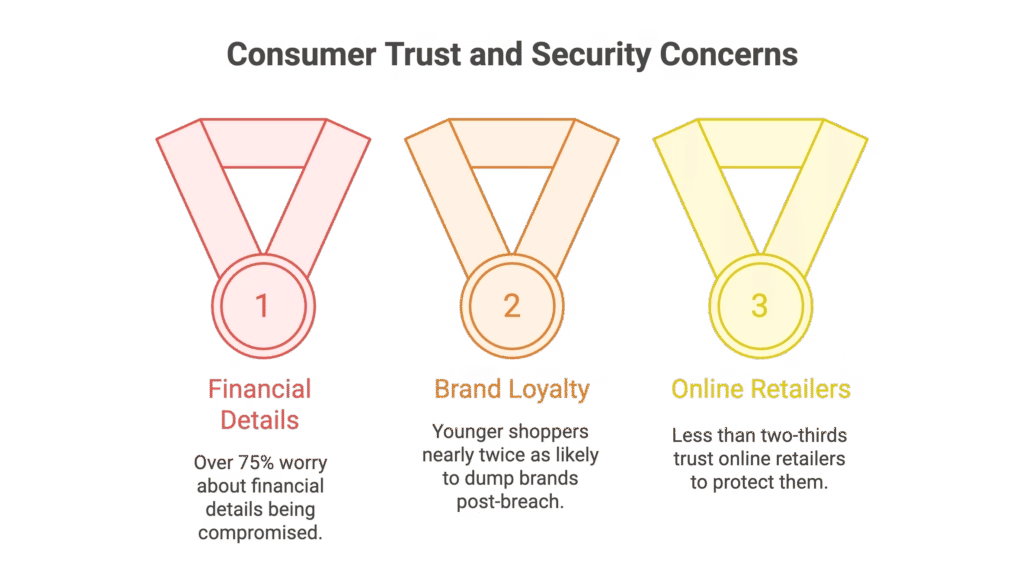
- Less than two-thirds trust online retailers to protect them
- Over 75% worry about their financial details being compromised
- Younger shoppers are nearly twice as likely to dump brands post-breach compared to over-55s
“Today’s shopper is increasingly security-savvy, and retailers who ignore that do so at their peril,” warns Matt Knell from ESET UK.
What’s JLR Doing About It?
The company is working “around the clock” with cybersecurity specialists and law enforcement to get systems back online safely. Their retail partners remain open, but the manufacturing side is still largely down.
A JLR spokesperson said they’re “very sorry for the disruption” – though that probably doesn’t help the workers missing paychecks or customers waiting for their new Range Rovers.
The Bottom Line
This attack shows how a single cyber incident can paralyse even the biggest companies. For JLR, the cost isn’t just in lost production – it’s damaged reputation, delayed deliveries, and lost customer trust. The message is clear: in 2025, cybersecurity isn’t optional. It’s survival.
Ready to bulletproof your business? Learn the cybersecurity strategies that actually work before you become the next headline.
FAQ
Q1: How long will the Jaguar Land Rover cyber attack disruption last?
A: Industry experts predict disruptions could continue for “most of September” or potentially longer. JLR is making day-by-day decisions on when to bring staff back to work.
Q2: What type of cyber attack hit Jaguar Land Rover?
A: While JLR hasn’t specified the exact nature of the attack, cybersecurity experts describe it as a “frustratingly simple” approach that forced the company to shut down systems as a precautionary measure.
Q3: Are JLR dealerships still open during the cyber attack?
A: Yes, JLR’s retail partners remain open for business. However, production and some backend systems are still offline, which may affect vehicle availability and delivery times.
Q4: How does this compare to other retail cyber attacks in 2025?
A: JLR joins a growing list of major British retailers hit this year, including M&S, Co-op, and Harrods. Data shows Q2 consistently sees spikes in retail-focused cyberattacks.
Q5: What should customers do if they’re waiting for a JLR vehicle?
A: Contact your local JLR dealer for updates on your order status. The company is working to restore systems safely but delivery timelines may be affected.
DISCLAIMER
Effective Date: 15th July 2025
The information provided on this website is for informational and educational purposes only and reflects the personal opinions of the author(s). It is not intended as financial, investment, tax, or legal advice.
We are not certified financial advisers. None of the content on this website constitutes a recommendation to buy, sell, or hold any financial product, asset, or service. You should not rely on any information provided here to make financial decisions.
We strongly recommend that you:
- Conduct your own research and due diligence
- Consult with a qualified financial adviser or professional before making any investment or financial decisions
While we strive to ensure that all information is accurate and up to date, we make no guarantees about the completeness, reliability, or suitability of any content on this site.
By using this website, you acknowledge and agree that we are not responsible for any financial loss, damage, or decisions made based on the content presented.
MORE NEWS








Disclosure & Editorial Standards
MJBurrows is not authorised or regulated by the Financial Conduct Authority (FCA). The content on this website — including articles, calculators, and tools — is for general informational and educational purposes only. It does not constitute personal financial, investment, tax, or legal advice and does not take into account your individual circumstances, financial situation, or objectives.
Nothing on this site is a personal recommendation to buy, sell, hold, or otherwise deal in any financial product, asset, or service. You should always conduct your own research and seek advice from a qualified, FCA-regulated financial adviser before making any financial decisions.
Our calculators produce estimates based on simplified models using HMRC-published rates for the current tax year. They cannot account for every individual circumstance and should not be relied upon as exact figures. Tax rules and rates may change — verify current rates with HMRC or a qualified tax adviser.
Projections are not guarantees. Where our tools show future values (investment growth, pension projections, compound interest), these are hypothetical illustrations based on assumed growth rates. Past performance does not guarantee future results. The value of investments can go down as well as up.
Market data displayed on this site is provided by third-party sources including Twelve Data, Yahoo Finance, and CoinGecko. We do not guarantee the accuracy, completeness, or timeliness of third-party data.
This content is designed for UK residents and reflects UK tax rules, thresholds, and legislation. It may not apply to other jurisdictions.
Using this website does not create a professional-client relationship of any kind. MJBurrows is not responsible for any financial loss, damage, or decision made based on the content presented. By using this site, you accept these terms.
This disclaimer may be updated from time to time without prior notice. Last reviewed: 23 April 2026.
MJBurrows is an independent UK personal finance publication, written and edited by Matthew Burrows. There is no parent company, no investor group, and no advertising sales team — decisions about what to cover and how to frame it are made by Matthew alone. Our full Editorial Policy sets out how the site operates in detail.
Commercial model. As of April 2026, MJBurrows generates no revenue. The site carries no display advertising, no affiliate links, no sponsored content, no paid product placements, and no pay-for-coverage arrangements. If this changes in future, it will be disclosed openly on the Editorial Policy page.
Sources. Articles and tools reference primary sources — HM Revenue & Customs (HMRC), gov.uk, the Bank of England, the Office for National Statistics (ONS), the Financial Conduct Authority (FCA), Companies House, and UK government departmental publications (DWP, Treasury). Calculator data uses HMRC-published rates for the 2026/27 tax year. Market data (tickers, asset prices) is provided by Twelve Data, Yahoo Finance, and CoinGecko.
Verification. Every published article is fact-checked before going live. Numerical claims are traced to their primary source, quotes are checked against the original speaker or document, and calculator outputs are tested against HMRC worked examples. See our verification and accuracy policy for the full process.
Corrections. If you spot an error, please report it via the Corrections page. A three-tier severity system commits to specific response times:
- Tier 1 — Urgent (material reader harm, defamatory statements, regulatory or legal issues): acknowledged within 24 hours, page actioned within 24 hours, correction published within 48 hours of confirmation.
- Tier 2 — High (significant factual errors that misinform readers): acknowledged within 3 working days, correction published within 7 working days of confirmation.
- Tier 3 — Standard (minor factual errors, dated references, missing context): acknowledged within 7 working days, correction published at the next regular content review (within the quarter).
Significant corrections are logged on the public Corrections log.
Updates and review cadence. Calculators are reviewed at least quarterly, plus event-driven updates when HMRC publishes new rates (Budget, Autumn Statement, new tax year). Guides are reviewed at least twice a year, with major rewrites whenever underlying regulation changes. Tax-year-sensitive content is prioritised for review at the April tax-year transition.
Get in touch. For editorial enquiries — corrections, story tips, reader questions — the address is contact@mjburrows.com. The contact page is at mjburrows.com/contact. Every email is read personally by Matthew.