
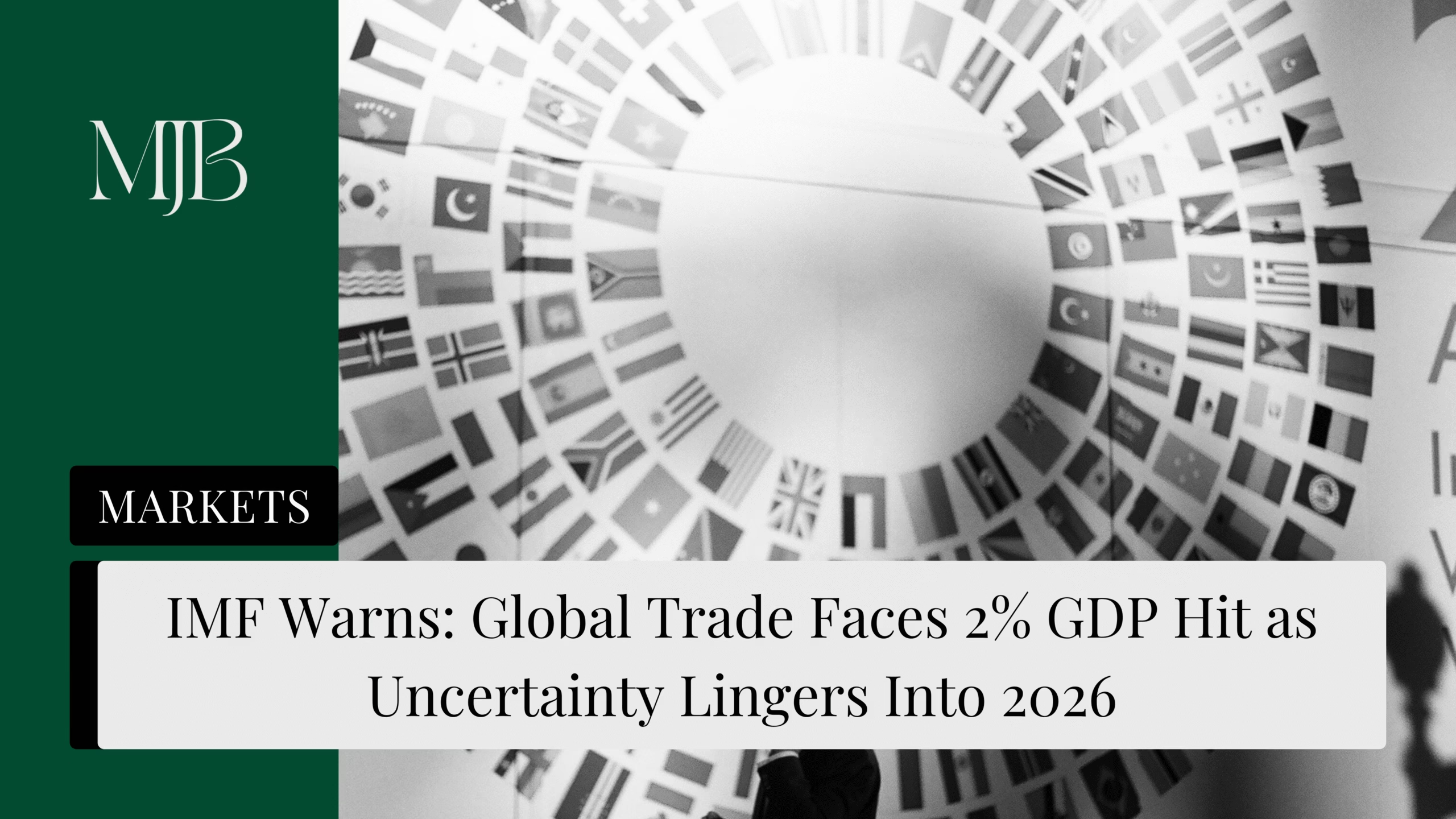
Trade Stabilises But Risks Mount—Here’s What the IMF Sees Coming
Trade’s holding steady, but don’t pop the champagne just yet. The International Monetary Fund (IMF) is flagging serious headwinds for 2026—think persistent uncertainty that could shave up to 2% off global GDP. Jihad Azour, IMF director overseeing MENA, North Africa, Central Asia, and the Caucasus, painted a mixed picture at Abu Dhabi Finance Week: resilient trade flows paired with mounting debt pressures and sky-high asset valuations in tech. Here’s what businesses and investors need to watch.
2025: A Year of Contradictions
Strong Investment Meets Persistent Shocks
Azour described 2025 as “a year of two cities”—shocks colliding with opportunity. Despite tariff concerns, inflationary impacts stayed relatively muted, and the global economy showed muscle thanks to a massive AI investment surge, particularly in the US.
The MENA region saw capital flows double compared to 2024, signalling strong investor appetite for emerging markets. “We saw a strong appetite for capital flow moving to emerging economies,” Azour noted, highlighting the region’s transaction boom.
Trade Outlook: Slower But Steady
Looking ahead, the IMF expects trade to stabilise in 2026, slowing down but maintaining strength. The problem? Global uncertainty isn’t going anywhere.

Three Major Risks for 2026
1. Uncertainty Could Cost Economies Dearly
The IMF projects that ongoing global uncertainty could drag economies lower by up to 2% of GDP over the next two years. That’s not a rounding error, it’s a serious economic drag that demands vigilance from policymakers and business leaders alike.
2. The AI Bubble Question
AI investment’s booming, but Azour’s raising red flags about asset valuations. “We see that the level of risks in terms of assets is reaching one of the highest over the last three decades,” he warned.
There’s a growing disconnect between tech sector valuations and the rest of the market. The promise is huge, but so is the potential for correction. “It’s an area where we see a lot of promises, but we have to be extremely careful,” he added.
3. Debt Gets More Expensive
Here’s the big one: “What we need to watch in 2026 is debt,” Azour told business leaders.
Spreads are widening, particularly on high-yield debt, and gross financing needs for advanced economies are ballooning. Any adjustment in developed markets will ripple through emerging economies, potentially hard.

The Bottom Line
Trade’s resilient, but 2026 brings a tricky mix of slowing momentum, tech valuation concerns, and mounting debt pressures. The IMF’s message? Stay sharp, monitor risks closely, and don’t assume the good times will automatically roll on.
For investors and businesses, that means stress-testing portfolios against uncertainty, watching debt exposure, and questioning whether AI valuations reflect reality or hype.
Want to stay ahead of global economic shifts? Keep monitoring IMF forecasts and adjust your strategy accordingly.
FAQ: Global Trade and Economic Outlook for 2026
Q1: Will global trade grow in 2026?
A: Yes, but expect slower growth. The IMF projects trade will stabilise and remain strong overall, though it won’t match the pace seen in previous years. Think steady rather than spectacular.
Q2: How much could uncertainty impact GDP?
A: The IMF estimates global uncertainty could reduce economic output by up to 2% of GDP over the next two years. That’s a significant drag on growth potential across both developed and emerging markets.
Q3: Is the AI investment boom sustainable?
A: That’s the billion-dollar question. While AI investment continues surging, asset valuations have reached three-decade highs with a worrying disconnect between tech and broader market prices. The IMF urges caution despite the sector’s promise.
Q4: Why is debt a major concern for 2026?
A: Debt servicing costs are rising as spreads widen, particularly for high-yield borrowers. Advanced economies face ballooning gross financing needs, and any policy adjustments will disproportionately impact emerging markets that rely on capital flows.
Q5: Which regions showed the strongest capital flows in 2025?
A: The MENA region stood out, with transaction volumes doubling compared to 2024. Emerging markets generally attracted strong capital inflows despite global uncertainty, signalling investor confidence in growth opportunities outside traditional Western markets.
DISCLAIMER
Effective Date: 15th July 2025
The information provided on this website is for informational and educational purposes only and reflects the personal opinions of the author(s). It is not intended as financial, investment, tax, or legal advice.
We are not certified financial advisers. None of the content on this website constitutes a recommendation to buy, sell, or hold any financial product, asset, or service. You should not rely on any information provided here to make financial decisions.
We strongly recommend that you:
- Conduct your own research and due diligence
- Consult with a qualified financial adviser or professional before making any investment or financial decisions
While we strive to ensure that all information is accurate and up to date, we make no guarantees about the completeness, reliability, or suitability of any content on this site.
By using this website, you acknowledge and agree that we are not responsible for any financial loss, damage, or decisions made based on the content presented.
MORE NEWS






Disclosure & Editorial Standards
MJBurrows is not authorised or regulated by the Financial Conduct Authority (FCA). The content on this website — including articles, calculators, and tools — is for general informational and educational purposes only. It does not constitute personal financial, investment, tax, or legal advice and does not take into account your individual circumstances, financial situation, or objectives.
Nothing on this site is a personal recommendation to buy, sell, hold, or otherwise deal in any financial product, asset, or service. You should always conduct your own research and seek advice from a qualified, FCA-regulated financial adviser before making any financial decisions.
Our calculators produce estimates based on simplified models using HMRC-published rates for the current tax year. They cannot account for every individual circumstance and should not be relied upon as exact figures. Tax rules and rates may change — verify current rates with HMRC or a qualified tax adviser.
Projections are not guarantees. Where our tools show future values (investment growth, pension projections, compound interest), these are hypothetical illustrations based on assumed growth rates. Past performance does not guarantee future results. The value of investments can go down as well as up.
Market data displayed on this site is provided by third-party sources including Twelve Data, Yahoo Finance, and CoinGecko. We do not guarantee the accuracy, completeness, or timeliness of third-party data.
This content is designed for UK residents and reflects UK tax rules, thresholds, and legislation. It may not apply to other jurisdictions.
Using this website does not create a professional-client relationship of any kind. MJBurrows is not responsible for any financial loss, damage, or decision made based on the content presented. By using this site, you accept these terms.
This disclaimer may be updated from time to time without prior notice. Last reviewed: 23 April 2026.
MJBurrows is an independent UK personal finance publication, written and edited by Matthew Burrows. There is no parent company, no investor group, and no advertising sales team — decisions about what to cover and how to frame it are made by Matthew alone. Our full Editorial Policy sets out how the site operates in detail.
Commercial model. As of April 2026, MJBurrows generates no revenue. The site carries no display advertising, no affiliate links, no sponsored content, no paid product placements, and no pay-for-coverage arrangements. If this changes in future, it will be disclosed openly on the Editorial Policy page.
Sources. Articles and tools reference primary sources — HM Revenue & Customs (HMRC), gov.uk, the Bank of England, the Office for National Statistics (ONS), the Financial Conduct Authority (FCA), Companies House, and UK government departmental publications (DWP, Treasury). Calculator data uses HMRC-published rates for the 2026/27 tax year. Market data (tickers, asset prices) is provided by Twelve Data, Yahoo Finance, and CoinGecko.
Verification. Every published article is fact-checked before going live. Numerical claims are traced to their primary source, quotes are checked against the original speaker or document, and calculator outputs are tested against HMRC worked examples. See our verification and accuracy policy for the full process.
Corrections. If you spot an error, please report it via the Corrections page. A three-tier severity system commits to specific response times:
- Tier 1 — Urgent (material reader harm, defamatory statements, regulatory or legal issues): acknowledged within 24 hours, page actioned within 24 hours, correction published within 48 hours of confirmation.
- Tier 2 — High (significant factual errors that misinform readers): acknowledged within 3 working days, correction published within 7 working days of confirmation.
- Tier 3 — Standard (minor factual errors, dated references, missing context): acknowledged within 7 working days, correction published at the next regular content review (within the quarter).
Significant corrections are logged on the public Corrections log.
Updates and review cadence. Calculators are reviewed at least quarterly, plus event-driven updates when HMRC publishes new rates (Budget, Autumn Statement, new tax year). Guides are reviewed at least twice a year, with major rewrites whenever underlying regulation changes. Tax-year-sensitive content is prioritised for review at the April tax-year transition.
Get in touch. For editorial enquiries — corrections, story tips, reader questions — the address is contact@mjburrows.com. The contact page is at mjburrows.com/contact. Every email is read personally by Matthew.