Wondering how to spot financial scams before they empty your bank account? You’re not alone. Here’s a sobering fact: criminals stole over £1bn through financial fraud in 2024, with scam cases hitting 3.3 million — a 12% jump from 2023.
But here’s the silver lining: banks prevented £1.5bn in fraudulent transactions, proving that spotting financial scams early really works. Ready to protect yourself? Let’s dive into the most common financial scams and exactly how to avoid them.
Most Common Financial Scams in 2025: What to Watch For
Investment Fraud Scams: The Biggest Money Trap
Investment fraud topped the charts for financial damage in 2024, with victims losing £144m — a staggering 34% increase. These sophisticated scams have evolved far beyond traditional pyramid schemes.
Modern investment scammers create professional-looking fake platforms, promise guaranteed high returns, and use deepfake technology featuring trusted financial experts to promote fraudulent WhatsApp investment groups.
Purchase Fraud: The Online Shopping Nightmare
Purchase scams remain the most frequent type of financial fraud. Victims pay for goods or services upfront but never receive them, making this a persistent threat for online shoppers.
Social Media Financial Scams: Where Most Fraud Begins
Here’s the alarming reality: 70% of financial scams now start on social media platforms. Fraudsters use luxury lifestyle content to attract victims, then direct them to fake investment opportunities through private messaging.

How to Spot Financial Scams: Red Flags That Matter
Watch for these warning signs:
Pressure tactics: “Limited time offer!” or “Act now!” Real investments don’t come with ticking clocks.
Unsolicited contact: Random calls, texts, emails, or door-knocks about financial opportunities should trigger immediate suspicion.
Dodgy contact details: If they won’t provide proper contact information or you can’t verify them through official channels, walk away.
Unrealistic promises: Returns that sound too good to be true usually are. If someone’s guaranteeing 50% returns with “zero risk,” they’re either lying or defying economic reality.
The golden rule? Legitimate investment opportunities don’t vanish the moment you hang up to verify details.
How to Protect Yourself From Financial Scams
Prevention is your best defence against financial fraud:
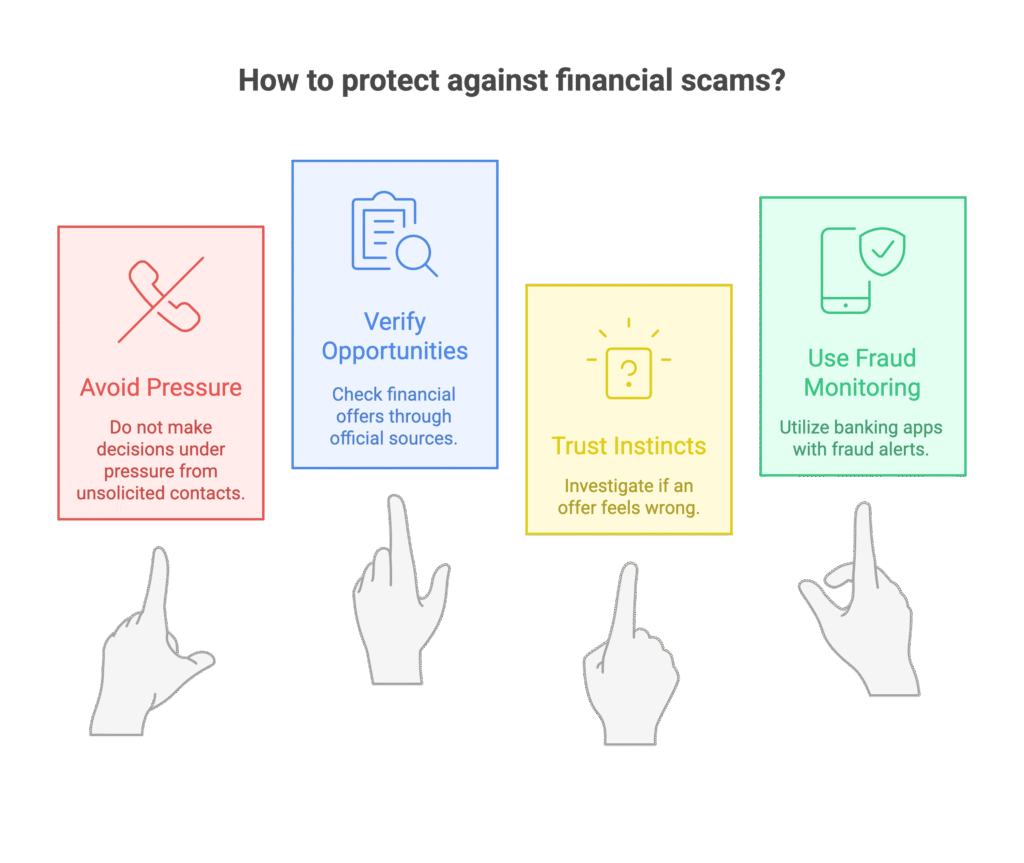
- Never make investment decisions under pressure from unsolicited contacts
- Always verify financial opportunities through independent, official sources
- Trust your instincts — if something feels wrong about a financial offer, investigate further
- Use banking apps with fraud monitoring that alert you to suspicious account activity
As financial expert Sarah Coles from Hargreaves Lansdown advises: “If in doubt, it’s always better to err on the side of caution and assume something is a scam.”
What to Do After Being Scammed
If you’ve been hit by a financial scam, time is critical:
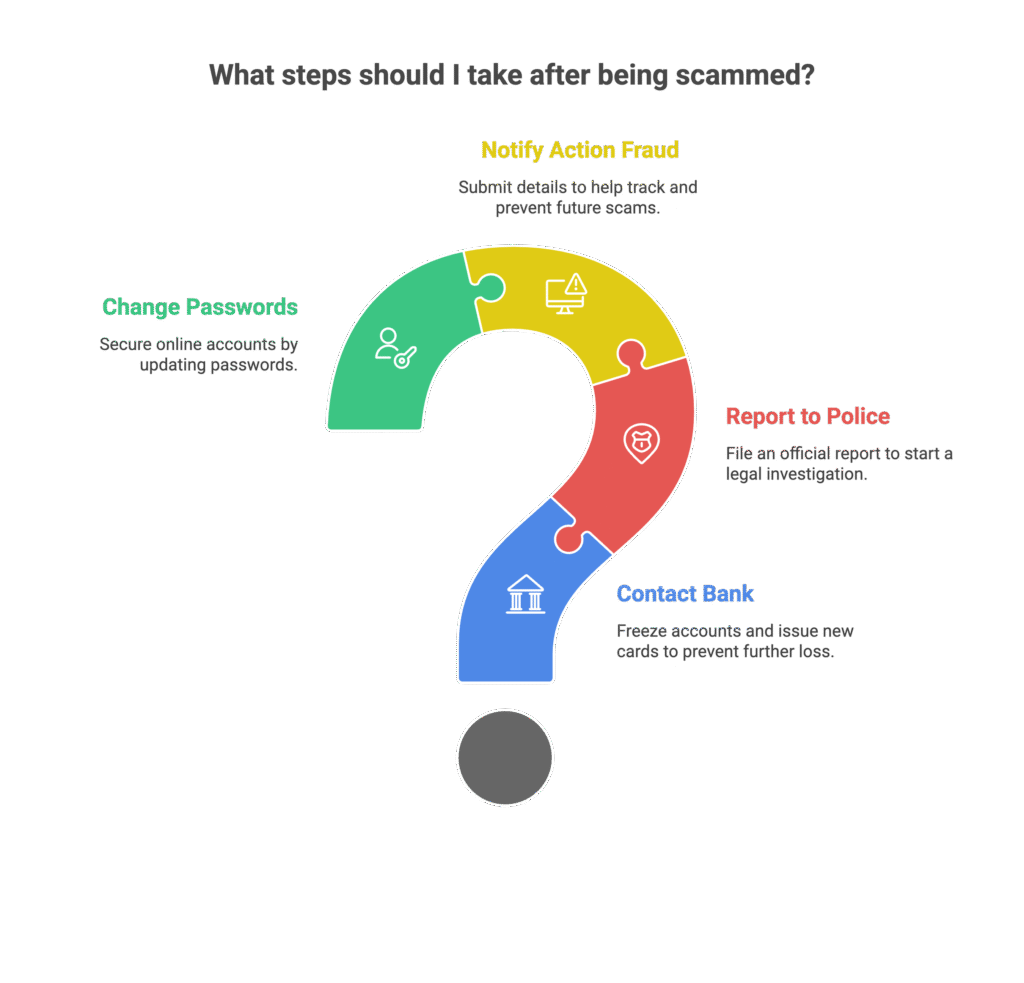
- Contact your bank first — They can freeze compromised accounts and issue replacement cards
- Report to police — Call 101 to file an official report
- Notify Action Fraud — Submit details through their reporting system
- Change all passwords — Especially if you shared login credentials with scammers
Quick action significantly improves your chances of recovering funds and preventing further losses.
FAQ
Q1: What are the most common financial scams in 2025?
A: Purchase scams lead in frequency, while investment fraud causes the largest financial losses. Social media platforms now generate 70% of all financial scam cases.
Q2: How can I verify if an investment opportunity is a scam?
A: Check the Financial Conduct Authority (FCA) register, verify contact details independently, and never invest based on social media advertisements or unsolicited communications. Legitimate opportunities don’t require immediate decisions.
Q3: Can banks prevent financial scams effectively?
A: Banks prevented £1.5bn in unauthorised fraud in 2024, but they cannot stop authorised payments to scammers. Prevention through scam awareness remains your primary protection.
Q4: What should I do if I receive suspicious investment calls?
A: End the call immediately and verify any claims through official channels. Note down details they provide, then check the FCA register and search for independent reviews before considering any offers.
Q5: Are deepfake videos really used in financial scams?
A: Yes, scammers increasingly use deepfake technology featuring well-known financial experts to promote fraudulent investment schemes. Always verify investment advice through official company channels, not social media content.
DISCLAIMER
Effective Date: 15th July 2025
The information provided on this website is for informational and educational purposes only and reflects the personal opinions of the author(s). It is not intended as financial, investment, tax, or legal advice.
We are not certified financial advisers. None of the content on this website constitutes a recommendation to buy, sell, or hold any financial product, asset, or service. You should not rely on any information provided here to make financial decisions.
We strongly recommend that you:
- Conduct your own research and due diligence
- Consult with a qualified financial adviser or professional before making any investment or financial decisions
While we strive to ensure that all information is accurate and up to date, we make no guarantees about the completeness, reliability, or suitability of any content on this site.
By using this website, you acknowledge and agree that we are not responsible for any financial loss, damage, or decisions made based on the content presented.
MORE NEWS







Disclosure & Editorial Standards
MJBurrows is not authorised or regulated by the Financial Conduct Authority (FCA). The content on this website — including articles, calculators, and tools — is for general informational and educational purposes only. It does not constitute personal financial, investment, tax, or legal advice and does not take into account your individual circumstances, financial situation, or objectives.
Nothing on this site is a personal recommendation to buy, sell, hold, or otherwise deal in any financial product, asset, or service. You should always conduct your own research and seek advice from a qualified, FCA-regulated financial adviser before making any financial decisions.
Our calculators produce estimates based on simplified models using HMRC-published rates for the current tax year. They cannot account for every individual circumstance and should not be relied upon as exact figures. Tax rules and rates may change — verify current rates with HMRC or a qualified tax adviser.
Projections are not guarantees. Where our tools show future values (investment growth, pension projections, compound interest), these are hypothetical illustrations based on assumed growth rates. Past performance does not guarantee future results. The value of investments can go down as well as up.
Market data displayed on this site is provided by third-party sources including Twelve Data, Yahoo Finance, and CoinGecko. We do not guarantee the accuracy, completeness, or timeliness of third-party data.
This content is designed for UK residents and reflects UK tax rules, thresholds, and legislation. It may not apply to other jurisdictions.
Using this website does not create a professional-client relationship of any kind. MJBurrows is not responsible for any financial loss, damage, or decision made based on the content presented. By using this site, you accept these terms.
This disclaimer may be updated from time to time without prior notice. Last reviewed: 23 April 2026.
MJBurrows is an independent UK personal finance publication, written and edited by Matthew Burrows. There is no parent company, no investor group, and no advertising sales team — decisions about what to cover and how to frame it are made by Matthew alone. Our full Editorial Policy sets out how the site operates in detail.
Commercial model. As of April 2026, MJBurrows generates no revenue. The site carries no display advertising, no affiliate links, no sponsored content, no paid product placements, and no pay-for-coverage arrangements. If this changes in future, it will be disclosed openly on the Editorial Policy page.
Sources. Articles and tools reference primary sources — HM Revenue & Customs (HMRC), gov.uk, the Bank of England, the Office for National Statistics (ONS), the Financial Conduct Authority (FCA), Companies House, and UK government departmental publications (DWP, Treasury). Calculator data uses HMRC-published rates for the 2026/27 tax year. Market data (tickers, asset prices) is provided by Twelve Data, Yahoo Finance, and CoinGecko.
Verification. Every published article is fact-checked before going live. Numerical claims are traced to their primary source, quotes are checked against the original speaker or document, and calculator outputs are tested against HMRC worked examples. See our verification and accuracy policy for the full process.
Corrections. If you spot an error, please report it via the Corrections page. A three-tier severity system commits to specific response times:
- Tier 1 — Urgent (material reader harm, defamatory statements, regulatory or legal issues): acknowledged within 24 hours, page actioned within 24 hours, correction published within 48 hours of confirmation.
- Tier 2 — High (significant factual errors that misinform readers): acknowledged within 3 working days, correction published within 7 working days of confirmation.
- Tier 3 — Standard (minor factual errors, dated references, missing context): acknowledged within 7 working days, correction published at the next regular content review (within the quarter).
Significant corrections are logged on the public Corrections log.
Updates and review cadence. Calculators are reviewed at least quarterly, plus event-driven updates when HMRC publishes new rates (Budget, Autumn Statement, new tax year). Guides are reviewed at least twice a year, with major rewrites whenever underlying regulation changes. Tax-year-sensitive content is prioritised for review at the April tax-year transition.
Get in touch. For editorial enquiries — corrections, story tips, reader questions — the address is contact@mjburrows.com. The contact page is at mjburrows.com/contact. Every email is read personally by Matthew.