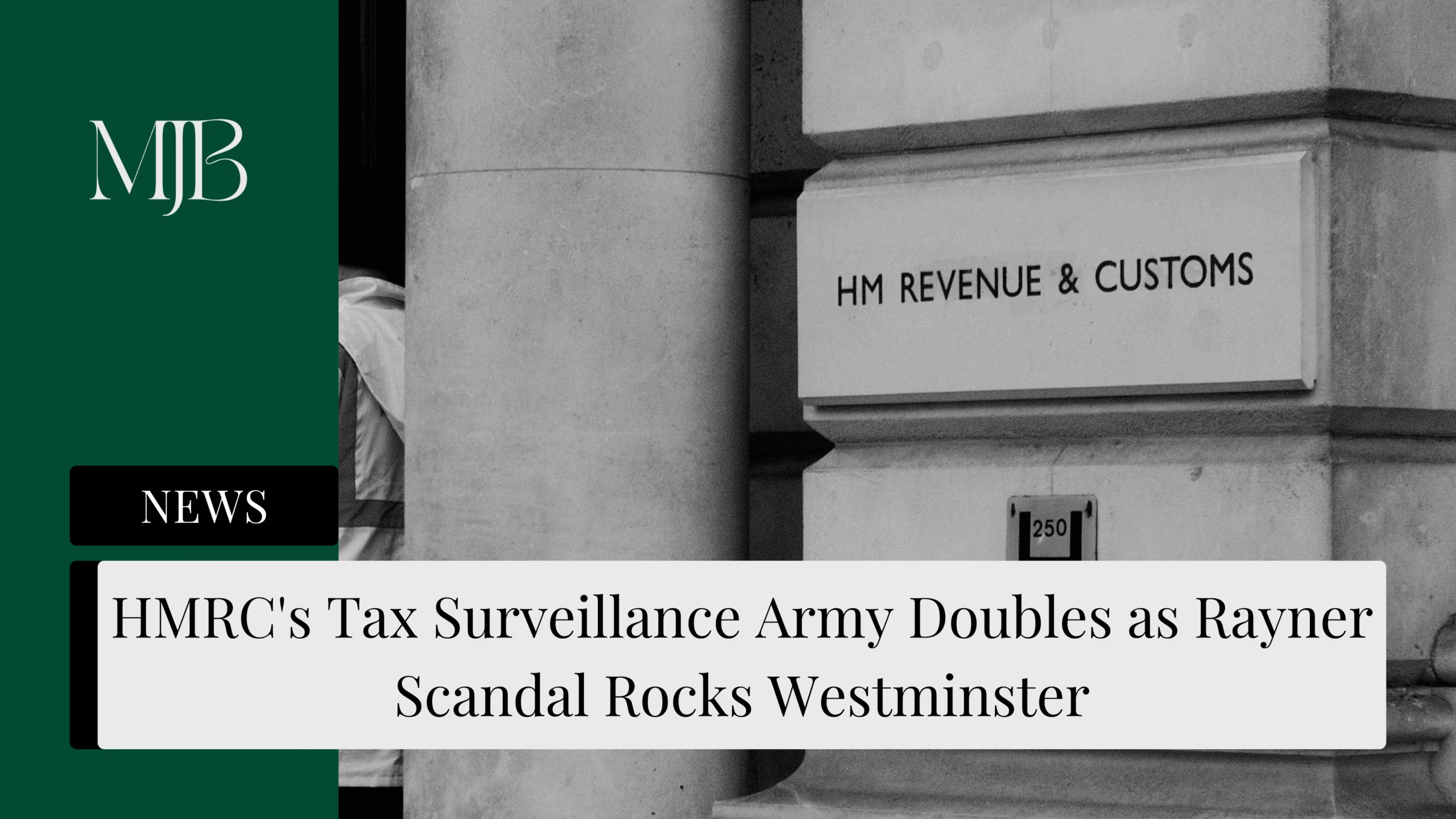
Ever feel like someone’s watching you? Well, if you’re dodging taxes, they probably are. HMRC just doubled its surveillance team to 337 staff while Angela Rayner’s £40k stamp duty mess puts the tax authority under the microscope.
The timing couldn’t be more awkward. Just as HMRC flexes its surveillance muscles, their political masters are getting caught in tax scandals. Here’s what this means for your wallet and Britain’s tax system.
HMRC’s Surveillance Operation Goes Full Throttle
HMRC isn’t holding back. Freedom of Information data shows they’ve nearly doubled their covert surveillance team from 171 to 337 officers in just two years, spending £580k on the program last year alone.
What does this surveillance team actually do? Think less James Bond, more nosy neighbor with a badge. They’re authorized for “drive-bys” of properties and undercover test purchases to catch tax evaders red-handed.
But that’s not all. Another 196 employees got criminal investigation training, while over 2,000 staff received personal safety training. Translation: HMRC is preparing for more confrontational enforcement.
This expansion is part of Labour’s “Close the Tax Gap” initiative, which includes more dawn raids on suspected tax dodgers. The message is clear – pay up or face the consequences.

The Rayner Effect: When Politicians Face Their Own Medicine
Angela Rayner’s resignation as deputy PM over a £40k stamp duty underpayment couldn’t have come at a worse time for HMRC’s credibility.
The former deputy Labour leader admitted she should’ve paid higher rates on her £800k Hove flat due to “complex trust arrangements” around her family home. Ethics adviser Sir Laurie Magnus found she acted with “integrity” but failed to get proper tax advice despite warnings.
Now HMRC is reportedly investigating her case, with tax lawyers suggesting she faces around £8k in penalties for a “careless” error. The irony? The same department ramping up surveillance is now chasing one of its former political bosses.
Digital Chaos Meets Physical Surveillance
While HMRC builds its ground surveillance force, their digital transformation is hitting speed bumps. A recent glitch in their capital gains tax service could leave thousands of taxpayers accidentally underpaying.
David Wright from the Association of Taxation Technicians warns that mistakes are “inevitable,” with HMRC slapping interest charges at 8% plus fines up to 30% on underpaid CGT.
Then there’s Making Tax Digital, pulling another 800,000 people into HMRC’s online regime by April 2026. Craig Ogilvie, HMRC’s MTD director, is urging accountants to prepare clients with income over £50k now.
But here’s the kicker – while surveillance expands, HMRC’s call-handling times have nearly doubled, and compliance costs for small businesses keep rising.

The Bottom Line: Trust Issues at the Top
HMRC is playing a dangerous game. They’re building a surveillance state for tax compliance whilst their digital systems crash and their political masters dodge stamp duty.
The Rayner scandal exposes a fundamental problem: how can HMRC enforce rules consistently when Westminster can’t even get its own tax affairs straight?
For ordinary taxpayers, this means more scrutiny, higher compliance costs, and potentially more aggressive enforcement. Whether you’re a small business owner or property investor, HMRC’s watching – and they’re not afraid to knock on your door.
Ready to get your tax affairs bulletproof? Consider professional advice now, before HMRC’s surveillance team comes calling.
Frequently Asked Questions
Q1: How many HMRC surveillance officers are there now?
A: HMRC has 337 staff trained in covert surveillance, nearly double the 171 from two years ago. They spent £580k on this program last year alone.
Q2: What can HMRC surveillance officers actually do?
A: They can conduct “drive-bys” of properties, make undercover test purchases, and gather evidence of tax fraud. It’s legal surveillance designed to catch tax evaders.
Q3: Will Angela Rayner face criminal charges over her tax scandal?
A: Unlikely. Ethics advisers found she acted with “integrity” but made a “careless” error. She’s expected to face around £8k in penalties rather than criminal prosecution.
Q4: How does Making Tax Digital affect me?
A: If your income exceeds £50k, you’ll need to join HMRC’s digital regime by April 2026. This means quarterly digital submissions and potentially higher compliance costs.
DISCLAIMER
Effective Date: 15th July 2025
The information provided on this website is for informational and educational purposes only and reflects the personal opinions of the author(s). It is not intended as financial, investment, tax, or legal advice.
We are not certified financial advisers. None of the content on this website constitutes a recommendation to buy, sell, or hold any financial product, asset, or service. You should not rely on any information provided here to make financial decisions.
We strongly recommend that you:
- Conduct your own research and due diligence
- Consult with a qualified financial adviser or professional before making any investment or financial decisions
While we strive to ensure that all information is accurate and up to date, we make no guarantees about the completeness, reliability, or suitability of any content on this site.
By using this website, you acknowledge and agree that we are not responsible for any financial loss, damage, or decisions made based on the content presented.
MORE NEWS








Disclosure & Editorial Standards
MJBurrows is not authorised or regulated by the Financial Conduct Authority (FCA). The content on this website — including articles, calculators, and tools — is for general informational and educational purposes only. It does not constitute personal financial, investment, tax, or legal advice and does not take into account your individual circumstances, financial situation, or objectives.
Nothing on this site is a personal recommendation to buy, sell, hold, or otherwise deal in any financial product, asset, or service. You should always conduct your own research and seek advice from a qualified, FCA-regulated financial adviser before making any financial decisions.
Our calculators produce estimates based on simplified models using HMRC-published rates for the current tax year. They cannot account for every individual circumstance and should not be relied upon as exact figures. Tax rules and rates may change — verify current rates with HMRC or a qualified tax adviser.
Projections are not guarantees. Where our tools show future values (investment growth, pension projections, compound interest), these are hypothetical illustrations based on assumed growth rates. Past performance does not guarantee future results. The value of investments can go down as well as up.
Market data displayed on this site is provided by third-party sources including Twelve Data, Yahoo Finance, and CoinGecko. We do not guarantee the accuracy, completeness, or timeliness of third-party data.
This content is designed for UK residents and reflects UK tax rules, thresholds, and legislation. It may not apply to other jurisdictions.
Using this website does not create a professional-client relationship of any kind. MJBurrows is not responsible for any financial loss, damage, or decision made based on the content presented. By using this site, you accept these terms.
This disclaimer may be updated from time to time without prior notice. Last reviewed: 23 April 2026.
MJBurrows is an independent UK personal finance publication, written and edited by Matthew Burrows. There is no parent company, no investor group, and no advertising sales team — decisions about what to cover and how to frame it are made by Matthew alone. Our full Editorial Policy sets out how the site operates in detail.
Commercial model. As of April 2026, MJBurrows generates no revenue. The site carries no display advertising, no affiliate links, no sponsored content, no paid product placements, and no pay-for-coverage arrangements. If this changes in future, it will be disclosed openly on the Editorial Policy page.
Sources. Articles and tools reference primary sources — HM Revenue & Customs (HMRC), gov.uk, the Bank of England, the Office for National Statistics (ONS), the Financial Conduct Authority (FCA), Companies House, and UK government departmental publications (DWP, Treasury). Calculator data uses HMRC-published rates for the 2026/27 tax year. Market data (tickers, asset prices) is provided by Twelve Data, Yahoo Finance, and CoinGecko.
Verification. Every published article is fact-checked before going live. Numerical claims are traced to their primary source, quotes are checked against the original speaker or document, and calculator outputs are tested against HMRC worked examples. See our verification and accuracy policy for the full process.
Corrections. If you spot an error, please report it via the Corrections page. A three-tier severity system commits to specific response times:
- Tier 1 — Urgent (material reader harm, defamatory statements, regulatory or legal issues): acknowledged within 24 hours, page actioned within 24 hours, correction published within 48 hours of confirmation.
- Tier 2 — High (significant factual errors that misinform readers): acknowledged within 3 working days, correction published within 7 working days of confirmation.
- Tier 3 — Standard (minor factual errors, dated references, missing context): acknowledged within 7 working days, correction published at the next regular content review (within the quarter).
Significant corrections are logged on the public Corrections log.
Updates and review cadence. Calculators are reviewed at least quarterly, plus event-driven updates when HMRC publishes new rates (Budget, Autumn Statement, new tax year). Guides are reviewed at least twice a year, with major rewrites whenever underlying regulation changes. Tax-year-sensitive content is prioritised for review at the April tax-year transition.
Get in touch. For editorial enquiries — corrections, story tips, reader questions — the address is contact@mjburrows.com. The contact page is at mjburrows.com/contact. Every email is read personally by Matthew.