
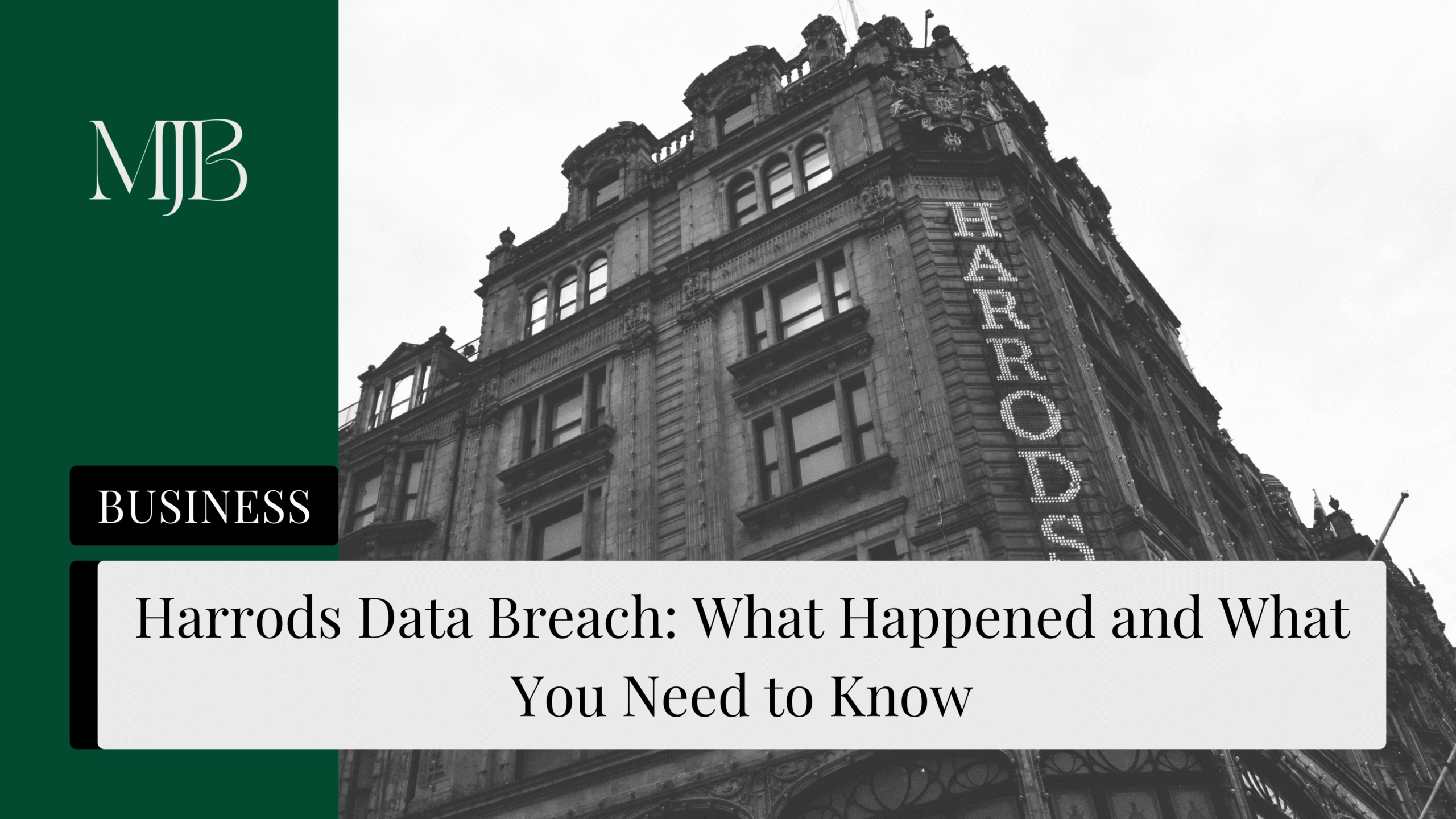
Luxury shopping just got a little less secure. Harrods recently confirmed that some customer details were stolen after a third-party IT provider got breached. If you’ve shopped online at the iconic Knightsbridge store, your name and contact info might be floating around somewhere it shouldn’t be. Here’s what happened, what’s at risk, and why this Harrods data breach matters in today’s digital retail landscape.
What Happened in the Harrods Data Breach?
Let’s start with the good news: your credit card details and passwords are safe. The bad news? Basic personal identifiers like names, email addresses, and phone numbers were compromised.
This wasn’t a direct attack on Harrods itself. Instead, hackers targeted one of the store’s third-party vendors—a common weak link in retail cybersecurity. The data was lifted from a third-party provider’s system, not Harrods’ own infrastructure. Think of it like this—someone broke into your delivery company’s warehouse, not your actual house.
Third-party breaches are becoming the norm. Why? Because major retailers like Harrods have fortress-level security, but their suppliers? Not always. It’s easier to break in through the side door than the front gate. Harrods said the incident has been “contained” and that relevant authorities have been notified.
Is This Connected to Earlier Cyber Attacks?
Short answer: no. Back in May, Harrods restricted internet access after detecting unauthorised access attempts. Then in July, four people were arrested in connection with cyber attacks on major UK retailers, including Harrods, M&S, and Co-op. But Harrods has been clear—this latest breach is unrelated. Different incident, different vulnerability, different headache.

What Should Affected Customers Do?
If Harrods contacted you about the breach, here’s your action plan:
Watch for phishing emails. Scammers love using stolen contact details to send fake messages. If something looks off, don’t click.
Monitor your accounts. Even though payment details weren’t taken, stay alert for unusual activity.
Update your passwords. Not because they were compromised, but because it’s always a good idea. Use unique, strong passwords for every account.
Report suspicious activity. If you notice anything weird, contact Harrods or your bank immediately.
The retailer has confirmed they’re taking this seriously and working to prevent future incidents.
Why Third-Party Breaches Are a Growing Problem
Here’s the uncomfortable truth: you can do everything right and still get burnt.
Retailers depend on dozens of third-party vendors for everything from payment processing to email marketing. Each one is a potential entry point for hackers. When one falls, customer data often goes with it.
This isn’t just a Harrods problem—it’s an industry-wide vulnerability. From Target to British Airways, some of the biggest breaches in history happened through third-party systems.
The lesson? Even luxury brands with deep pockets can’t always protect you from supply chain risks.

The Bottom Line
The Harrods data breach proves that even luxury retailers aren’t immune when third-party vendors get compromised. If you’re affected, watch for phishing attempts and stay alert. Want more insights on retail cybersecurity and protecting your data? Check out our latest articles on digital safety.
FAQ
Q1: Was my payment information stolen in the Harrods breach?
A: No, your financial data is safe. Harrods confirmed that credit card details and account passwords were not compromised in this incident. Only basic personal identifiers like names and contact details were taken.
Q2: How do I know if I’m affected by the Harrods data breach?
A: Harrods is directly contacting affected e-commerce customers via email or notification. If you haven’t received any communication from them, you’re likely in the clear. Keep an eye on your inbox just in case.
Q3: Is this breach connected to the earlier Harrods cyber attacks?
A: No, this is a separate incident. The May unauthorised access attempts and July arrests involving UK retailers are unrelated to this third-party provider breach. Each incident involved different vulnerabilities and attack vectors.
Q4: What should I do if I receive suspicious emails after the breach?
A: Don’t click on any links or provide personal information, no matter how legitimate the email looks. Report the suspicious message to Harrods’ customer service immediately and delete it from your inbox.
Q5: Can I still shop safely at Harrods after this breach?
A: Yes, you can continue shopping with confidence. The breach occurred at a third-party provider, not within Harrods’ own systems. The incident has been contained, and Harrods is working to enhance security across its supply chain.
DISCLAIMER
Effective Date: 15th July 2025
The information provided on this website is for informational and educational purposes only and reflects the personal opinions of the author(s). It is not intended as financial, investment, tax, or legal advice.
We are not certified financial advisers. None of the content on this website constitutes a recommendation to buy, sell, or hold any financial product, asset, or service. You should not rely on any information provided here to make financial decisions.
We strongly recommend that you:
- Conduct your own research and due diligence
- Consult with a qualified financial adviser or professional before making any investment or financial decisions
While we strive to ensure that all information is accurate and up to date, we make no guarantees about the completeness, reliability, or suitability of any content on this site.
By using this website, you acknowledge and agree that we are not responsible for any financial loss, damage, or decisions made based on the content presented.
MORE NEWS








Disclosure & Editorial Standards
MJBurrows is not authorised or regulated by the Financial Conduct Authority (FCA). The content on this website — including articles, calculators, and tools — is for general informational and educational purposes only. It does not constitute personal financial, investment, tax, or legal advice and does not take into account your individual circumstances, financial situation, or objectives.
Nothing on this site is a personal recommendation to buy, sell, hold, or otherwise deal in any financial product, asset, or service. You should always conduct your own research and seek advice from a qualified, FCA-regulated financial adviser before making any financial decisions.
Our calculators produce estimates based on simplified models using HMRC-published rates for the current tax year. They cannot account for every individual circumstance and should not be relied upon as exact figures. Tax rules and rates may change — verify current rates with HMRC or a qualified tax adviser.
Projections are not guarantees. Where our tools show future values (investment growth, pension projections, compound interest), these are hypothetical illustrations based on assumed growth rates. Past performance does not guarantee future results. The value of investments can go down as well as up.
Market data displayed on this site is provided by third-party sources including Twelve Data, Yahoo Finance, and CoinGecko. We do not guarantee the accuracy, completeness, or timeliness of third-party data.
This content is designed for UK residents and reflects UK tax rules, thresholds, and legislation. It may not apply to other jurisdictions.
Using this website does not create a professional-client relationship of any kind. MJBurrows is not responsible for any financial loss, damage, or decision made based on the content presented. By using this site, you accept these terms.
This disclaimer may be updated from time to time without prior notice. Last reviewed: 23 April 2026.
MJBurrows is an independent UK personal finance publication, written and edited by Matthew Burrows. There is no parent company, no investor group, and no advertising sales team — decisions about what to cover and how to frame it are made by Matthew alone. Our full Editorial Policy sets out how the site operates in detail.
Commercial model. As of April 2026, MJBurrows generates no revenue. The site carries no display advertising, no affiliate links, no sponsored content, no paid product placements, and no pay-for-coverage arrangements. If this changes in future, it will be disclosed openly on the Editorial Policy page.
Sources. Articles and tools reference primary sources — HM Revenue & Customs (HMRC), gov.uk, the Bank of England, the Office for National Statistics (ONS), the Financial Conduct Authority (FCA), Companies House, and UK government departmental publications (DWP, Treasury). Calculator data uses HMRC-published rates for the 2026/27 tax year. Market data (tickers, asset prices) is provided by Twelve Data, Yahoo Finance, and CoinGecko.
Verification. Every published article is fact-checked before going live. Numerical claims are traced to their primary source, quotes are checked against the original speaker or document, and calculator outputs are tested against HMRC worked examples. See our verification and accuracy policy for the full process.
Corrections. If you spot an error, please report it via the Corrections page. A three-tier severity system commits to specific response times:
- Tier 1 — Urgent (material reader harm, defamatory statements, regulatory or legal issues): acknowledged within 24 hours, page actioned within 24 hours, correction published within 48 hours of confirmation.
- Tier 2 — High (significant factual errors that misinform readers): acknowledged within 3 working days, correction published within 7 working days of confirmation.
- Tier 3 — Standard (minor factual errors, dated references, missing context): acknowledged within 7 working days, correction published at the next regular content review (within the quarter).
Significant corrections are logged on the public Corrections log.
Updates and review cadence. Calculators are reviewed at least quarterly, plus event-driven updates when HMRC publishes new rates (Budget, Autumn Statement, new tax year). Guides are reviewed at least twice a year, with major rewrites whenever underlying regulation changes. Tax-year-sensitive content is prioritised for review at the April tax-year transition.
Get in touch. For editorial enquiries — corrections, story tips, reader questions — the address is contact@mjburrows.com. The contact page is at mjburrows.com/contact. Every email is read personally by Matthew.