

Gold Price Soars to New All-Time High of $3,616
Gold prices smashed through the $3,600 barrier on Monday, hitting a stunning new record of $3,616 as investors pile into the precious metal. This latest gold rally comes just days after the yellow metal crossed the $3,500 threshold, cementing its position as 2025’s standout safe-haven investment.
What’s driving gold to these historic heights? A storm of Trump’s escalating Federal Reserve battle, weak jobs data fueling interest rate cut expectations, and growing concerns over central bank independence. With gold prices averaging $3,675/oz by Q4 2025 according to J.P. Morgan forecasts, this rally shows no signs of slowing.
“Gold keeps delivering,” says Neil Wilson from Saxo Markets, capturing the sentiment driving institutional and retail investors alike towards precious metals.
Trump Fed Independence Controversy Fuels Gold Demand
The Trump administration’s unprecedented attack on Federal Reserve independence has become a major catalyst for gold investment. President Trump’s attempt to fire Fed Governor Lisa Cook represents the first time in US history a president has tried to remove a Federal Reserve official.
This political interference with monetary policy is sending shockwaves through financial markets. When Trump announced Cook’s dismissal, gold prices jumped 0.5% in a single trading session, with investors viewing political chaos as bullish for precious metals.
The White House hasn’t held back its criticism either. Press Secretary Karoline Leavitt blamed Fed Chair Jerome Powell for weak economic data, calling him “Too Late” and claiming his policies are sabotaging Trump’s economic agenda.

Interest Rate Cut Expectations Drive Gold Rally
Friday’s disappointing jobs report has dramatically increased the probability of Federal Reserve rate cuts. With only 22,000 jobs added in August and unemployment rising to 4.3%, traders are now betting heavily on monetary easing.
Gold price forecasts for 2025 range between $3,500-$3,800, with some analysts predicting peaks near $5,155 by 2030. The CME’s FedWatcher tool shows a nearly 90% probability of a 25 basis point rate reduction on 17th September.
Why Gold Thrives When Interest Rates Fall
Gold’s appeal intensifies during periods of falling interest rates because the precious metal doesn’t pay dividends or interest. When bonds and savings accounts offer lower returns, the opportunity cost of holding gold decreases significantly.
This dynamic explains why gold ETF demand was particularly strong in H1 2025, with notable inflows from all regions as investors position for a lower rate environment.
Mining Stocks Rally on Gold Price Surge
London’s gold mining sector is capitalising on record precious metal prices. Key performers include:
- Fresnillo: Up over 2% to 2,164.00p
- Hochschild Mining: Rallied 4%+ to 339.60p on the FTSE 250
Mining companies offer leveraged exposure to gold price movements, often delivering amplified returns when precious metal prices surge. However, they also carry additional operational risks that pure gold investments avoid.

Gold Investment Outlook: What’s Next?
With Trump’s Fed confrontation escalating and economic data showing weakness, multiple factors support continued gold strength:
Bullish Factors:
- Persistent central bank buying (projected 900 tonnes in 2025)
- US dollar weakness and geopolitical uncertainty
- Inflation concerns and monetary policy uncertainty
- Growing institutional adoption of gold ETFs
Key Price Levels to Watch:
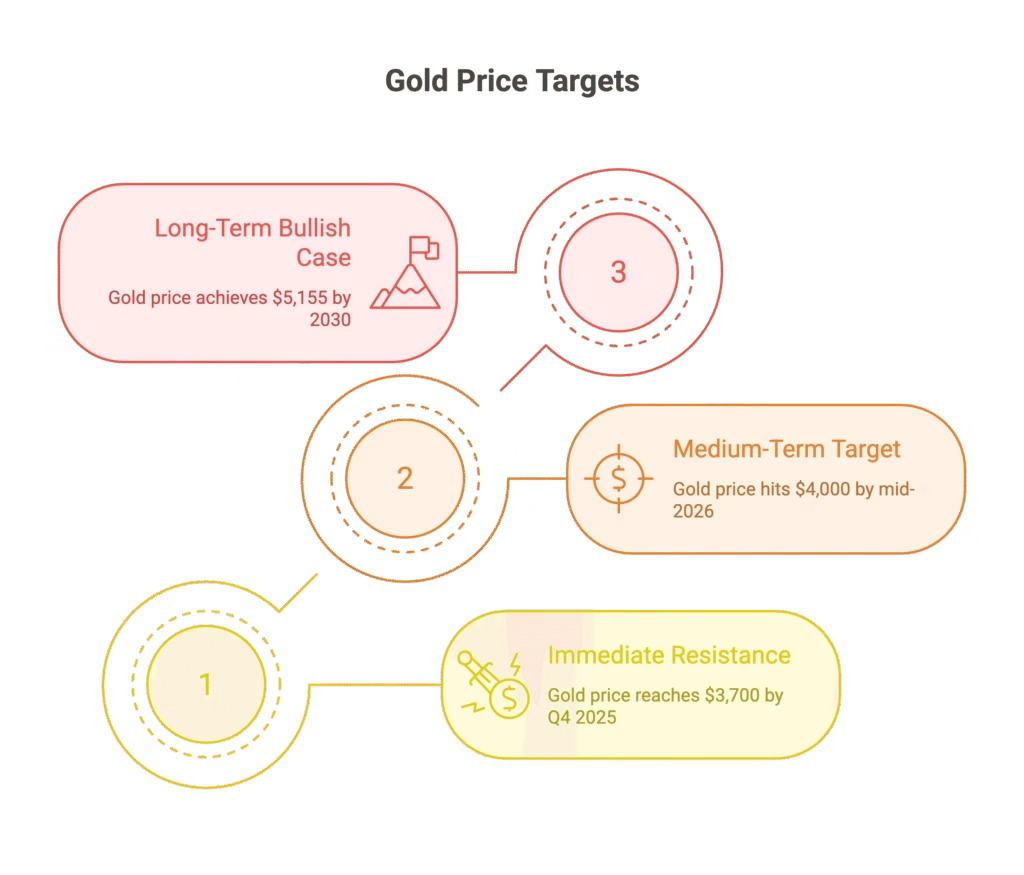
- Immediate resistance: $3,700 (Q4 2025 target)
- Medium-term target: $4,000 by mid-2026
- Long-term bullish case: $5,155 by 2030
For investors considering gold exposure, options include physical gold, ETFs, and mining stocks, each offering different risk-reward profiles in this volatile environment.
Frequently Asked Questions
Q1: Why is gold hitting record highs in 2025?
A: Multiple factors are driving gold to new records: Trump’s attacks on Fed independence, weak jobs data increasing rate cut odds, persistent geopolitical uncertainty, and strong central bank buying. Gold has risen 26% in the first half of 2025 alone.
Q2: How do Federal Reserve rate cuts affect gold prices?
A: Lower interest rates reduce the opportunity cost of holding non-yielding assets like gold. When bonds and savings accounts pay less, investors become more willing to own gold, which doesn’t pay interest but offers inflation protection and capital appreciation potential.
Q3: Should I buy gold mining stocks or physical gold?
A: Mining stocks offer leveraged exposure to gold prices with higher potential returns but greater volatility and operational risks. Physical gold provides direct exposure with lower volatility. Many investors diversify across both for balanced precious metals exposure.
Q4: What are expert gold price predictions for 2025-2026?
A: Major institutions forecast gold averaging $3,675/oz by Q4 2025 (J.P. Morgan) with targets near $4,000 by mid-2026. Long-term forecasts suggest potential peaks of $5,155 by 2030, driven by continued monetary uncertainty and geopolitical risks.
Q5: How does Trump’s Fed battle impact gold investment strategy?
A: Political interference with central bank independence creates monetary policy uncertainty, traditionally bullish for gold. If Trump gains Fed control and cuts rates aggressively, gold could benefit from currency debasement fears and inflation expectations.
DISCLAIMER
Effective Date: 15th July 2025
The information provided on this website is for informational and educational purposes only and reflects the personal opinions of the author(s). It is not intended as financial, investment, tax, or legal advice.
We are not certified financial advisers. None of the content on this website constitutes a recommendation to buy, sell, or hold any financial product, asset, or service. You should not rely on any information provided here to make financial decisions.
We strongly recommend that you:
- Conduct your own research and due diligence
- Consult with a qualified financial adviser or professional before making any investment or financial decisions
While we strive to ensure that all information is accurate and up to date, we make no guarantees about the completeness, reliability, or suitability of any content on this site.
By using this website, you acknowledge and agree that we are not responsible for any financial loss, damage, or decisions made based on the content presented.
MORE NEWS







Disclosure & Editorial Standards
MJBurrows is not authorised or regulated by the Financial Conduct Authority (FCA). The content on this website — including articles, calculators, and tools — is for general informational and educational purposes only. It does not constitute personal financial, investment, tax, or legal advice and does not take into account your individual circumstances, financial situation, or objectives.
Nothing on this site is a personal recommendation to buy, sell, hold, or otherwise deal in any financial product, asset, or service. You should always conduct your own research and seek advice from a qualified, FCA-regulated financial adviser before making any financial decisions.
Our calculators produce estimates based on simplified models using HMRC-published rates for the current tax year. They cannot account for every individual circumstance and should not be relied upon as exact figures. Tax rules and rates may change — verify current rates with HMRC or a qualified tax adviser.
Projections are not guarantees. Where our tools show future values (investment growth, pension projections, compound interest), these are hypothetical illustrations based on assumed growth rates. Past performance does not guarantee future results. The value of investments can go down as well as up.
Market data displayed on this site is provided by third-party sources including Twelve Data, Yahoo Finance, and CoinGecko. We do not guarantee the accuracy, completeness, or timeliness of third-party data.
This content is designed for UK residents and reflects UK tax rules, thresholds, and legislation. It may not apply to other jurisdictions.
Using this website does not create a professional-client relationship of any kind. MJBurrows is not responsible for any financial loss, damage, or decision made based on the content presented. By using this site, you accept these terms.
This disclaimer may be updated from time to time without prior notice. Last reviewed: 23 April 2026.
MJBurrows is an independent UK personal finance publication, written and edited by Matthew Burrows. There is no parent company, no investor group, and no advertising sales team — decisions about what to cover and how to frame it are made by Matthew alone. Our full Editorial Policy sets out how the site operates in detail.
Commercial model. As of April 2026, MJBurrows generates no revenue. The site carries no display advertising, no affiliate links, no sponsored content, no paid product placements, and no pay-for-coverage arrangements. If this changes in future, it will be disclosed openly on the Editorial Policy page.
Sources. Articles and tools reference primary sources — HM Revenue & Customs (HMRC), gov.uk, the Bank of England, the Office for National Statistics (ONS), the Financial Conduct Authority (FCA), Companies House, and UK government departmental publications (DWP, Treasury). Calculator data uses HMRC-published rates for the 2026/27 tax year. Market data (tickers, asset prices) is provided by Twelve Data, Yahoo Finance, and CoinGecko.
Verification. Every published article is fact-checked before going live. Numerical claims are traced to their primary source, quotes are checked against the original speaker or document, and calculator outputs are tested against HMRC worked examples. See our verification and accuracy policy for the full process.
Corrections. If you spot an error, please report it via the Corrections page. A three-tier severity system commits to specific response times:
- Tier 1 — Urgent (material reader harm, defamatory statements, regulatory or legal issues): acknowledged within 24 hours, page actioned within 24 hours, correction published within 48 hours of confirmation.
- Tier 2 — High (significant factual errors that misinform readers): acknowledged within 3 working days, correction published within 7 working days of confirmation.
- Tier 3 — Standard (minor factual errors, dated references, missing context): acknowledged within 7 working days, correction published at the next regular content review (within the quarter).
Significant corrections are logged on the public Corrections log.
Updates and review cadence. Calculators are reviewed at least quarterly, plus event-driven updates when HMRC publishes new rates (Budget, Autumn Statement, new tax year). Guides are reviewed at least twice a year, with major rewrites whenever underlying regulation changes. Tax-year-sensitive content is prioritised for review at the April tax-year transition.
Get in touch. For editorial enquiries — corrections, story tips, reader questions — the address is contact@mjburrows.com. The contact page is at mjburrows.com/contact. Every email is read personally by Matthew.