

British stocks are meant to be boring… right? Well, the FTSE 100 just flipped the script, smashing through 9,000 points for the first time ever while other global markets are stuck in neutral.
London’s blue-chip index peaked at 9,016.98 points Tuesday morning, pushing year-to-date gains to a spicy 10.3%. That’s not just good — it’s beating Wall Street’s S&P 500, Paris’s CAC 40, and pretty much everyone except Germany’s DAX (which got a steroid shot from their new chancellor’s spending spree).
Why London’s Suddenly the Cool Kid
Plot twist: while Trump’s tariff tantrums have other markets sweating bullets, the UK’s become the financial world’s favourite safe house.
Since Britain locked down that trade deal with Washington in May — first country to do so, by the way — London stocks have climbed nearly 5% in just two months. Meanwhile, the EU and US are still haggling over trade terms like they’re buying a used car.
“It took eight years for the FTSE to go from 7,000 to 8,000, yet only two years to break through 9,000,” notes Dan Coatsworth from AJ Bell. Translation? London’s stock market just went from zero to hero faster than you can say “Brexit who?”

Defence Stocks and Miners Are Printing Money
The FTSE’s secret sauce? It’s packed with exactly the kind of companies that thrive when the world gets messy — miners, energy firms, and defence contractors.
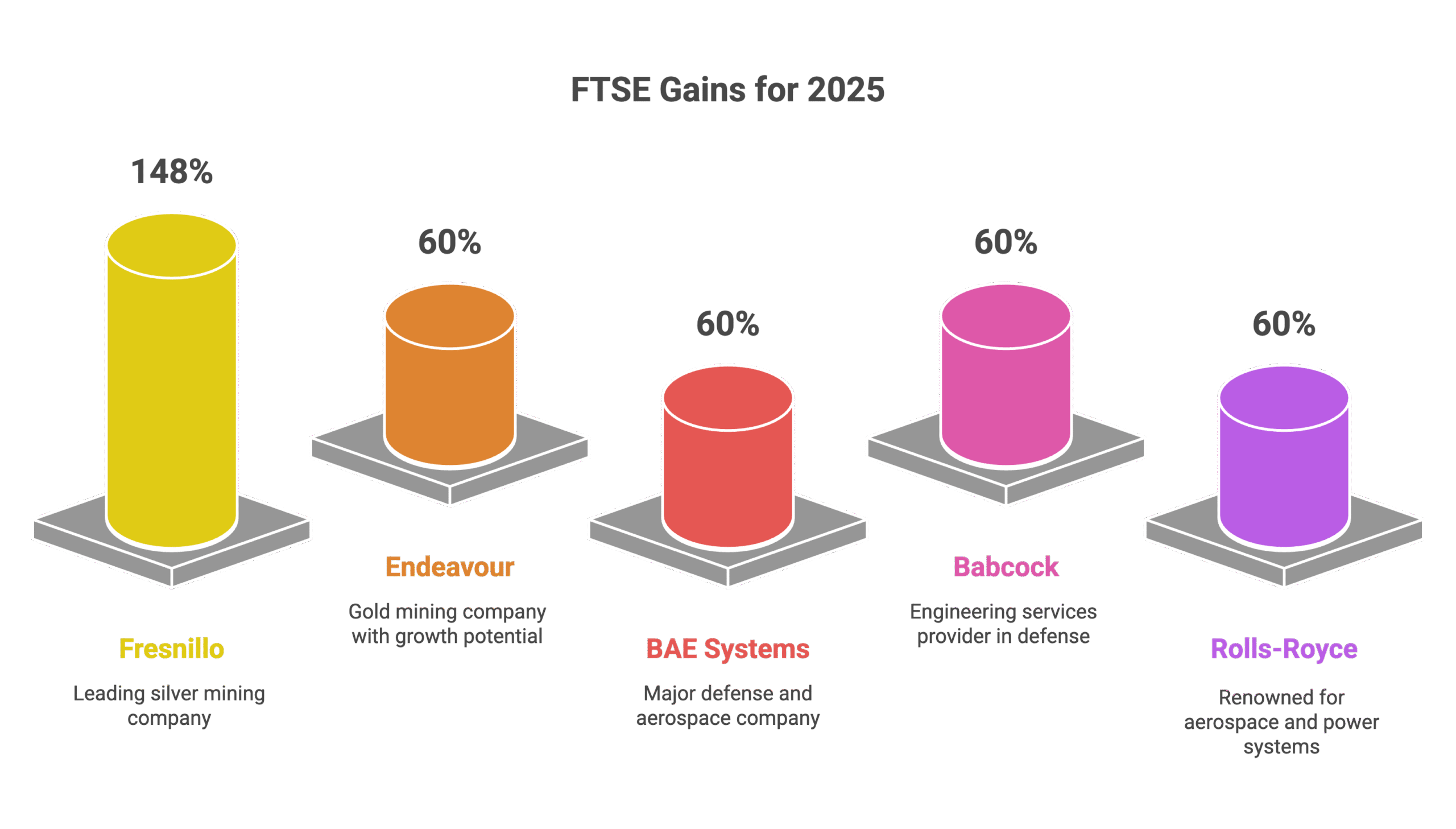
Check out these monster gains for 2025:
- Fresnillo (mining): +148%
- Endeavour (mining): +60%
- BAE Systems, Babcock, Rolls-Royce (defence): All up 60%+
With Western countries ramping up military spending and precious metals going vertical, these sectors are basically printing money. Rolls-Royce even snagged a massive government nuclear contract because apparently making jet engines wasn’t enough.
The Stability Factor Nobody’s Talking About
While Europe’s dealing with shaky coalition governments and the US is… well, being the US, Britain’s offering something radical: political predictability.
“The UK offers relative political stability compared to other parts of the world,” says John Moore from RBC Brewin Dolphin. Sure, there might be some tax hikes coming, but at least everyone knows who’s running the show for the next few years.
Bottom Line
The FTSE 100 hitting 9,000 isn’t just a number — it’s London giving the finger to everyone who wrote off UK markets. While other exchanges are playing defence against trade wars and political drama, British stocks are quietly off to the races.
Want to ride this wave? Keep an eye on defence stocks and commodity plays. They’re the ones driving this rally, and with global uncertainty not going anywhere, they might just keep the party going.
FAQ
Q1: Is the FTSE 100 outperforming US stocks?
A: Yes, the FTSE’s 10.3% gain in 2025 is beating the S&P 500. Only Germany’s DAX has performed better among major indices.
Q2: Which sectors are driving the FTSE’s gains?
A: Defence companies and miners are the big winners, with some stocks up over 100%. Banking and retail giants like Next and Tesco are also contributing.
Q3: Why is London seen as a ‘safe haven’ now?
A: The UK’s early trade deal with the US and relative political stability are attracting investors seeking shelter from tariff uncertainties elsewhere.
Q4: How long did it take to go from 8,000 to 9,000 points?
A: Just two years — compared to eight years for the jump from 7,000 to 8,000. The pace of gains has accelerated dramatically.
Q5: Should investors expect more gains?
A: With ongoing geopolitical tensions benefiting defence stocks and commodities, analysts suggest the momentum could continue, though nothing’s guaranteed.
DISCLAIMER
Effective Date: 15th July 2025
The information provided on this website is for informational and educational purposes only and reflects the personal opinions of the author(s). It is not intended as financial, investment, tax, or legal advice.
We are not certified financial advisers. None of the content on this website constitutes a recommendation to buy, sell, or hold any financial product, asset, or service. You should not rely on any information provided here to make financial decisions.
We strongly recommend that you:
- Conduct your own research and due diligence
- Consult with a qualified financial adviser or professional before making any investment or financial decisions
While we strive to ensure that all information is accurate and up to date, we make no guarantees about the completeness, reliability, or suitability of any content on this site.
By using this website, you acknowledge and agree that we are not responsible for any financial loss, damage, or decisions made based on the content presented.
MORE NEWS








Disclosure & Editorial Standards
MJBurrows is not authorised or regulated by the Financial Conduct Authority (FCA). The content on this website — including articles, calculators, and tools — is for general informational and educational purposes only. It does not constitute personal financial, investment, tax, or legal advice and does not take into account your individual circumstances, financial situation, or objectives.
Nothing on this site is a personal recommendation to buy, sell, hold, or otherwise deal in any financial product, asset, or service. You should always conduct your own research and seek advice from a qualified, FCA-regulated financial adviser before making any financial decisions.
Our calculators produce estimates based on simplified models using HMRC-published rates for the current tax year. They cannot account for every individual circumstance and should not be relied upon as exact figures. Tax rules and rates may change — verify current rates with HMRC or a qualified tax adviser.
Projections are not guarantees. Where our tools show future values (investment growth, pension projections, compound interest), these are hypothetical illustrations based on assumed growth rates. Past performance does not guarantee future results. The value of investments can go down as well as up.
Market data displayed on this site is provided by third-party sources including Twelve Data, Yahoo Finance, and CoinGecko. We do not guarantee the accuracy, completeness, or timeliness of third-party data.
This content is designed for UK residents and reflects UK tax rules, thresholds, and legislation. It may not apply to other jurisdictions.
Using this website does not create a professional-client relationship of any kind. MJBurrows is not responsible for any financial loss, damage, or decision made based on the content presented. By using this site, you accept these terms.
This disclaimer may be updated from time to time without prior notice. Last reviewed: 23 April 2026.
MJBurrows is an independent UK personal finance publication, written and edited by Matthew Burrows. There is no parent company, no investor group, and no advertising sales team — decisions about what to cover and how to frame it are made by Matthew alone. Our full Editorial Policy sets out how the site operates in detail.
Commercial model. As of April 2026, MJBurrows generates no revenue. The site carries no display advertising, no affiliate links, no sponsored content, no paid product placements, and no pay-for-coverage arrangements. If this changes in future, it will be disclosed openly on the Editorial Policy page.
Sources. Articles and tools reference primary sources — HM Revenue & Customs (HMRC), gov.uk, the Bank of England, the Office for National Statistics (ONS), the Financial Conduct Authority (FCA), Companies House, and UK government departmental publications (DWP, Treasury). Calculator data uses HMRC-published rates for the 2026/27 tax year. Market data (tickers, asset prices) is provided by Twelve Data, Yahoo Finance, and CoinGecko.
Verification. Every published article is fact-checked before going live. Numerical claims are traced to their primary source, quotes are checked against the original speaker or document, and calculator outputs are tested against HMRC worked examples. See our verification and accuracy policy for the full process.
Corrections. If you spot an error, please report it via the Corrections page. A three-tier severity system commits to specific response times:
- Tier 1 — Urgent (material reader harm, defamatory statements, regulatory or legal issues): acknowledged within 24 hours, page actioned within 24 hours, correction published within 48 hours of confirmation.
- Tier 2 — High (significant factual errors that misinform readers): acknowledged within 3 working days, correction published within 7 working days of confirmation.
- Tier 3 — Standard (minor factual errors, dated references, missing context): acknowledged within 7 working days, correction published at the next regular content review (within the quarter).
Significant corrections are logged on the public Corrections log.
Updates and review cadence. Calculators are reviewed at least quarterly, plus event-driven updates when HMRC publishes new rates (Budget, Autumn Statement, new tax year). Guides are reviewed at least twice a year, with major rewrites whenever underlying regulation changes. Tax-year-sensitive content is prioritised for review at the April tax-year transition.
Get in touch. For editorial enquiries — corrections, story tips, reader questions — the address is contact@mjburrows.com. The contact page is at mjburrows.com/contact. Every email is read personally by Matthew.