
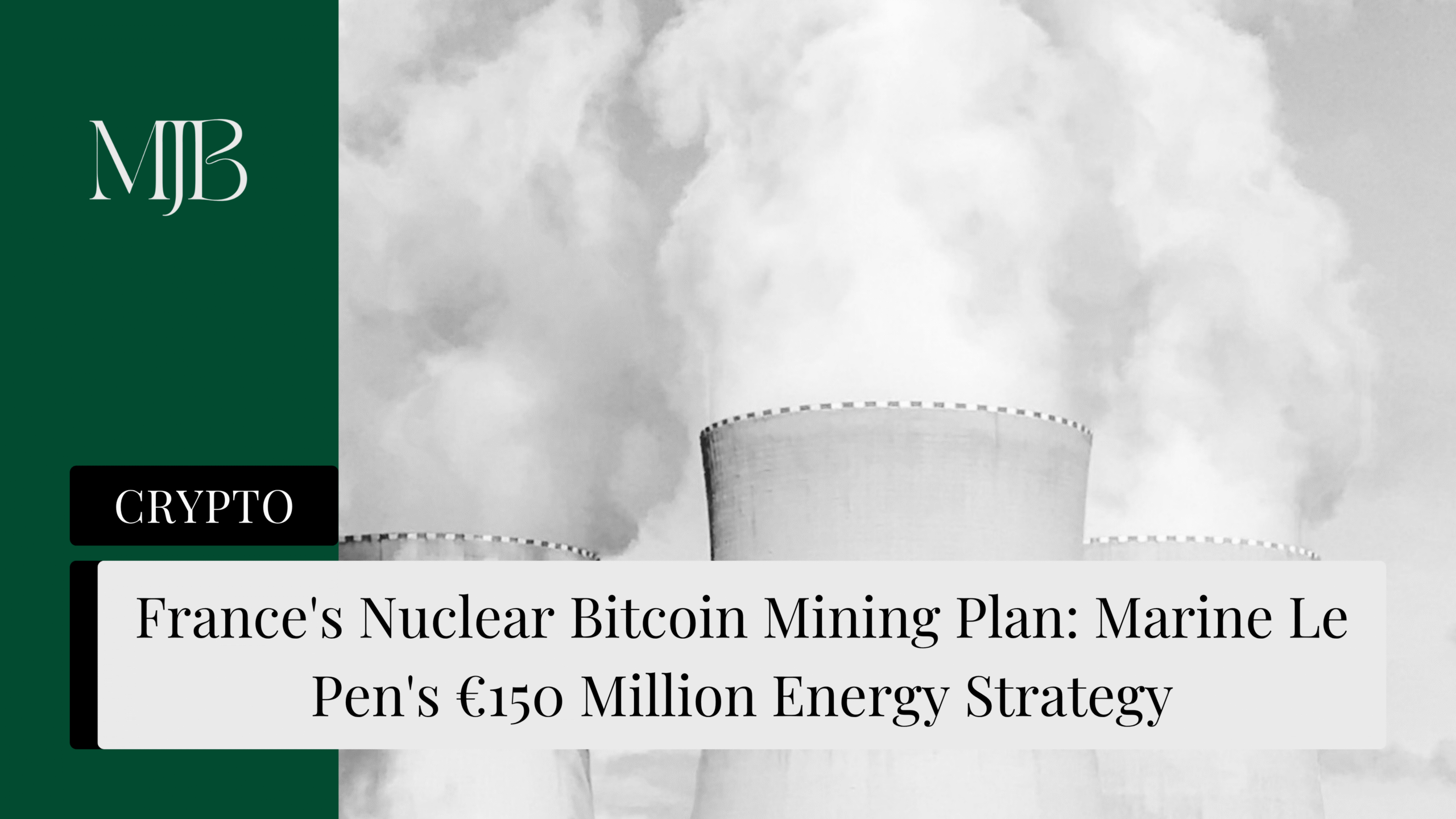
France’s far-right Rassemblement National party is drafting groundbreaking Bitcoin mining legislation that could generate up to €150 million annually. Led by Marine Le Pen, this nuclear-powered Bitcoin mining initiative transforms France’s energy waste problem into digital gold, marking a complete reversal from Le Pen’s 2016 crypto ban stance.
French lawmakers propose using surplus nuclear energy from state utility Électricité de France (EDF) to power Bitcoin mining operations. With France producing over 338,000 gigawatt hours of nuclear electricity annually — losing €80 million on surplus energy sales in 2024 — this five-year pilot programme could revolutionise European cryptocurrency mining while stabilising the power grid.
France’s Nuclear Bitcoin Mining Revolution: From Energy Waste to Crypto Profits
France dominates European nuclear energy production, generating 338,202 gigawatt hours in 2023 — over half the EU’s total nuclear output. This massive nuclear infrastructure creates a unique opportunity for sustainable Bitcoin mining operations.
But, the kicker: nuclear plants are energy wastrels. More than two-thirds of the heat from nuclear fission gets lost in the process.
The economics are compelling: one gigawatt of surplus nuclear power could yield €100-150 million annually in Bitcoin revenue. MP Aurélien Lopez-Liguori, architecting the nuclear Bitcoin mining bill, calls it “a secure and extremely profitable solution” for France’s energy surplus problem.

Marine Le Pen’s Crypto U-Turn: From Bitcoin Ban to Nuclear Mining Champion
Marine Le Pen’s transformation from crypto sceptic to Bitcoin mining advocate represents a stunning political pivot. In 2016, the Rassemblement National leader demanded a complete cryptocurrency ban, warning Bitcoin threatened France’s economic sovereignty.
Fast-forward to 2025: Le Pen now champions France’s nuclear-powered Bitcoin mining strategy after visiting the Flamanville nuclear plant. This ideological shift reflects Bitcoin’s growing legitimacy in national economic planning, with Le Pen recognising cryptocurrency’s potential to monetise France’s abundant nuclear energy surplus.
Global Bitcoin Mining Trends: How Countries Monetise Energy Surplus
France’s nuclear Bitcoin mining strategy joins a growing global trend of countries leveraging energy surpluses for cryptocurrency profits.
Pakistan’s Energy-to-Crypto Strategy
Pakistan allocated 2,000 megawatts to Bitcoin mining and AI data centres in May 2025, utilising coal plants operating at just 15% capacity. This strategic pivot transforms underutilised energy infrastructure into profitable digital asset operations.
Tether’s Renewable Mining Operations
Leading stablecoin issuer Tether explores Bitcoin mining using surplus renewable energy from South American agribusiness firm Adecoagro, where Tether holds a 70% stake. This demonstrates institutional appetite for energy-efficient crypto mining solutions.
The Bottom Line
France’s nuclear Bitcoin mining proposal represents smart energy economics: transforming €80 million annual losses from surplus electricity into potential €150 million cryptocurrency profits. This five-year pilot programme could establish France as Europe’s first nation officially combining nuclear power with state-backed Bitcoin mining operations.
The legislation faces political hurdles after a similar proposal’s June rejection, but growing support from Digital Minister Clara Chappaz suggests government openness to evaluating Bitcoin mining France initiatives economically rather than ideologically.
FAQ
Q1: Is Bitcoin mining with nuclear energy safe?
A: Yes, nuclear power plants already operate safely for electricity generation. Mining operations would use the same surplus energy that’s currently wasted, with no additional safety risks.
Q2: How much revenue could France’s nuclear Bitcoin mining generate?
A: Industry estimates suggest one gigawatt of surplus nuclear power could yield €100-150 million annually in Bitcoin revenue. With France losing €80 million on surplus energy sales in 2024, this represents a potential €230 million annual swing.
Q3: Will this affect French electricity prices?
A: Unlikely. The proposal specifically targets surplus energy that’s currently lost, not energy designated for the grid. This could actually help offset operational costs.
Q4: What’s driving Marine Le Pen’s support for Bitcoin mining?
A: Le Pen’s nuclear Bitcoin mining advocacy stems from visiting the Flamanville plant and recognising cryptocurrency’s potential for French energy sovereignty. Her 2025 position reverses her 2016 Bitcoin ban stance, reflecting cryptocurrency’s mainstream acceptance in national economic strategy.
Q5: Could other European countries follow France’s nuclear Bitcoin mining model?
A: France’s success could inspire nuclear-dependent EU nations to explore similar programmes. Countries with energy surpluses increasingly view Bitcoin mining as strategic infrastructure for grid stability and revenue generation from otherwise wasted power capacity.
DISCLAIMER
Effective Date: 15th July 2025
The information provided on this website is for informational and educational purposes only and reflects the personal opinions of the author(s). It is not intended as financial, investment, tax, or legal advice.
We are not certified financial advisers. None of the content on this website constitutes a recommendation to buy, sell, or hold any financial product, asset, or service. You should not rely on any information provided here to make financial decisions.
We strongly recommend that you:
- Conduct your own research and due diligence
- Consult with a qualified financial adviser or professional before making any investment or financial decisions
While we strive to ensure that all information is accurate and up to date, we make no guarantees about the completeness, reliability, or suitability of any content on this site.
By using this website, you acknowledge and agree that we are not responsible for any financial loss, damage, or decisions made based on the content presented.
MORE NEWS








Disclosure & Editorial Standards
MJBurrows is not authorised or regulated by the Financial Conduct Authority (FCA). The content on this website — including articles, calculators, and tools — is for general informational and educational purposes only. It does not constitute personal financial, investment, tax, or legal advice and does not take into account your individual circumstances, financial situation, or objectives.
Nothing on this site is a personal recommendation to buy, sell, hold, or otherwise deal in any financial product, asset, or service. You should always conduct your own research and seek advice from a qualified, FCA-regulated financial adviser before making any financial decisions.
Our calculators produce estimates based on simplified models using HMRC-published rates for the current tax year. They cannot account for every individual circumstance and should not be relied upon as exact figures. Tax rules and rates may change — verify current rates with HMRC or a qualified tax adviser.
Projections are not guarantees. Where our tools show future values (investment growth, pension projections, compound interest), these are hypothetical illustrations based on assumed growth rates. Past performance does not guarantee future results. The value of investments can go down as well as up.
Market data displayed on this site is provided by third-party sources including Twelve Data, Yahoo Finance, and CoinGecko. We do not guarantee the accuracy, completeness, or timeliness of third-party data.
This content is designed for UK residents and reflects UK tax rules, thresholds, and legislation. It may not apply to other jurisdictions.
Using this website does not create a professional-client relationship of any kind. MJBurrows is not responsible for any financial loss, damage, or decision made based on the content presented. By using this site, you accept these terms.
This disclaimer may be updated from time to time without prior notice. Last reviewed: 23 April 2026.
MJBurrows is an independent UK personal finance publication, written and edited by Matthew Burrows. There is no parent company, no investor group, and no advertising sales team — decisions about what to cover and how to frame it are made by Matthew alone. Our full Editorial Policy sets out how the site operates in detail.
Commercial model. As of April 2026, MJBurrows generates no revenue. The site carries no display advertising, no affiliate links, no sponsored content, no paid product placements, and no pay-for-coverage arrangements. If this changes in future, it will be disclosed openly on the Editorial Policy page.
Sources. Articles and tools reference primary sources — HM Revenue & Customs (HMRC), gov.uk, the Bank of England, the Office for National Statistics (ONS), the Financial Conduct Authority (FCA), Companies House, and UK government departmental publications (DWP, Treasury). Calculator data uses HMRC-published rates for the 2026/27 tax year. Market data (tickers, asset prices) is provided by Twelve Data, Yahoo Finance, and CoinGecko.
Verification. Every published article is fact-checked before going live. Numerical claims are traced to their primary source, quotes are checked against the original speaker or document, and calculator outputs are tested against HMRC worked examples. See our verification and accuracy policy for the full process.
Corrections. If you spot an error, please report it via the Corrections page. A three-tier severity system commits to specific response times:
- Tier 1 — Urgent (material reader harm, defamatory statements, regulatory or legal issues): acknowledged within 24 hours, page actioned within 24 hours, correction published within 48 hours of confirmation.
- Tier 2 — High (significant factual errors that misinform readers): acknowledged within 3 working days, correction published within 7 working days of confirmation.
- Tier 3 — Standard (minor factual errors, dated references, missing context): acknowledged within 7 working days, correction published at the next regular content review (within the quarter).
Significant corrections are logged on the public Corrections log.
Updates and review cadence. Calculators are reviewed at least quarterly, plus event-driven updates when HMRC publishes new rates (Budget, Autumn Statement, new tax year). Guides are reviewed at least twice a year, with major rewrites whenever underlying regulation changes. Tax-year-sensitive content is prioritised for review at the April tax-year transition.
Get in touch. For editorial enquiries — corrections, story tips, reader questions — the address is contact@mjburrows.com. The contact page is at mjburrows.com/contact. Every email is read personally by Matthew.