
Think back to when crypto was just for tech nerds and Reddit traders. Well, those days are done. Wall Street’s biggest brains at Bernstein just dropped a headline-maker: we’re in for a “long and exhausting” crypto bull market. And this time? It’s not your typical pump-and-dump fiasco.
Here’s why institutional investors are betting big on digital assets — and why this rally is different to anything we’ve witnessed before.
This Isn’t Your 2017 Crypto Rally
Forget everything you think you know about past crypto cycles. Bernstein analysts just revealed their “conviction in blockchain and digital assets has never been higher.” Bold words from a firm that doesn’t throw around superlatives lightly.
What’s changed? Three game-changers:
Regulatory clarity is finally here. The SEC launched a Crypto Task Force. The EU rolled out MiCA regulations. Even Congress is pushing major crypto bills through. No more regulatory hit and hope.
Institutions aren’t just dipping toes — they’re diving in. Bitcoin ETFs are pulling serious money. Major firms are building dedicated crypto desks. This isn’t retail FOMO; it’s calculated institutional allocation.
Governments want in on the action. Countries are exploring Bitcoin reserves. Central banks are testing digital currencies. When nations start HODLing, you know something’s shifted.

The Real Story: Building a New Financial System
The spicy bit. Bernstein isn’t just bullish on Bitcoin — they’re calling this the foundation of an “internet-native financial system.”
Think bigger than just sending money. We’re talking:
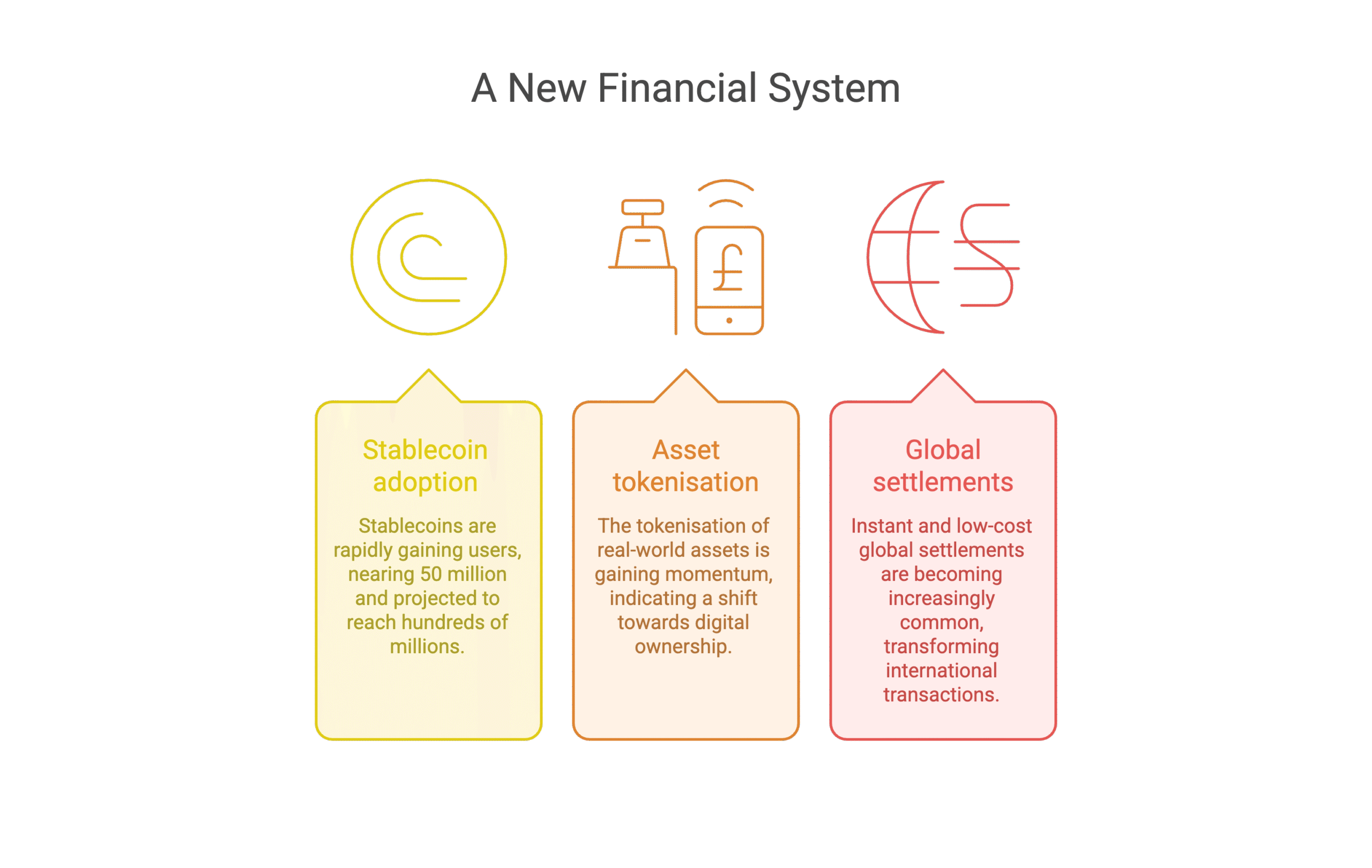
- Stablecoins approaching 50 million users (headed for hundreds of millions)
- Tokenisation of real-world assets gaining steam
- Instant, low-cost global settlements becoming the norm
“We are in the build-out and installation phase,” the analysts noted. Translation? We’re watching the financial equivalent of the early internet being built.
Why This Bull Market Feels Different
Past rallies rode on Bitcoin halving hype and retail speculation. This time? The momentum comes from structural shifts that aren’t going away.
Public blockchains like Ethereum and Solana are becoming legitimate infrastructure. Banking, payments, and commerce are integrating crypto tools. It’s less “when moon?” and more “how do we build on this?”
Bernstein called it “a rather long and exhausting crypto bull market.” They’re not predicting a quick spike — they’re forecasting a marathon of growth.
The Bottom Line
Wall Street’s smartest money managers aren’t just tolerating crypto anymore — they’re embracing it as the future of finance. With regulatory frameworks solidifying, institutions piling in, and real-world use cases multiplying, this bull market has legs.
Ready to dive deeper into crypto’s institutional revolution? Start tracking stablecoin adoption metrics and tokenisation projects. The next phase of finance is being built right now.
FAQ
Q1: How is this crypto bull market different from previous ones?
A: Unlike past cycles driven mainly by Bitcoin halvings and retail speculation, this rally is powered by institutional adoption, regulatory clarity, and government involvement. It’s a structural shift, not just another price pump.
Q2: What role are stablecoins playing in this bull market?
A: Stablecoins are the gateway drug of crypto adoption, with nearly 50 million wallet users already. Bernstein sees them as the first blockchain application to hit critical mass, paving the way for mainstream financial integration.
Q3: Why are analysts calling it a “long and exhausting” bull market?
A: This isn’t a quick spike — it’s a sustained build-out phase of new financial infrastructure. Think years of steady growth and development rather than months of explosive gains.
Q4: What’s driving institutional confidence in crypto now?
A: Clear regulations (like the EU’s MiCA), dedicated oversight (SEC’s Crypto Task Force), and proven use cases in payments and asset tokenization. The Wild West days are ending, making room for serious money.
Q5: What should investors watch for next?
A: Keep an eye on tokenization projects, stablecoin adoption rates, and integration with traditional banking systems. These are the building blocks of the “internet-native financial system” Bernstein predicts.
DISCLAIMER
Effective Date: 15th July 2025
The information provided on this website is for informational and educational purposes only and reflects the personal opinions of the author(s). It is not intended as financial, investment, tax, or legal advice.
We are not certified financial advisers. None of the content on this website constitutes a recommendation to buy, sell, or hold any financial product, asset, or service. You should not rely on any information provided here to make financial decisions.
We strongly recommend that you:
- Conduct your own research and due diligence
- Consult with a qualified financial adviser or professional before making any investment or financial decisions
While we strive to ensure that all information is accurate and up to date, we make no guarantees about the completeness, reliability, or suitability of any content on this site.
By using this website, you acknowledge and agree that we are not responsible for any financial loss, damage, or decisions made based on the content presented.
MORE NEWS








Disclosure & Editorial Standards
MJBurrows is not authorised or regulated by the Financial Conduct Authority (FCA). The content on this website — including articles, calculators, and tools — is for general informational and educational purposes only. It does not constitute personal financial, investment, tax, or legal advice and does not take into account your individual circumstances, financial situation, or objectives.
Nothing on this site is a personal recommendation to buy, sell, hold, or otherwise deal in any financial product, asset, or service. You should always conduct your own research and seek advice from a qualified, FCA-regulated financial adviser before making any financial decisions.
Our calculators produce estimates based on simplified models using HMRC-published rates for the current tax year. They cannot account for every individual circumstance and should not be relied upon as exact figures. Tax rules and rates may change — verify current rates with HMRC or a qualified tax adviser.
Projections are not guarantees. Where our tools show future values (investment growth, pension projections, compound interest), these are hypothetical illustrations based on assumed growth rates. Past performance does not guarantee future results. The value of investments can go down as well as up.
Market data displayed on this site is provided by third-party sources including Twelve Data, Yahoo Finance, and CoinGecko. We do not guarantee the accuracy, completeness, or timeliness of third-party data.
This content is designed for UK residents and reflects UK tax rules, thresholds, and legislation. It may not apply to other jurisdictions.
Using this website does not create a professional-client relationship of any kind. MJBurrows is not responsible for any financial loss, damage, or decision made based on the content presented. By using this site, you accept these terms.
This disclaimer may be updated from time to time without prior notice. Last reviewed: 23 April 2026.
MJBurrows is an independent UK personal finance publication, written and edited by Matthew Burrows. There is no parent company, no investor group, and no advertising sales team — decisions about what to cover and how to frame it are made by Matthew alone. Our full Editorial Policy sets out how the site operates in detail.
Commercial model. As of April 2026, MJBurrows generates no revenue. The site carries no display advertising, no affiliate links, no sponsored content, no paid product placements, and no pay-for-coverage arrangements. If this changes in future, it will be disclosed openly on the Editorial Policy page.
Sources. Articles and tools reference primary sources — HM Revenue & Customs (HMRC), gov.uk, the Bank of England, the Office for National Statistics (ONS), the Financial Conduct Authority (FCA), Companies House, and UK government departmental publications (DWP, Treasury). Calculator data uses HMRC-published rates for the 2026/27 tax year. Market data (tickers, asset prices) is provided by Twelve Data, Yahoo Finance, and CoinGecko.
Verification. Every published article is fact-checked before going live. Numerical claims are traced to their primary source, quotes are checked against the original speaker or document, and calculator outputs are tested against HMRC worked examples. See our verification and accuracy policy for the full process.
Corrections. If you spot an error, please report it via the Corrections page. A three-tier severity system commits to specific response times:
- Tier 1 — Urgent (material reader harm, defamatory statements, regulatory or legal issues): acknowledged within 24 hours, page actioned within 24 hours, correction published within 48 hours of confirmation.
- Tier 2 — High (significant factual errors that misinform readers): acknowledged within 3 working days, correction published within 7 working days of confirmation.
- Tier 3 — Standard (minor factual errors, dated references, missing context): acknowledged within 7 working days, correction published at the next regular content review (within the quarter).
Significant corrections are logged on the public Corrections log.
Updates and review cadence. Calculators are reviewed at least quarterly, plus event-driven updates when HMRC publishes new rates (Budget, Autumn Statement, new tax year). Guides are reviewed at least twice a year, with major rewrites whenever underlying regulation changes. Tax-year-sensitive content is prioritised for review at the April tax-year transition.
Get in touch. For editorial enquiries — corrections, story tips, reader questions — the address is contact@mjburrows.com. The contact page is at mjburrows.com/contact. Every email is read personally by Matthew.