The Great Crypto Flip That Lasted Hours
Remember when Solana had its moment in the sun? For a few glorious hours in late June, SOL muscled past BNB to claim the fifth spot in crypto rankings. At $200 per coin and a whopping $107 billion market cap, it looked like Solana was finally getting the respect it deserved.
That victory lap however, was shorter than a Hobbit. SOL quickly tumbled below $190, and BNB reclaimed its throne. Yet before you write off Solana’s comeback story, the DeFi numbers tell a different tale. This race is far from over.
DeFi Metrics Show Solana’s Real Strength
TVL Stays Strong Despite Price Drops
Here’s what caught my attention: whilst Solana’s price took a hit, its DeFi ecosystem barely flinched. The total value locked (TVL) stayed above $10 billion even as SOL’s price corrected. That signals genuine underlying demand.
The Revenue Reality Check
The original data shows some inconsistencies, but what’s clear is that Solana’s DeFi ecosystem generates significantly more activity and value than BNB’s more limited DeFi presence.
Meanwhile, BNB’s DeFi scene looks pretty quiet with just $6.832 billion in TVL. It’s like comparing a bustling marketplace to a corner shop.

Why BNB Keeps Fighting Back
The Binance Advantage
But here’s BNB’s secret weapon: it’s got Binance in its corner. Every time someone trades on the world’s largest crypto exchange, those fees get funnelled into BNB token burns. It’s like having a built-in scarcity machine that doesn’t care about market sentiment.
Binance’s market share has stayed rock-solid against both centralised and decentralised competitors. As long as people keep trading crypto (spoiler: they will), BNB gets that steady demand boost.
The Path to $200: What Needs to Happen
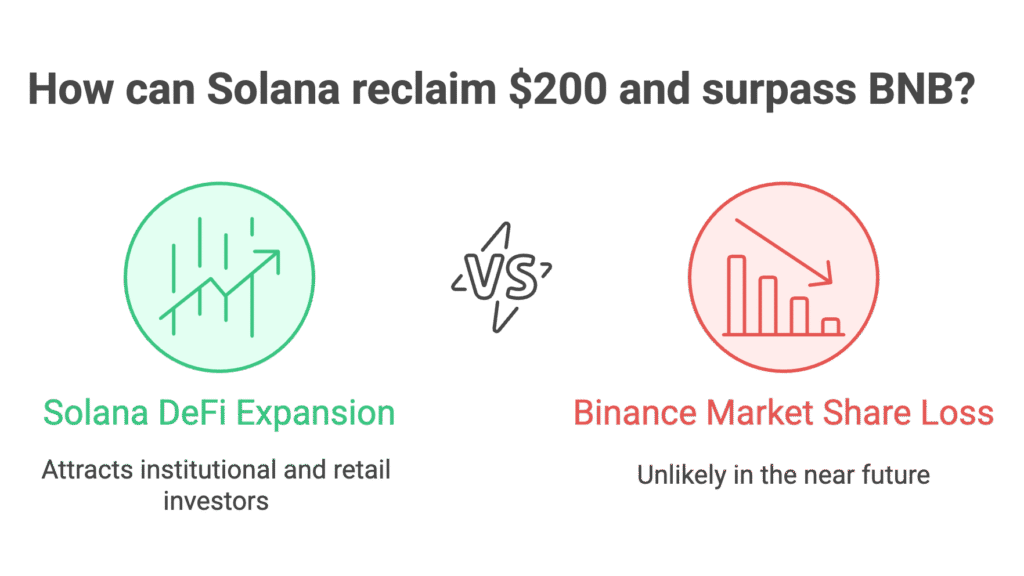
For Solana to reclaim $200 and flip BNB permanently, we’d need to see one of two things:
Option A: Solana’s DeFi ecosystem explodes even further, pulling in more institutional money and retail investors who actually use the network.
Option B: Binance loses significant market share to DeFi platforms – which, let’s be honest, isn’t happening anytime soon.
The Bottom Line
Solana’s brief moment above BNB wasn’t just a fluke. The strong DeFi fundamentals show there’s real substance behind the hype. Whilst BNB has its Binance safety net, Solana’s building an ecosystem that doesn’t need permission from any single exchange.
Will SOL hit $200 again? The DeFi metrics suggest it’s more of a “when” than an “if” question. But taking down BNB permanently? That’s a tougher battle that’ll require more than just strong fundamentals.
FAQ
Q1: Why did Solana’s price drop so quickly after hitting $200?
A: Crypto markets are volatile, and profit-taking is common at psychological levels like $200. The key is that Solana’s DeFi ecosystem stayed strong despite the price correction, showing genuine user adoption.
Q2: Is Solana’s DeFi TVL more important than its price?
A: TVL reflects actual usage and demand for the network’s services, whilst price can be driven by speculation. A high TVL with temporarily lower prices often suggests a buying opportunity for long-term investors.
Q3: Can BNB maintain its position without Binance’s support?
A: BNB’s value is closely tied to Binance’s success and token burn mechanism. Without the exchange’s backing, BNB would likely struggle to compete with more decentralised alternatives like Solana.
Q4: What would it take for Solana to permanently overtake BNB?
A: Solana would need sustained DeFi growth, institutional adoption, or a significant decline in Binance’s market dominance. The strong fundamentals are there, but timing and market conditions matter.
Q5: Should investors focus on SOL or BNB for the next bull run?
A: Both have different risk profiles. SOL offers more upside potential through DeFi growth, whilst BNB provides steadier returns tied to Binance’s trading volumes. Diversification between both could be the smart play.
DISCLAIMER
Effective Date: 15th July 2025
The information provided on this website is for informational and educational purposes only and reflects the personal opinions of the author(s). It is not intended as financial, investment, tax, or legal advice.
We are not certified financial advisers. None of the content on this website constitutes a recommendation to buy, sell, or hold any financial product, asset, or service. You should not rely on any information provided here to make financial decisions.
We strongly recommend that you:
- Conduct your own research and due diligence
- Consult with a qualified financial adviser or professional before making any investment or financial decisions
While we strive to ensure that all information is accurate and up to date, we make no guarantees about the completeness, reliability, or suitability of any content on this site.
By using this website, you acknowledge and agree that we are not responsible for any financial loss, damage, or decisions made based on the content presented.
MORE NEWS








Disclosure & Editorial Standards
MJBurrows is not authorised or regulated by the Financial Conduct Authority (FCA). The content on this website — including articles, calculators, and tools — is for general informational and educational purposes only. It does not constitute personal financial, investment, tax, or legal advice and does not take into account your individual circumstances, financial situation, or objectives.
Nothing on this site is a personal recommendation to buy, sell, hold, or otherwise deal in any financial product, asset, or service. You should always conduct your own research and seek advice from a qualified, FCA-regulated financial adviser before making any financial decisions.
Our calculators produce estimates based on simplified models using HMRC-published rates for the current tax year. They cannot account for every individual circumstance and should not be relied upon as exact figures. Tax rules and rates may change — verify current rates with HMRC or a qualified tax adviser.
Projections are not guarantees. Where our tools show future values (investment growth, pension projections, compound interest), these are hypothetical illustrations based on assumed growth rates. Past performance does not guarantee future results. The value of investments can go down as well as up.
Market data displayed on this site is provided by third-party sources including Twelve Data, Yahoo Finance, and CoinGecko. We do not guarantee the accuracy, completeness, or timeliness of third-party data.
This content is designed for UK residents and reflects UK tax rules, thresholds, and legislation. It may not apply to other jurisdictions.
Using this website does not create a professional-client relationship of any kind. MJBurrows is not responsible for any financial loss, damage, or decision made based on the content presented. By using this site, you accept these terms.
This disclaimer may be updated from time to time without prior notice. Last reviewed: 23 April 2026.
MJBurrows is an independent UK personal finance publication, written and edited by Matthew Burrows. There is no parent company, no investor group, and no advertising sales team — decisions about what to cover and how to frame it are made by Matthew alone. Our full Editorial Policy sets out how the site operates in detail.
Commercial model. As of April 2026, MJBurrows generates no revenue. The site carries no display advertising, no affiliate links, no sponsored content, no paid product placements, and no pay-for-coverage arrangements. If this changes in future, it will be disclosed openly on the Editorial Policy page.
Sources. Articles and tools reference primary sources — HM Revenue & Customs (HMRC), gov.uk, the Bank of England, the Office for National Statistics (ONS), the Financial Conduct Authority (FCA), Companies House, and UK government departmental publications (DWP, Treasury). Calculator data uses HMRC-published rates for the 2026/27 tax year. Market data (tickers, asset prices) is provided by Twelve Data, Yahoo Finance, and CoinGecko.
Verification. Every published article is fact-checked before going live. Numerical claims are traced to their primary source, quotes are checked against the original speaker or document, and calculator outputs are tested against HMRC worked examples. See our verification and accuracy policy for the full process.
Corrections. If you spot an error, please report it via the Corrections page. A three-tier severity system commits to specific response times:
- Tier 1 — Urgent (material reader harm, defamatory statements, regulatory or legal issues): acknowledged within 24 hours, page actioned within 24 hours, correction published within 48 hours of confirmation.
- Tier 2 — High (significant factual errors that misinform readers): acknowledged within 3 working days, correction published within 7 working days of confirmation.
- Tier 3 — Standard (minor factual errors, dated references, missing context): acknowledged within 7 working days, correction published at the next regular content review (within the quarter).
Significant corrections are logged on the public Corrections log.
Updates and review cadence. Calculators are reviewed at least quarterly, plus event-driven updates when HMRC publishes new rates (Budget, Autumn Statement, new tax year). Guides are reviewed at least twice a year, with major rewrites whenever underlying regulation changes. Tax-year-sensitive content is prioritised for review at the April tax-year transition.
Get in touch. For editorial enquiries — corrections, story tips, reader questions — the address is contact@mjburrows.com. The contact page is at mjburrows.com/contact. Every email is read personally by Matthew.