
Here’s some news that’ll make your accountant reach for the paracetamol: English businesses face a massive business rates increase in 2025, with commercial property taxes set to rise by £2.5bn. This business rates double whammy combines inflation adjustments with new government tax changes that are unavoidable for most companies.
Thanks to inflation running hot and questionable property tax policy decisions, your business rates bill is about to get significantly more expensive. If you thought commercial property costs were high in 2024, prepare for an even costlier 2025.
What’s Driving the 2025 Business Rates Increase?
The Perfect Storm of Commercial Property Tax Rises
Two key factors are combining to create this unprecedented business rates increase for English companies:
First, inflation-driven business rates increases. The Bank of England expects inflation to hit 4% by September 2024 – higher than previously thought, thanks to climbing food prices. Since commercial property tax rates typically increase in line with September’s Consumer Price Index (CPI), that translates to an extra £1.11bn business rates burden across English companies.
Second, new supplementary property tax multipliers. Starting April 2026, commercial properties worth over £500,000 will face a new “supplementary multiplier” of up to 10p. This business rates change affects roughly 17,000 properties nationwide and will shift about £1.38bn in costs from government-funded discounts onto larger businesses.
How Business Rates Revaluation Works
Business rates are commercial property taxes on business premises – think your local coffee shop, office building, or warehouse. They’re based on “rateable values” that get updated every few years during business rates revaluations to reflect current commercial property market conditions.
Here’s the kicker: while business rates revaluations are supposed to be “revenue neutral” (meaning the total commercial property tax take stays the same), the way that money gets distributed can shift dramatically between sectors and regions.

Which Businesses Face Higher Property Tax Bills?
Large Commercial Properties Hit Hardest by Business Rates Changes
If you’re operating from a commercial property valued above £500,000, you’re essentially subsidising smaller businesses through higher business rates. The government’s rationale? Fund permanent discounts for retail, hospitality, and leisure businesses by making larger commercial property occupiers pay more.
Alex Probyn from global tax firm Ryan stated: “Larger commercial property occupiers in particular will shoulder a disproportionate business rates burden.”
UK Commercial Property Tax Competitiveness Issues
Here’s the uncomfortable truth: the UK already has the highest commercial property taxes in the developed world. Adding another £2.5bn in business rates increases doesn’t exactly scream “business-friendly environment.”
This business rates timing couldn’t be worse, with the economy still finding its footing and companies already dealing with elevated costs across the board.
Business Rates Impact on Company Finances
The business rates calculation is straightforward, if painful:
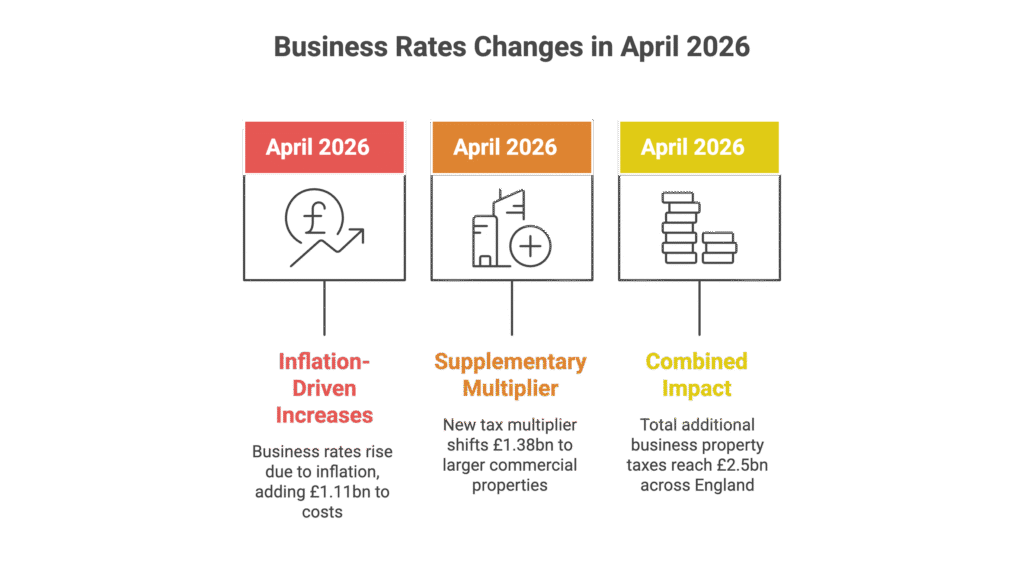
- April 2026: Inflation-driven business rates increases kick in (estimated £1.11bn total impact)
- April 2026: New supplementary multiplier hits larger commercial properties (£1.38bn shifted from government to businesses)
- Combined business rates impact: £2.5bn in additional commercial property taxes across England
For context, this isn’t just a minor business rates adjustment – it’s a significant cost increase that many companies will struggle to absorb, especially in sectors already operating on thin margins.
Business Rates Key Takeaways
English businesses face an unavoidable commercial property tax increase that’s built into the system. Between inflation adjustments and policy changes designed to shift costs from government to private sector, there’s no escaping this business rates rise.
Smart companies should start factorising these business rates increases into their financial planning now. Whether you’re a small retailer or a large corporation, your commercial property tax bill is about to get significantly more expensive.
Need help with your business rates strategy? Consider consulting with a commercial property tax specialist to understand exactly how these business rates changes will impact your specific situation.
FAQ: Business Rates Double Whammy Explained
Q1: When exactly do these business rates increases take effect?
A: The inflation-based increases start in April 2026, based on September 2024’s CPI reading. The new supplementary multiplier for larger properties also kicks in from April 2026.
Q2: Which businesses will pay the supplementary multiplier?
A: Properties with rateable values above £500,000 will face the new multiplier of up to 10p. This affects approximately 17,000 properties across England.
Q3: Are business rates the same across the entire UK?
A: No, business rates are devolved in Scotland, Wales, and Northern Ireland. These changes specifically affect England only.
Q3: Why is the government implementing these changes?
A: The supplementary multiplier is designed to fund permanent discounts for retail, hospitality, and leisure businesses. Essentially, larger businesses are subsidizing smaller ones in these sectors.
Q4: Can businesses do anything to reduce their business rates burden?
A: While you can’t avoid the system-wide increases, it’s worth having your property professionally valued and exploring any available reliefs or exemptions. Many businesses overpay simply because they haven’t challenged their rateable value.
DISCLAIMER
Effective Date: 15th July 2025
The information provided on this website is for informational and educational purposes only and reflects the personal opinions of the author(s). It is not intended as financial, investment, tax, or legal advice.
We are not certified financial advisers. None of the content on this website constitutes a recommendation to buy, sell, or hold any financial product, asset, or service. You should not rely on any information provided here to make financial decisions.
We strongly recommend that you:
- Conduct your own research and due diligence
- Consult with a qualified financial adviser or professional before making any investment or financial decisions
While we strive to ensure that all information is accurate and up to date, we make no guarantees about the completeness, reliability, or suitability of any content on this site.
By using this website, you acknowledge and agree that we are not responsible for any financial loss, damage, or decisions made based on the content presented.
MORE NEWS








Disclosure & Editorial Standards
MJBurrows is not authorised or regulated by the Financial Conduct Authority (FCA). The content on this website — including articles, calculators, and tools — is for general informational and educational purposes only. It does not constitute personal financial, investment, tax, or legal advice and does not take into account your individual circumstances, financial situation, or objectives.
Nothing on this site is a personal recommendation to buy, sell, hold, or otherwise deal in any financial product, asset, or service. You should always conduct your own research and seek advice from a qualified, FCA-regulated financial adviser before making any financial decisions.
Our calculators produce estimates based on simplified models using HMRC-published rates for the current tax year. They cannot account for every individual circumstance and should not be relied upon as exact figures. Tax rules and rates may change — verify current rates with HMRC or a qualified tax adviser.
Projections are not guarantees. Where our tools show future values (investment growth, pension projections, compound interest), these are hypothetical illustrations based on assumed growth rates. Past performance does not guarantee future results. The value of investments can go down as well as up.
Market data displayed on this site is provided by third-party sources including Twelve Data, Yahoo Finance, and CoinGecko. We do not guarantee the accuracy, completeness, or timeliness of third-party data.
This content is designed for UK residents and reflects UK tax rules, thresholds, and legislation. It may not apply to other jurisdictions.
Using this website does not create a professional-client relationship of any kind. MJBurrows is not responsible for any financial loss, damage, or decision made based on the content presented. By using this site, you accept these terms.
This disclaimer may be updated from time to time without prior notice. Last reviewed: 23 April 2026.
MJBurrows is an independent UK personal finance publication, written and edited by Matthew Burrows. There is no parent company, no investor group, and no advertising sales team — decisions about what to cover and how to frame it are made by Matthew alone. Our full Editorial Policy sets out how the site operates in detail.
Commercial model. As of April 2026, MJBurrows generates no revenue. The site carries no display advertising, no affiliate links, no sponsored content, no paid product placements, and no pay-for-coverage arrangements. If this changes in future, it will be disclosed openly on the Editorial Policy page.
Sources. Articles and tools reference primary sources — HM Revenue & Customs (HMRC), gov.uk, the Bank of England, the Office for National Statistics (ONS), the Financial Conduct Authority (FCA), Companies House, and UK government departmental publications (DWP, Treasury). Calculator data uses HMRC-published rates for the 2026/27 tax year. Market data (tickers, asset prices) is provided by Twelve Data, Yahoo Finance, and CoinGecko.
Verification. Every published article is fact-checked before going live. Numerical claims are traced to their primary source, quotes are checked against the original speaker or document, and calculator outputs are tested against HMRC worked examples. See our verification and accuracy policy for the full process.
Corrections. If you spot an error, please report it via the Corrections page. A three-tier severity system commits to specific response times:
- Tier 1 — Urgent (material reader harm, defamatory statements, regulatory or legal issues): acknowledged within 24 hours, page actioned within 24 hours, correction published within 48 hours of confirmation.
- Tier 2 — High (significant factual errors that misinform readers): acknowledged within 3 working days, correction published within 7 working days of confirmation.
- Tier 3 — Standard (minor factual errors, dated references, missing context): acknowledged within 7 working days, correction published at the next regular content review (within the quarter).
Significant corrections are logged on the public Corrections log.
Updates and review cadence. Calculators are reviewed at least quarterly, plus event-driven updates when HMRC publishes new rates (Budget, Autumn Statement, new tax year). Guides are reviewed at least twice a year, with major rewrites whenever underlying regulation changes. Tax-year-sensitive content is prioritised for review at the April tax-year transition.
Get in touch. For editorial enquiries — corrections, story tips, reader questions — the address is contact@mjburrows.com. The contact page is at mjburrows.com/contact. Every email is read personally by Matthew.