
BMW Joins the Motor Finance Mess
BMW just threw another £206m into the motor finance scandal pot. That’s nearly triple what they set aside last year.
The German carmaker’s UK finance arm is bracing for a potential hit from what’s shaping up to be one of the biggest mis-selling scandals since PPI. And they’re not alone – virtually every major lender and car company is scrambling to cover their backs.
Here’s the deal: millions of drivers might be owed compensation because they weren’t properly told about commission arrangements when buying their cars on finance.
The Supreme Court Opened the Floodgates (Sort Of)
Back in July, the Supreme Court delivered a mixed verdict that left everyone scratching their heads.
Two lenders won their appeals, which initially looked like good news for the industry. But then the court sided with one claimant, essentially saying “actually, some of these claims might have legs.”
It’s like winning 2-1 but knowing the other team still has a penalty to take.

FCA Steps In: £950 Per Customer on the Table
The Financial Conduct Authority isn’t messing around. They’re rolling out an industry-wide compensation scheme next year after admitting a “large number of consumers” got a raw deal.
The watchdog estimates payouts could hit £950 per customer. That’s real money for millions of drivers who financed their cars through dodgy commission arrangements.
FCA boss Nikhil Rathi told MPs the consultation ends in early October, with compensation payments starting in 2025.
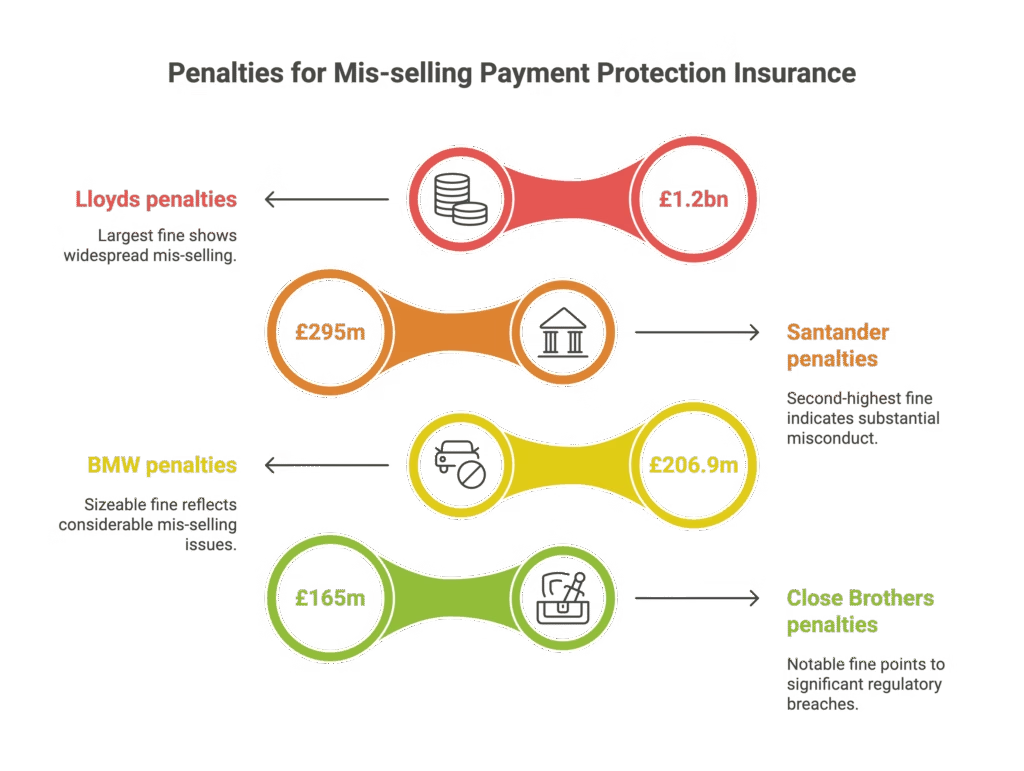
Who’s Paying What? The Provision League Table
BMW’s £206.9m provision puts them in the middle of the pack:
- Lloyds: £1.2bn (ouch)
- Santander: £295m
- BMW: £206.9m
- Close Brothers: £165m
But BMW warns there’s “considerable uncertainty” – final costs could be much higher or lower depending on how the FCA’s scheme shakes out.
The Co-operation Game
When pressed about which firms aren’t playing ball, the FCA’s Rathi stayed diplomatic. But he did hint that some companies are “raising questions” about the compensation scheme.
Translation: not everyone’s happy about writing massive cheques.
The regulator’s walking a tightrope here. They want fair compensation but don’t want to bankrupt lenders or drive them out of the market. That would just make car finance more expensive for everyone.

What Happens Next?
The FCA consultation wraps up in October. Then it’s a waiting game until the compensation scheme launches next year.
If you bought a car on finance and suspect you weren’t told the full story about commissions, you might be in line for a payout. Keep an eye on the FCA’s updates – this could affect millions of drivers.
FAQ
Q1: Who’s eligible for motor finance compensation?
A: Anyone who bought a car on finance and wasn’t properly informed about commission arrangements. The FCA says “large numbers” of consumers were affected, so eligibility could be broad.
Q2: How much compensation can I expect?
A: The FCA estimates around £950 per customer on average. But individual payouts will vary depending on your specific circumstances and the commission involved.
Q3: When will compensation start being paid?
A: The FCA aims to start payments next year once their industry-wide scheme is finalised. The consultation ends in early October 2025.
Q4: Do I need to do anything now?
A: Not yet. Wait for the FCA’s official scheme to launch rather than going through claims management companies that might charge hefty fees.
Q5: Could this make car finance more expensive?
A: Possibly. The FCA is trying to balance fair compensation with keeping lenders in the market. If too many firms exit, competition could decrease and costs rise.
DISCLAIMER
Effective Date: 15th July 2025
The information provided on this website is for informational and educational purposes only and reflects the personal opinions of the author(s). It is not intended as financial, investment, tax, or legal advice.
We are not certified financial advisers. None of the content on this website constitutes a recommendation to buy, sell, or hold any financial product, asset, or service. You should not rely on any information provided here to make financial decisions.
We strongly recommend that you:
- Conduct your own research and due diligence
- Consult with a qualified financial adviser or professional before making any investment or financial decisions
While we strive to ensure that all information is accurate and up to date, we make no guarantees about the completeness, reliability, or suitability of any content on this site.
By using this website, you acknowledge and agree that we are not responsible for any financial loss, damage, or decisions made based on the content presented.
MORE NEWS








Disclosure & Editorial Standards
MJBurrows is not authorised or regulated by the Financial Conduct Authority (FCA). The content on this website — including articles, calculators, and tools — is for general informational and educational purposes only. It does not constitute personal financial, investment, tax, or legal advice and does not take into account your individual circumstances, financial situation, or objectives.
Nothing on this site is a personal recommendation to buy, sell, hold, or otherwise deal in any financial product, asset, or service. You should always conduct your own research and seek advice from a qualified, FCA-regulated financial adviser before making any financial decisions.
Our calculators produce estimates based on simplified models using HMRC-published rates for the current tax year. They cannot account for every individual circumstance and should not be relied upon as exact figures. Tax rules and rates may change — verify current rates with HMRC or a qualified tax adviser.
Projections are not guarantees. Where our tools show future values (investment growth, pension projections, compound interest), these are hypothetical illustrations based on assumed growth rates. Past performance does not guarantee future results. The value of investments can go down as well as up.
Market data displayed on this site is provided by third-party sources including Twelve Data, Yahoo Finance, and CoinGecko. We do not guarantee the accuracy, completeness, or timeliness of third-party data.
This content is designed for UK residents and reflects UK tax rules, thresholds, and legislation. It may not apply to other jurisdictions.
Using this website does not create a professional-client relationship of any kind. MJBurrows is not responsible for any financial loss, damage, or decision made based on the content presented. By using this site, you accept these terms.
This disclaimer may be updated from time to time without prior notice. Last reviewed: 23 April 2026.
MJBurrows is an independent UK personal finance publication, written and edited by Matthew Burrows. There is no parent company, no investor group, and no advertising sales team — decisions about what to cover and how to frame it are made by Matthew alone. Our full Editorial Policy sets out how the site operates in detail.
Commercial model. As of April 2026, MJBurrows generates no revenue. The site carries no display advertising, no affiliate links, no sponsored content, no paid product placements, and no pay-for-coverage arrangements. If this changes in future, it will be disclosed openly on the Editorial Policy page.
Sources. Articles and tools reference primary sources — HM Revenue & Customs (HMRC), gov.uk, the Bank of England, the Office for National Statistics (ONS), the Financial Conduct Authority (FCA), Companies House, and UK government departmental publications (DWP, Treasury). Calculator data uses HMRC-published rates for the 2026/27 tax year. Market data (tickers, asset prices) is provided by Twelve Data, Yahoo Finance, and CoinGecko.
Verification. Every published article is fact-checked before going live. Numerical claims are traced to their primary source, quotes are checked against the original speaker or document, and calculator outputs are tested against HMRC worked examples. See our verification and accuracy policy for the full process.
Corrections. If you spot an error, please report it via the Corrections page. A three-tier severity system commits to specific response times:
- Tier 1 — Urgent (material reader harm, defamatory statements, regulatory or legal issues): acknowledged within 24 hours, page actioned within 24 hours, correction published within 48 hours of confirmation.
- Tier 2 — High (significant factual errors that misinform readers): acknowledged within 3 working days, correction published within 7 working days of confirmation.
- Tier 3 — Standard (minor factual errors, dated references, missing context): acknowledged within 7 working days, correction published at the next regular content review (within the quarter).
Significant corrections are logged on the public Corrections log.
Updates and review cadence. Calculators are reviewed at least quarterly, plus event-driven updates when HMRC publishes new rates (Budget, Autumn Statement, new tax year). Guides are reviewed at least twice a year, with major rewrites whenever underlying regulation changes. Tax-year-sensitive content is prioritised for review at the April tax-year transition.
Get in touch. For editorial enquiries — corrections, story tips, reader questions — the address is contact@mjburrows.com. The contact page is at mjburrows.com/contact. Every email is read personally by Matthew.