
Here’s a stat that’ll make Bitcoin investors sit up straight: businesses are hoarding Bitcoin nearly four times faster than miners can produce it. With companies buying 1,755 Bitcoin daily whilst miners only generate 450 new coins, we’re heading towards a potential supply shock that could reshape cryptocurrency markets in 2025.
According to River’s latest institutional data, this dramatic imbalance between Bitcoin supply and demand has analysts predicting significant price appreciation ahead. When demand outstrips supply by 7:1, basic economics suggests one outcome: higher prices.
Bitcoin Supply Shock Indicators: The Numbers Don’t Lie
The current Bitcoin buying frenzy breaks down as follows:
- Corporate Bitcoin treasury companies: 1,755 BTC/day
- Bitcoin ETFs and investment funds: 1,430 BTC/day
- Government Bitcoin purchases: 39 BTC/day
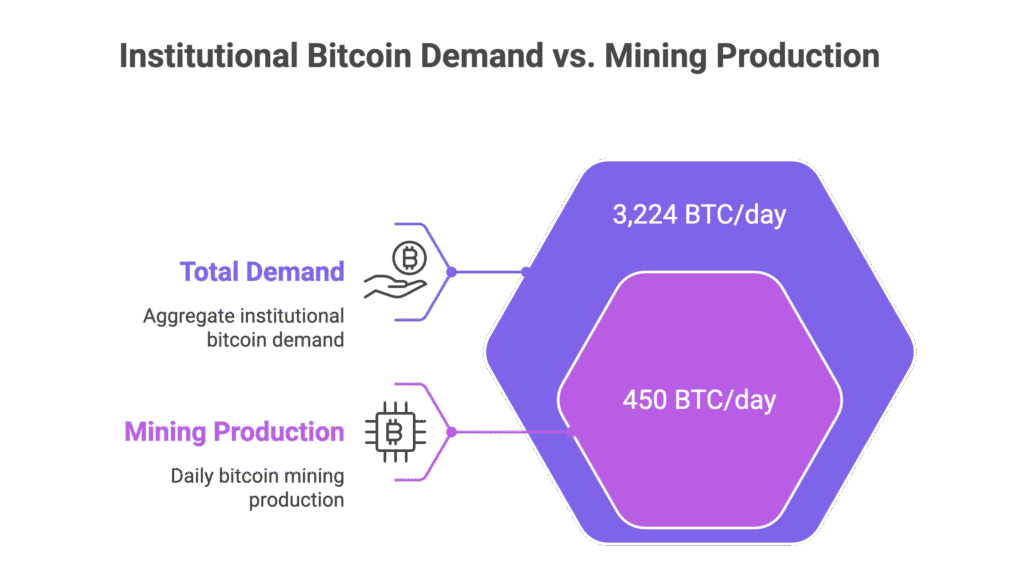
- Total institutional Bitcoin demand: 3,224 BTC/day
- Daily Bitcoin mining production: 450 BTC/day
This creates a demand-to-supply ratio that hasn’t been seen since Bitcoin’s early days, with exchange reserves now sitting at five-year lows representing less than 11% of total circulating supply.
MicroStrategy Bitcoin Holdings: Leading the Corporate Charge
Leading this corporate Bitcoin accumulation strategy is MicroStrategy (now rebranded as Strategy), holding 632,457 Bitcoin – making it the world’s largest corporate Bitcoin holder. That’s roughly £63 billion worth at current Bitcoin prices, with no other company coming remotely close.
Bitcoin treasury companies collectively acquired 159,107 Bitcoin in Q2 2025 alone, bringing total corporate Bitcoin holdings to approximately 1.3 million coins. Some analysts suggest MicroStrategy is “synthetically” creating its own Bitcoin halving through relentless accumulation.
The company’s aggressive Bitcoin strategy has transformed it from an enterprise software firm into what’s essentially become a Bitcoin investment vehicle. Strategy’s most recent purchase involved 21,021 Bitcoin worth $2.46 billion, demonstrating continued commitment despite Bitcoin trading near all-time highs.
Bitcoin Exchange Reserves: A Critical Supply Metric
One of the strongest Bitcoin supply shock indicators is the steady decline of Bitcoin held on centralised exchanges, now at its lowest point in over five years. Exchange reserves continue dwindling as Bitcoin moves into institutional custody and corporate treasuries.
This trend isn’t just about retail investors moving Bitcoin to cold storage. A substantial portion of recent exchange outflows represents institutional reshuffling – from exchange hot wallets into ETF custodian wallets and corporate treasury holdings.

Bitcoin ETF Impact: Institutional Demand Accelerating
BlackRock’s iShares Bitcoin Trust (IBIT) averaged £344 million in daily net inflows during late May 2025, culminating in £5.1 billion of monthly inflows – its largest ever. U.S. spot Bitcoin ETFs absorbed 2.4 times the annual mining supply in 2024, fundamentally altering Bitcoin market dynamics.
When institutions purchase through spot Bitcoin ETFs, the underlying Bitcoin gets moved into custodial cold storage, effectively removing these coins from liquid market supply. This creates additional upward pressure on Bitcoin prices whilst simultaneously reducing available supply for retail investors.
Bitcoin Price Predictions: Supply Shock Implications
Industry experts are increasingly bullish, with Michael Saylor predicting a “supply shock” following Bitcoin’s recent halving, whilst Marshall Beard of Gemini Exchange projects Bitcoin could reach $150,000 by year-end.
More ambitious forecasts include Cathie Wood of Ark Invest predicting Bitcoin could reach $1 million within five years, driven by its finite supply and increasing institutional adoption as a global store of value.
The mathematical reality supports these optimistic projections. With Bitcoin’s hard cap of 21 million coins and 93% already mined, combined with institutional hoarding and declining exchange reserves, supply scarcity is becoming increasingly acute.
What This Bitcoin Supply Crunch Means for Investors
If corporations and institutions continue accumulating Bitcoin whilst exchange reserves shrink, we’re approaching a legitimate supply shock scenario. Some market analysts predict this supply shortage would be decidedly bullish for Bitcoin, tightening sell-side liquidity and amplifying upward price pressure during periods of rising demand.
The question isn’t whether this trend continues – institutional Bitcoin adoption shows no signs of slowing. Rather, it’s how dramatically Bitcoin prices will react when supply scarcity truly bites and retail investors compete for increasingly limited available coins.
For Bitcoin investors, this supply shock narrative represents both opportunity and urgency. Those wanting exposure to Bitcoin may find themselves competing with deep-pocketed institutions for an increasingly scarce digital asset.
Frequently Asked Questions
Q1: What exactly is a Bitcoin supply shock?
A: A Bitcoin supply shock occurs when available BTC for purchase on exchanges becomes significantly limited whilst demand remains steady or accelerates, often leading to sharp price increases due to basic supply and demand principles. Unlike fiat currencies, Bitcoin has a fixed supply cap of 21 million coins.
Q2: How does MicroStrategy’s buying strategy avoid pumping Bitcoin prices immediately?
A: MicroStrategy spreads purchases through over-the-counter (OTC) transactions that occur off public exchanges. Their treasury officer explains that with Bitcoin trading over $50 billion daily volume, buying $1 billion over several days doesn’t immediately impact spot market prices.
Q3: Are Bitcoin exchange reserves really at critical levels?
A: Yes, Bitcoin held on centralised exchanges has declined to five-year lows, representing less than 11% of total circulating supply. About 70% of Bitcoin supply hasn’t moved in at least a year, indicating most holders are taking long-term positions.
Q4: Could this Bitcoin supply shortage be sustainable long-term?
A: Some analysis suggests potential selling pressure from long-term holders during bull runs could provide natural market rebalancing, with approximately 1.4 million BTC potentially transferring from long-term to short-term hands during 2025’s bull run.
Q5: Which other companies are following MicroStrategy’s Bitcoin treasury strategy?
A: Over 70 public companies worldwide have now adopted Bitcoin treasury standards, though none approach MicroStrategy’s scale. Marathon Digital holds the second-largest corporate Bitcoin position at 40,435 coins, whilst Tesla holds 9,720 Bitcoin.
DISCLAIMER
Effective Date: 15th July 2025
The information provided on this website is for informational and educational purposes only and reflects the personal opinions of the author(s). It is not intended as financial, investment, tax, or legal advice.
We are not certified financial advisers. None of the content on this website constitutes a recommendation to buy, sell, or hold any financial product, asset, or service. You should not rely on any information provided here to make financial decisions.
We strongly recommend that you:
- Conduct your own research and due diligence
- Consult with a qualified financial adviser or professional before making any investment or financial decisions
While we strive to ensure that all information is accurate and up to date, we make no guarantees about the completeness, reliability, or suitability of any content on this site.
By using this website, you acknowledge and agree that we are not responsible for any financial loss, damage, or decisions made based on the content presented.
MORE NEWS








Disclosure & Editorial Standards
MJBurrows is not authorised or regulated by the Financial Conduct Authority (FCA). The content on this website — including articles, calculators, and tools — is for general informational and educational purposes only. It does not constitute personal financial, investment, tax, or legal advice and does not take into account your individual circumstances, financial situation, or objectives.
Nothing on this site is a personal recommendation to buy, sell, hold, or otherwise deal in any financial product, asset, or service. You should always conduct your own research and seek advice from a qualified, FCA-regulated financial adviser before making any financial decisions.
Our calculators produce estimates based on simplified models using HMRC-published rates for the current tax year. They cannot account for every individual circumstance and should not be relied upon as exact figures. Tax rules and rates may change — verify current rates with HMRC or a qualified tax adviser.
Projections are not guarantees. Where our tools show future values (investment growth, pension projections, compound interest), these are hypothetical illustrations based on assumed growth rates. Past performance does not guarantee future results. The value of investments can go down as well as up.
Market data displayed on this site is provided by third-party sources including Twelve Data, Yahoo Finance, and CoinGecko. We do not guarantee the accuracy, completeness, or timeliness of third-party data.
This content is designed for UK residents and reflects UK tax rules, thresholds, and legislation. It may not apply to other jurisdictions.
Using this website does not create a professional-client relationship of any kind. MJBurrows is not responsible for any financial loss, damage, or decision made based on the content presented. By using this site, you accept these terms.
This disclaimer may be updated from time to time without prior notice. Last reviewed: 23 April 2026.
MJBurrows is an independent UK personal finance publication, written and edited by Matthew Burrows. There is no parent company, no investor group, and no advertising sales team — decisions about what to cover and how to frame it are made by Matthew alone. Our full Editorial Policy sets out how the site operates in detail.
Commercial model. As of April 2026, MJBurrows generates no revenue. The site carries no display advertising, no affiliate links, no sponsored content, no paid product placements, and no pay-for-coverage arrangements. If this changes in future, it will be disclosed openly on the Editorial Policy page.
Sources. Articles and tools reference primary sources — HM Revenue & Customs (HMRC), gov.uk, the Bank of England, the Office for National Statistics (ONS), the Financial Conduct Authority (FCA), Companies House, and UK government departmental publications (DWP, Treasury). Calculator data uses HMRC-published rates for the 2026/27 tax year. Market data (tickers, asset prices) is provided by Twelve Data, Yahoo Finance, and CoinGecko.
Verification. Every published article is fact-checked before going live. Numerical claims are traced to their primary source, quotes are checked against the original speaker or document, and calculator outputs are tested against HMRC worked examples. See our verification and accuracy policy for the full process.
Corrections. If you spot an error, please report it via the Corrections page. A three-tier severity system commits to specific response times:
- Tier 1 — Urgent (material reader harm, defamatory statements, regulatory or legal issues): acknowledged within 24 hours, page actioned within 24 hours, correction published within 48 hours of confirmation.
- Tier 2 — High (significant factual errors that misinform readers): acknowledged within 3 working days, correction published within 7 working days of confirmation.
- Tier 3 — Standard (minor factual errors, dated references, missing context): acknowledged within 7 working days, correction published at the next regular content review (within the quarter).
Significant corrections are logged on the public Corrections log.
Updates and review cadence. Calculators are reviewed at least quarterly, plus event-driven updates when HMRC publishes new rates (Budget, Autumn Statement, new tax year). Guides are reviewed at least twice a year, with major rewrites whenever underlying regulation changes. Tax-year-sensitive content is prioritised for review at the April tax-year transition.
Get in touch. For editorial enquiries — corrections, story tips, reader questions — the address is contact@mjburrows.com. The contact page is at mjburrows.com/contact. Every email is read personally by Matthew.