
Ever seen a mining stock surge while bitcoin stays flat? That’s exactly what happened on Tuesday when Microsoft’s massive AI deal sent crypto miners soaring, even as bitcoin itself stumbled.
The twist: Nebius Group’s $17.4 billion GPU supply agreement with Microsoft sparked a 22% rally in mining stocks like Bitfarms, while bitcoin dropped 1% to $111,100. The disconnect reveals something bigger—miners aren’t just bitcoin plays anymore.

Why Microsoft’s AI Deal Boosted Bitcoin Miners
Microsoft’s five-year GPU contract with Nebius Group lit up the mining sector because investors finally connected the dots. These companies don’t just mine crypto—they’ve got serious computing power that AI companies desperately need.
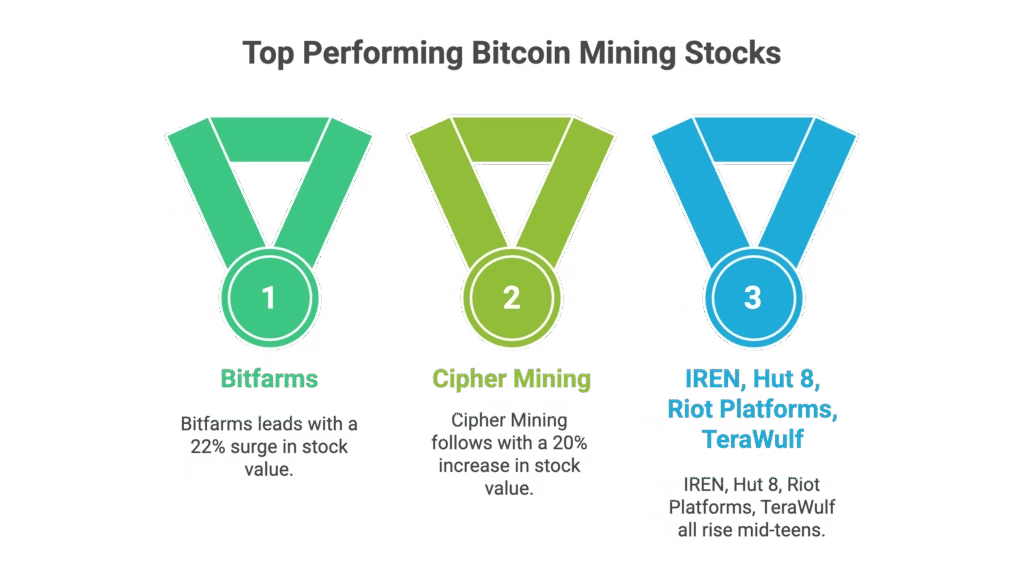
The winners were clear:
- Bitfarms (BITF): +22%
- Cipher Mining (CIFR): +20%
- IREN, Hut 8, Riot Platforms, TeraWulf: All up mid-teens
The outlier? MARA Holdings gained just 4%. Why? They’ve positioned themselves as a bitcoin treasury play rather than a high-performance computing company. Tuesday’s action shows which strategy investors prefer right now.
The Mining Industry’s New Reality Check
Bitcoin mining used to follow a simple playbook: halving cycles every four years cut block rewards in half, driving price and miner profitability. That predictable rhythm? It’s dead.
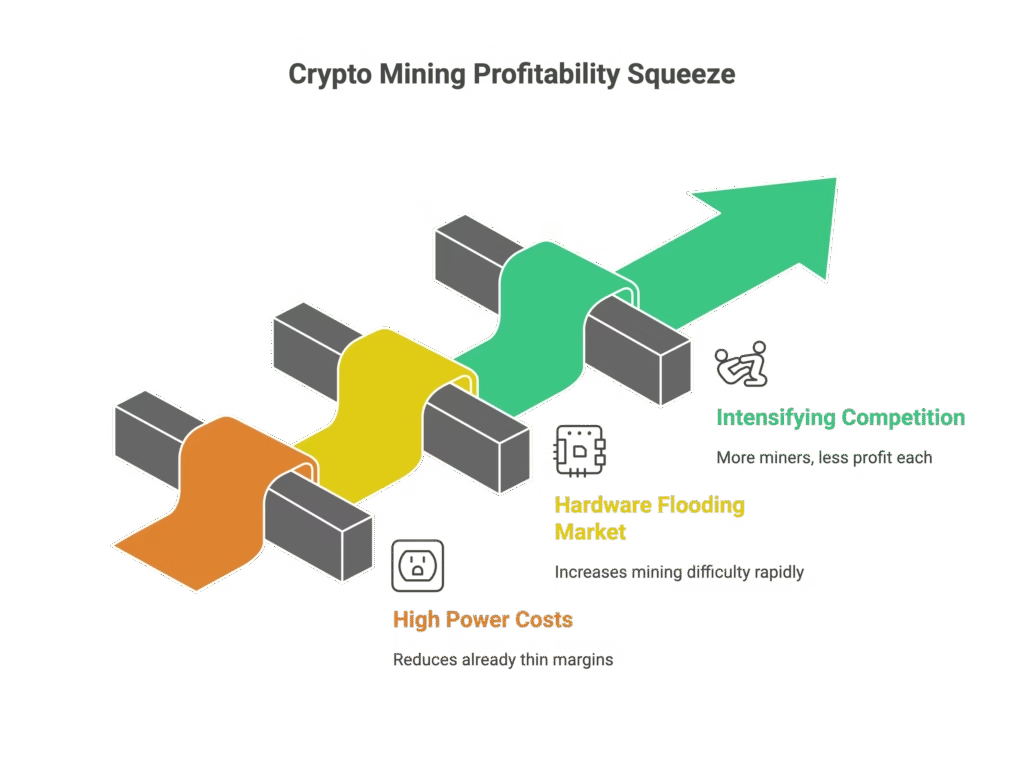
Now miners face a cluster of challenges:
- Soaring power costs eating into margins
- Hardware makers like Bitmain flooding the market with new equipment
- Intensifying competition from new players entering the space
The old bitcoin-price-equals-miner-success formula doesn’t work anymore. Smart miners are adapting fast.
AI Infrastructure: The New Gold Rush
Miners with massive energy footprints and advanced computing setups are pivoting toward AI and data center services. They’re leasing spare capacity to hyperscalers and tech giants hungry for GPU power.
The Nebius-Microsoft deal proves GPU access is liquid gold in today’s AI boom. Markets are rewarding miners who can scale beyond just bitcoin—and punishing those stuck in the old playbook.
What This Means for Crypto Investors
Tuesday’s action shows the mining sector is evolving beyond pure bitcoin exposure. Companies with scalable infrastructure and AI partnerships are commanding premium valuations, while traditional miners focused solely on bitcoin are getting left behind.
Smart money is betting on miners who can adapt to both crypto cycles and AI demand. If you’re investing in this space, look for companies building bridges between crypto mining and AI infrastructure.
FAQ
Q1: Why did mining stocks rise while bitcoin fell?
A: Investors are valuing miners’ AI and computing potential beyond just bitcoin mining. Microsoft’s massive GPU deal highlighted how valuable this infrastructure has become in the AI boom.
Q2: Which mining companies performed best?
A: Bitfarms led with 22% gains, followed by Cipher Mining at 20%. Companies focused on high-performance computing outperformed those positioning as bitcoin treasury plays.
Q3: Is bitcoin mining still profitable?
A: Traditional mining faces challenges from rising power costs and increased competition. The most successful miners are diversifying into AI infrastructure and data centre services.
Q4: What’s driving the shift toward AI infrastructure?
A: Miners have existing energy capacity and computing power that AI companies need. This creates new revenue streams beyond bitcoin mining rewards.
Q5: Should investors focus on bitcoin price or mining innovation?
A: Tuesday’s action suggests the market values mining companies’ ability to adapt and scale infrastructure for multiple use cases, not just bitcoin price correlation.
DISCLAIMER
Effective Date: 15th July 2025
The information provided on this website is for informational and educational purposes only and reflects the personal opinions of the author(s). It is not intended as financial, investment, tax, or legal advice.
We are not certified financial advisers. None of the content on this website constitutes a recommendation to buy, sell, or hold any financial product, asset, or service. You should not rely on any information provided here to make financial decisions.
We strongly recommend that you:
- Conduct your own research and due diligence
- Consult with a qualified financial adviser or professional before making any investment or financial decisions
While we strive to ensure that all information is accurate and up to date, we make no guarantees about the completeness, reliability, or suitability of any content on this site.
By using this website, you acknowledge and agree that we are not responsible for any financial loss, damage, or decisions made based on the content presented.
MORE NEWS








Disclosure & Editorial Standards
MJBurrows is not authorised or regulated by the Financial Conduct Authority (FCA). The content on this website — including articles, calculators, and tools — is for general informational and educational purposes only. It does not constitute personal financial, investment, tax, or legal advice and does not take into account your individual circumstances, financial situation, or objectives.
Nothing on this site is a personal recommendation to buy, sell, hold, or otherwise deal in any financial product, asset, or service. You should always conduct your own research and seek advice from a qualified, FCA-regulated financial adviser before making any financial decisions.
Our calculators produce estimates based on simplified models using HMRC-published rates for the current tax year. They cannot account for every individual circumstance and should not be relied upon as exact figures. Tax rules and rates may change — verify current rates with HMRC or a qualified tax adviser.
Projections are not guarantees. Where our tools show future values (investment growth, pension projections, compound interest), these are hypothetical illustrations based on assumed growth rates. Past performance does not guarantee future results. The value of investments can go down as well as up.
Market data displayed on this site is provided by third-party sources including Twelve Data, Yahoo Finance, and CoinGecko. We do not guarantee the accuracy, completeness, or timeliness of third-party data.
This content is designed for UK residents and reflects UK tax rules, thresholds, and legislation. It may not apply to other jurisdictions.
Using this website does not create a professional-client relationship of any kind. MJBurrows is not responsible for any financial loss, damage, or decision made based on the content presented. By using this site, you accept these terms.
This disclaimer may be updated from time to time without prior notice. Last reviewed: 23 April 2026.
MJBurrows is an independent UK personal finance publication, written and edited by Matthew Burrows. There is no parent company, no investor group, and no advertising sales team — decisions about what to cover and how to frame it are made by Matthew alone. Our full Editorial Policy sets out how the site operates in detail.
Commercial model. As of April 2026, MJBurrows generates no revenue. The site carries no display advertising, no affiliate links, no sponsored content, no paid product placements, and no pay-for-coverage arrangements. If this changes in future, it will be disclosed openly on the Editorial Policy page.
Sources. Articles and tools reference primary sources — HM Revenue & Customs (HMRC), gov.uk, the Bank of England, the Office for National Statistics (ONS), the Financial Conduct Authority (FCA), Companies House, and UK government departmental publications (DWP, Treasury). Calculator data uses HMRC-published rates for the 2026/27 tax year. Market data (tickers, asset prices) is provided by Twelve Data, Yahoo Finance, and CoinGecko.
Verification. Every published article is fact-checked before going live. Numerical claims are traced to their primary source, quotes are checked against the original speaker or document, and calculator outputs are tested against HMRC worked examples. See our verification and accuracy policy for the full process.
Corrections. If you spot an error, please report it via the Corrections page. A three-tier severity system commits to specific response times:
- Tier 1 — Urgent (material reader harm, defamatory statements, regulatory or legal issues): acknowledged within 24 hours, page actioned within 24 hours, correction published within 48 hours of confirmation.
- Tier 2 — High (significant factual errors that misinform readers): acknowledged within 3 working days, correction published within 7 working days of confirmation.
- Tier 3 — Standard (minor factual errors, dated references, missing context): acknowledged within 7 working days, correction published at the next regular content review (within the quarter).
Significant corrections are logged on the public Corrections log.
Updates and review cadence. Calculators are reviewed at least quarterly, plus event-driven updates when HMRC publishes new rates (Budget, Autumn Statement, new tax year). Guides are reviewed at least twice a year, with major rewrites whenever underlying regulation changes. Tax-year-sensitive content is prioritised for review at the April tax-year transition.
Get in touch. For editorial enquiries — corrections, story tips, reader questions — the address is contact@mjburrows.com. The contact page is at mjburrows.com/contact. Every email is read personally by Matthew.