
The Bank of England just threw cold water on rate cut hopes. With inflation still running hot at 3.8%, the MPC voted 7-2 to keep interest rates locked at 4% whilst also pumping the brakes on their gilt-selling spree.
A kicker: they’re also dialling back quantitative tightening from £100bn to £70bn annually. Why? Because dumping government bonds into already jittery markets isn’t exactly helping Chancellor Rachel Reeves sleep better at night.
Interest Rates Stay Put Despite Economic Headwinds
The Bank of England’s decision wasn’t exactly shocking, but the reasoning tells a story. Governor Andrew Bailey made it clear: “We’re not out of the woods yet” when it comes to hitting that 2% inflation target.
Current inflation sits at 3.8% – nearly double where it should be. Food prices have been climbing for five straight months, and services inflation remains stubborn despite some cooling.
Only two MPC members pushed for a 25 basis point cut: Swati Dhingra and Alan Taylor. They pointed to weakening job markets (142,000 jobs vanished in the past year) and slowing wage growth as reasons to ease up.
But the majority wasn’t buying it. With inflation expectations still “elevated relative to historical averages,” most policymakers decided patience beats panic.

QT Gets a Haircut: From £100bn to £70bn
The Bank slashed its quantitative tightening target by 30% for the next 12 months.
Why the sudden change of heart? Bond markets are already under pressure, and continuing to flood them with gilt sales would be like adding fuel to a fire that’s already scorching the Treasury’s borrowing costs.
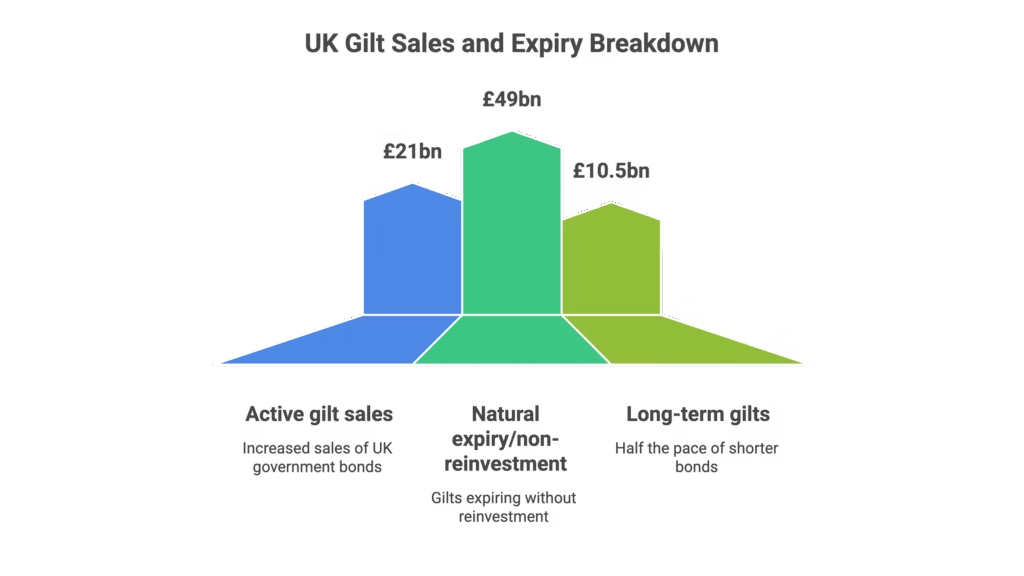
The new breakdown:
- Active gilt sales: £21bn (up from £13bn)
- Natural expiry/non-reinvestment: The remaining £49bn
- Long-term gilts: Half the pace of short and medium-term bonds
The timing couldn’t be more awkward for Reeves – the Bank’s first long-term gilt sale hits just two weeks before her Autumn Budget.
What This Means for Your Wallet
Higher borrowing costs aren’t going anywhere fast. The Office for Budget Responsibility is expected to forecast even steeper government borrowing costs later this year, which likely means more tax hikes are coming.
Shadow Chancellor Mel Stride didn’t hold back, calling Labour’s policies “reckless decisions” that have pushed up inflation and created “deep nervousness” about the UK’s economic direction.
For regular folks? Mortgage rates probably aren’t dropping anytime soon, and the cost of living squeeze continues.
The Bottom Line
The Bank of England is playing it safe – perhaps too safe for some. They’re caught between persistent inflation and a weakening economy, choosing to err on the side of caution.
With gilt markets already stressed and the Chancellor facing a tough Budget, expect this cautious approach to continue. Rate cuts might be on the horizon, but they’ll come “gradually and carefully” – Bank speak for “don’t hold your breath.”
Ready to stay ahead of the next Bank of England decision? Keep an eye on inflation data and gilt yields – they’re your best crystal ball for what comes next.
FAQ
Q1: When will the Bank of England cut interest rates?
A: Most economists expect the first cut in November, potentially taking rates to 3.75%. However, with inflation still at 3.8%, any cuts will be gradual and data-dependent.
Q2: Why did the Bank reduce quantitative tightening?
A: Gilt markets are already under pressure, pushing up government borrowing costs. Selling fewer bonds gives markets breathing room and helps the Treasury manage its debt burden more effectively.
Q3: What does this mean for mortgage rates?
A: Mortgage rates are likely to stay elevated in the near term. With the Bank holding rates steady and bond yields rising, cheap borrowing remains off the table for now.
Q4: How is inflation still so high?
A: Food prices have risen for five consecutive months, and services inflation remains sticky despite some cooling. Wage pressures and elevated inflation expectations are keeping prices above the 2% target.
Q5: Will there be more tax rises after the Budget?
A: Very likely. Higher government borrowing costs mean the Chancellor needs to find extra revenue somewhere, and tax hikes remain the most direct tool available.
DISCLAIMER
Effective Date: 15th July 2025
The information provided on this website is for informational and educational purposes only and reflects the personal opinions of the author(s). It is not intended as financial, investment, tax, or legal advice.
We are not certified financial advisers. None of the content on this website constitutes a recommendation to buy, sell, or hold any financial product, asset, or service. You should not rely on any information provided here to make financial decisions.
We strongly recommend that you:
- Conduct your own research and due diligence
- Consult with a qualified financial adviser or professional before making any investment or financial decisions
While we strive to ensure that all information is accurate and up to date, we make no guarantees about the completeness, reliability, or suitability of any content on this site.
By using this website, you acknowledge and agree that we are not responsible for any financial loss, damage, or decisions made based on the content presented.
MORE NEWS








Disclosure & Editorial Standards
MJBurrows is not authorised or regulated by the Financial Conduct Authority (FCA). The content on this website — including articles, calculators, and tools — is for general informational and educational purposes only. It does not constitute personal financial, investment, tax, or legal advice and does not take into account your individual circumstances, financial situation, or objectives.
Nothing on this site is a personal recommendation to buy, sell, hold, or otherwise deal in any financial product, asset, or service. You should always conduct your own research and seek advice from a qualified, FCA-regulated financial adviser before making any financial decisions.
Our calculators produce estimates based on simplified models using HMRC-published rates for the current tax year. They cannot account for every individual circumstance and should not be relied upon as exact figures. Tax rules and rates may change — verify current rates with HMRC or a qualified tax adviser.
Projections are not guarantees. Where our tools show future values (investment growth, pension projections, compound interest), these are hypothetical illustrations based on assumed growth rates. Past performance does not guarantee future results. The value of investments can go down as well as up.
Market data displayed on this site is provided by third-party sources including Twelve Data, Yahoo Finance, and CoinGecko. We do not guarantee the accuracy, completeness, or timeliness of third-party data.
This content is designed for UK residents and reflects UK tax rules, thresholds, and legislation. It may not apply to other jurisdictions.
Using this website does not create a professional-client relationship of any kind. MJBurrows is not responsible for any financial loss, damage, or decision made based on the content presented. By using this site, you accept these terms.
This disclaimer may be updated from time to time without prior notice. Last reviewed: 23 April 2026.
MJBurrows is an independent UK personal finance publication, written and edited by Matthew Burrows. There is no parent company, no investor group, and no advertising sales team — decisions about what to cover and how to frame it are made by Matthew alone. Our full Editorial Policy sets out how the site operates in detail.
Commercial model. As of April 2026, MJBurrows generates no revenue. The site carries no display advertising, no affiliate links, no sponsored content, no paid product placements, and no pay-for-coverage arrangements. If this changes in future, it will be disclosed openly on the Editorial Policy page.
Sources. Articles and tools reference primary sources — HM Revenue & Customs (HMRC), gov.uk, the Bank of England, the Office for National Statistics (ONS), the Financial Conduct Authority (FCA), Companies House, and UK government departmental publications (DWP, Treasury). Calculator data uses HMRC-published rates for the 2026/27 tax year. Market data (tickers, asset prices) is provided by Twelve Data, Yahoo Finance, and CoinGecko.
Verification. Every published article is fact-checked before going live. Numerical claims are traced to their primary source, quotes are checked against the original speaker or document, and calculator outputs are tested against HMRC worked examples. See our verification and accuracy policy for the full process.
Corrections. If you spot an error, please report it via the Corrections page. A three-tier severity system commits to specific response times:
- Tier 1 — Urgent (material reader harm, defamatory statements, regulatory or legal issues): acknowledged within 24 hours, page actioned within 24 hours, correction published within 48 hours of confirmation.
- Tier 2 — High (significant factual errors that misinform readers): acknowledged within 3 working days, correction published within 7 working days of confirmation.
- Tier 3 — Standard (minor factual errors, dated references, missing context): acknowledged within 7 working days, correction published at the next regular content review (within the quarter).
Significant corrections are logged on the public Corrections log.
Updates and review cadence. Calculators are reviewed at least quarterly, plus event-driven updates when HMRC publishes new rates (Budget, Autumn Statement, new tax year). Guides are reviewed at least twice a year, with major rewrites whenever underlying regulation changes. Tax-year-sensitive content is prioritised for review at the April tax-year transition.
Get in touch. For editorial enquiries — corrections, story tips, reader questions — the address is contact@mjburrows.com. The contact page is at mjburrows.com/contact. Every email is read personally by Matthew.