

Even though cryptocurrency ownership has exploded 8x since 2018, most Americans still won’t touch it. A fresh Gallup survey shows only 14% of U.S. adults own cryptocurrency, whilst 60% have zero interest in buying any. Despite all the Bitcoin ETFs and institutional adoption, the “very risky” label isn’t going anywhere – 64% of investors still see crypto as a dangerous bet. So what’s keeping mainstream America on the sidelines?
Crypto Adoption Hits a Wall
The latest Gallup data paints a clear picture of crypto’s uphill battle for mainstream acceptance. Whilst ownership jumped from a measly 2% in 2018 to 17% amongst investors with $10,000+ portfolios, that’s still a tiny slice of the pie.
Here’s what’s really telling: only 4% of Americans plan to buy crypto soon, and just 17% admit they’re even curious about it. Compare that to traditional investments – nearly six in 10 Americans own stocks or real estate.
The trust factor? Still broken. Only 35% of survey respondents said they actually understand how cryptocurrency works, even though nearly everyone has heard of it.

Who’s Actually Buying Crypto (And Who Isn’t)
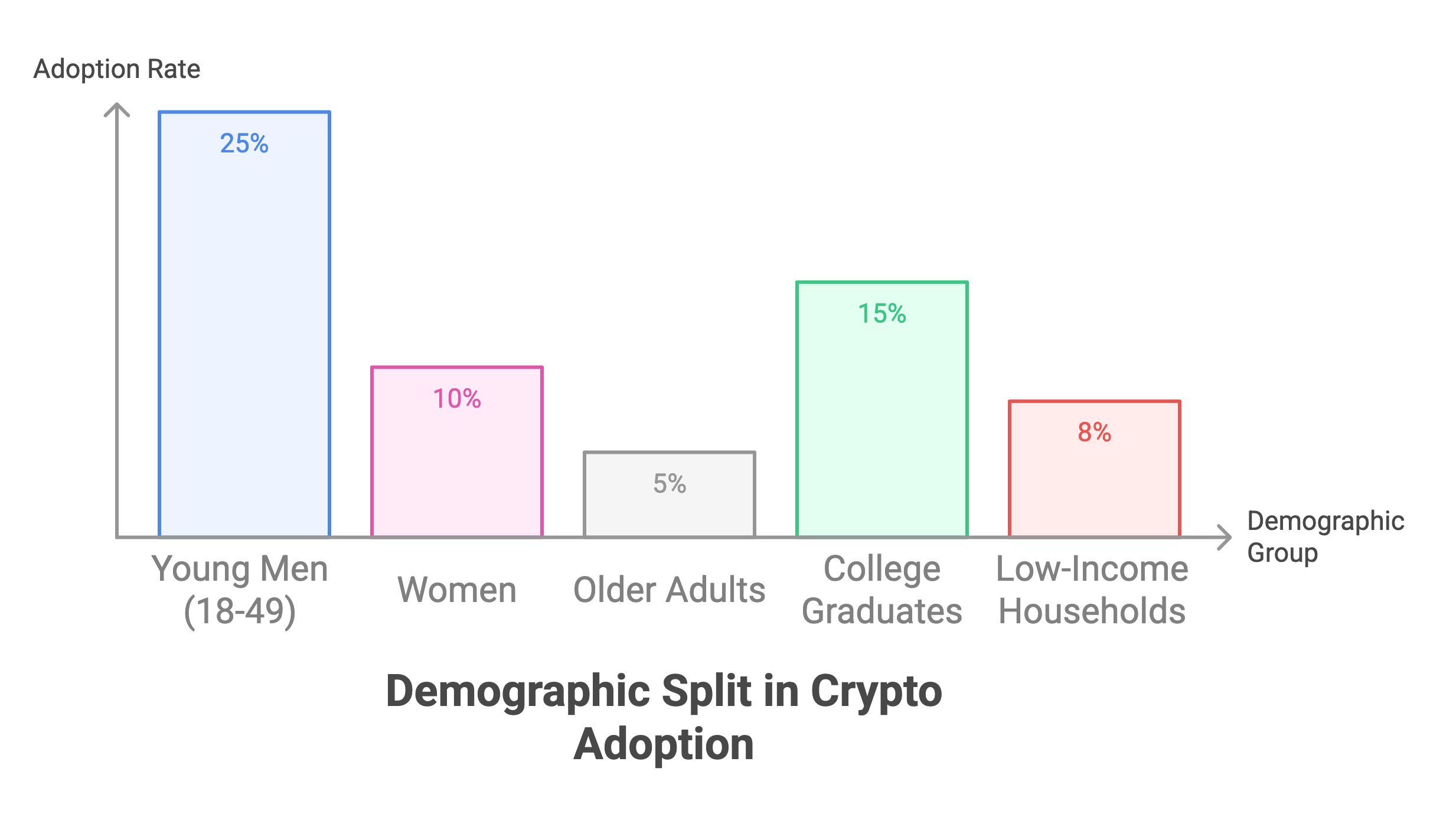
The demographic split is stark, and it follows predictable lines:
The Crypto Crowd:
- Young men (18-49): 1 in 4 owns crypto
- College graduates and high earners lead adoption
- Tech-savvy millennials driving growth
The Skeptics:
- Women remain underrepresented
- Older adults largely absent from the space
- Low-income households staying away
This isn’t just about risk tolerance – it’s about access, education, and trust. When you’ve watched FTX collapse and countless crypto scams make headlines, skepticism makes sense.
Why the “Very Risky” Label Sticks
Even with a pro-crypto president and clearer regulations rolling out, Americans aren’t forgetting the crypto winter of 2022. The brutal crashes, high-profile bankruptcies, and endless scam stories left scars.
The perception of risk has actually gotten worse. Back in 2021, 60% of investors called crypto “very risky.” Now? That number’s climbed to 64%.
Sure, institutional money is flooding in and Bitcoin ETFs are mainstream, but retail investors who got burned are staying cautious.
The Bottom Line
Crypto has come a long way since 2018, but it’s still fighting an uphill battle for mainstream acceptance. Whilst ownership has grown dramatically, the vast majority of Americans remain sceptical, uninformed, or simply uninterested.
For crypto to truly go mainstream, it needs to solve the trust problem – not just the technology problem. Until then, expect slow and steady growth rather than explosive adoption.
FAQ
Q1: What percentage of Americans actually own cryptocurrency?
A: According to the latest Gallup survey, only 14% of U.S. adults own crypto. Among investors with portfolios over $10,000, that number rises to 17%.
Q2: Why do most Americans still consider crypto “very risky”?
A: 64% of U.S. investors view crypto as very risky, largely due to the 2022 crypto winter, high-profile bankruptcies like FTX, and ongoing volatility. The perception has actually worsened since 2021.
Q3: Who is most likely to own cryptocurrency?
A: Young men aged 18-49 lead adoption (25% ownership rate), along with college graduates and high-income earners. Women, older adults, and low-income households remain largely absent from crypto investing.
Q4: How much has crypto ownership grown since 2018?
A: Crypto ownership among U.S. investors has skyrocketed from just 2% in 2018 to 17% today – an 8x increase over six years.
Q5: Do most Americans understand how cryptocurrency works?
A: No. While nearly everyone has heard of crypto, only 35% say they actually understand how it works. This knowledge gap is a major barrier to adoption.
DISCLAIMER
Effective Date: 15th July 2025
The information provided on this website is for informational and educational purposes only and reflects the personal opinions of the author(s). It is not intended as financial, investment, tax, or legal advice.
We are not certified financial advisers. None of the content on this website constitutes a recommendation to buy, sell, or hold any financial product, asset, or service. You should not rely on any information provided here to make financial decisions.
We strongly recommend that you:
- Conduct your own research and due diligence
- Consult with a qualified financial adviser or professional before making any investment or financial decisions
While we strive to ensure that all information is accurate and up to date, we make no guarantees about the completeness, reliability, or suitability of any content on this site.
By using this website, you acknowledge and agree that we are not responsible for any financial loss, damage, or decisions made based on the content presented.
MORE NEWS








Disclosure & Editorial Standards
MJBurrows is not authorised or regulated by the Financial Conduct Authority (FCA). The content on this website — including articles, calculators, and tools — is for general informational and educational purposes only. It does not constitute personal financial, investment, tax, or legal advice and does not take into account your individual circumstances, financial situation, or objectives.
Nothing on this site is a personal recommendation to buy, sell, hold, or otherwise deal in any financial product, asset, or service. You should always conduct your own research and seek advice from a qualified, FCA-regulated financial adviser before making any financial decisions.
Our calculators produce estimates based on simplified models using HMRC-published rates for the current tax year. They cannot account for every individual circumstance and should not be relied upon as exact figures. Tax rules and rates may change — verify current rates with HMRC or a qualified tax adviser.
Projections are not guarantees. Where our tools show future values (investment growth, pension projections, compound interest), these are hypothetical illustrations based on assumed growth rates. Past performance does not guarantee future results. The value of investments can go down as well as up.
Market data displayed on this site is provided by third-party sources including Twelve Data, Yahoo Finance, and CoinGecko. We do not guarantee the accuracy, completeness, or timeliness of third-party data.
This content is designed for UK residents and reflects UK tax rules, thresholds, and legislation. It may not apply to other jurisdictions.
Using this website does not create a professional-client relationship of any kind. MJBurrows is not responsible for any financial loss, damage, or decision made based on the content presented. By using this site, you accept these terms.
This disclaimer may be updated from time to time without prior notice. Last reviewed: 23 April 2026.
MJBurrows is an independent UK personal finance publication, written and edited by Matthew Burrows. There is no parent company, no investor group, and no advertising sales team — decisions about what to cover and how to frame it are made by Matthew alone. Our full Editorial Policy sets out how the site operates in detail.
Commercial model. As of April 2026, MJBurrows generates no revenue. The site carries no display advertising, no affiliate links, no sponsored content, no paid product placements, and no pay-for-coverage arrangements. If this changes in future, it will be disclosed openly on the Editorial Policy page.
Sources. Articles and tools reference primary sources — HM Revenue & Customs (HMRC), gov.uk, the Bank of England, the Office for National Statistics (ONS), the Financial Conduct Authority (FCA), Companies House, and UK government departmental publications (DWP, Treasury). Calculator data uses HMRC-published rates for the 2026/27 tax year. Market data (tickers, asset prices) is provided by Twelve Data, Yahoo Finance, and CoinGecko.
Verification. Every published article is fact-checked before going live. Numerical claims are traced to their primary source, quotes are checked against the original speaker or document, and calculator outputs are tested against HMRC worked examples. See our verification and accuracy policy for the full process.
Corrections. If you spot an error, please report it via the Corrections page. A three-tier severity system commits to specific response times:
- Tier 1 — Urgent (material reader harm, defamatory statements, regulatory or legal issues): acknowledged within 24 hours, page actioned within 24 hours, correction published within 48 hours of confirmation.
- Tier 2 — High (significant factual errors that misinform readers): acknowledged within 3 working days, correction published within 7 working days of confirmation.
- Tier 3 — Standard (minor factual errors, dated references, missing context): acknowledged within 7 working days, correction published at the next regular content review (within the quarter).
Significant corrections are logged on the public Corrections log.
Updates and review cadence. Calculators are reviewed at least quarterly, plus event-driven updates when HMRC publishes new rates (Budget, Autumn Statement, new tax year). Guides are reviewed at least twice a year, with major rewrites whenever underlying regulation changes. Tax-year-sensitive content is prioritised for review at the April tax-year transition.
Get in touch. For editorial enquiries — corrections, story tips, reader questions — the address is contact@mjburrows.com. The contact page is at mjburrows.com/contact. Every email is read personally by Matthew.