The Magnificent Seven – Alphabet, Amazon, Apple, Tesla, Meta, Microsoft, and Nvidia – control a fifth of global markets. Their trillion-dollar valuations ride on one massive bet: they’ll win the AI arms race. But as spending hits eye-watering levels and the AI bubble shows cracks, not all seven will land safely. Some are building empires on solid ground. Others? They’re dancing on quicksand. Here’s who’s most at risk when reality catches up with the hype.
The $1 Trillion AI Spending Spree
We’re watching the most expensive tech arms race in history unfold in real-time.
Microsoft can’t build data centres fast enough. CFO Amy Hood admits demand is so intense the company “can’t keep up” – they’re dropping over $80bn this fiscal year alone. Alphabet’s matching that energy with $40bn committed to three new data centres in Texas. Not backing down.
Meta’s going even bigger. Zuckerberg’s betting up to $72bn this year, even as costs surge 32%. His CMO Alex Schultz defends the madness: “Humanity has the ability to have a lot more abundance than it does.”
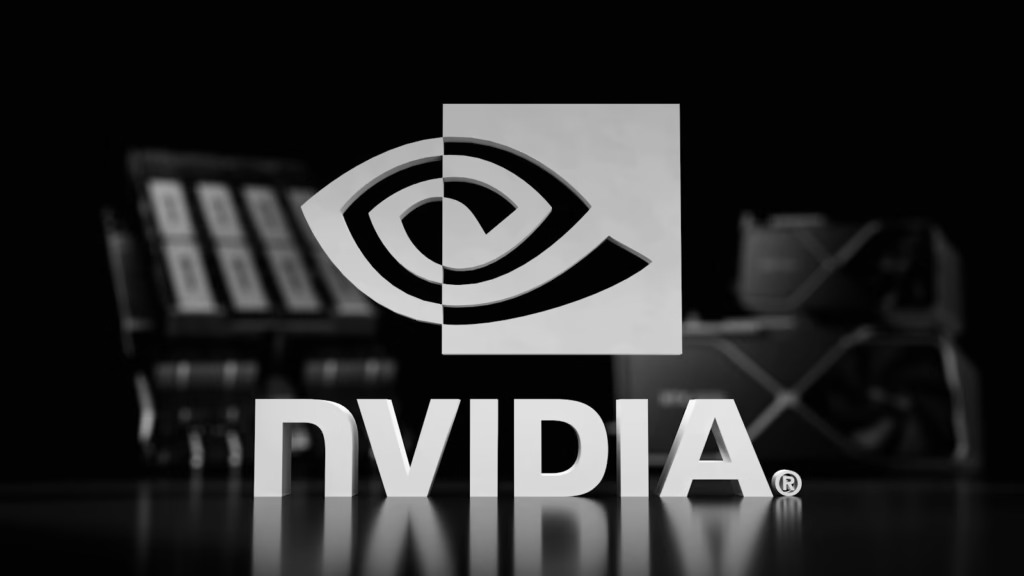
At the centre of it all? Nvidia. Jensen Huang’s chip empire posted 94% revenue growth in its most recent quarter, and analysts are projecting $383bn in revenue by 2028. That’s not a typo.
Here’s the problem: this spending spree could cross $1tn in the next few years. To justify that, these companies would need to generate $2tn in annual AI revenue. The maths is getting sticky.
Who’s Most Exposed When the Bubble Deflates?
When (not if) this bubble pops, the damage won’t be equal. Each company’s vulnerability depends on one thing: how much of their valuation is based on future promises versus actual profits today.
Tesla: The Biggest Risk
Tesla’s trading at 270 times past earnings. That’s astronomical. Almost its entire valuation hangs on products that don’t exist yet, like robotaxis. If those bets don’t pay off, there’s a “possibility for a very unhappy ending.” Current earnings? They don’t justify the price tag.
The Middle Ground: Alphabet and Microsoft
Alphabet’s sitting prettier at 27 times earnings. Why? YouTube and search pump out massive cash flow that cushions its cloud spending. The valuation isn’t cheap, but it’s “not outlandish” either.
Microsoft’s in similar territory, profitable today, betting heavily on tomorrow.
The Safest Bet: Apple
Apple’s the fortress. Yes, it trades at 36 times earnings, but its ecosystem is bulletproof. Over two billion active devices worldwide. A services division generating 20%+ of revenue. Recurring cash flow that doesn’t depend on AI hype cycles. It’s insulated.

Scale Is the Ultimate Defence
Here’s what separates the Magnificent Seven from everyone else: deep pockets and market power.
While giants issue bonds and tap credit lines to fund their AI obsessions, smaller players are getting crushed. Startups like legal AI firm Robin and London-listed Cykel AI can’t secure follow-on funding. They’re folding.
This is deliberate. The big seven are cannibalising the competition. Goldman Sachs compares it to the late 1990s tech boom – but this time, scale determines who survives.
The Bottom Line
The AI bubble won’t end in total collapse. Instead, we’ll see an uneven transfer of wealth. The largest firms will leverage their size to ride out the storm, but only the ones with sustainable business models will justify the future they’re aggressively funding.
Tesla’s skating on thin ice. Alphabet and Microsoft are hedged. Apple’s practically untouchable.
When the reckoning comes, the market will finally separate the AI winners from the pretenders.
Want to stay ahead of market shifts? Track these companies’ quarterly earnings and capex spending, they’re the signals for AI investment reality checks.
FAQ
Q1: What is the Magnificent Seven in stock markets?
A: The Magnificent Seven refers to Alphabet, Amazon, Apple, Tesla, Meta, Microsoft, and Nvidia – tech giants that dominate global markets and collectively control about 20% of total market capitalisation. They’re heavily invested in AI infrastructure.
Q2: Why is Tesla most vulnerable in an AI bubble pop?
A: Tesla trades at 270 times past earnings with most of its valuation based on unproven future products like robotaxis. Unlike its peers, it lacks diversified revenue streams or current profitability to justify its massive valuation.
Q3: How much are tech giants spending on AI infrastructure?
A: Microsoft is spending over $80bn this fiscal year, Meta up to $72bn, and Alphabet committed $40bn to new data centres in Texas. Combined industry spending could exceed $1tn in coming years, requiring $2tn in annual AI revenue to break even.
Q4: Which Magnificent Seven stock is safest from an AI crash?
A: Apple appears most insulated with over two billion active devices, a massive services division generating recurring revenue, and an ecosystem less dependent on AI speculation. Its 36 times earnings valuation is backed by actual cash flow.
Q5: Is the AI market actually in a bubble?
A: Many analysts believe so. OpenAI chairman Bret Taylor summarised it perfectly: “AI will transform the economy and we’re also in a bubble, and a lot of people will lose a lot of money.” The spending far exceeds current revenue justification.
DISCLAIMER
Effective Date: 15th July 2025
The information provided on this website is for informational and educational purposes only and reflects the personal opinions of the author(s). It is not intended as financial, investment, tax, or legal advice.
We are not certified financial advisers. None of the content on this website constitutes a recommendation to buy, sell, or hold any financial product, asset, or service. You should not rely on any information provided here to make financial decisions.
We strongly recommend that you:
- Conduct your own research and due diligence
- Consult with a qualified financial adviser or professional before making any investment or financial decisions
While we strive to ensure that all information is accurate and up to date, we make no guarantees about the completeness, reliability, or suitability of any content on this site.
By using this website, you acknowledge and agree that we are not responsible for any financial loss, damage, or decisions made based on the content presented.
MORE NEWS





Disclosure & Editorial Standards
MJBurrows is not authorised or regulated by the Financial Conduct Authority (FCA). The content on this website — including articles, calculators, and tools — is for general informational and educational purposes only. It does not constitute personal financial, investment, tax, or legal advice and does not take into account your individual circumstances, financial situation, or objectives.
Nothing on this site is a personal recommendation to buy, sell, hold, or otherwise deal in any financial product, asset, or service. You should always conduct your own research and seek advice from a qualified, FCA-regulated financial adviser before making any financial decisions.
Our calculators produce estimates based on simplified models using HMRC-published rates for the current tax year. They cannot account for every individual circumstance and should not be relied upon as exact figures. Tax rules and rates may change — verify current rates with HMRC or a qualified tax adviser.
Projections are not guarantees. Where our tools show future values (investment growth, pension projections, compound interest), these are hypothetical illustrations based on assumed growth rates. Past performance does not guarantee future results. The value of investments can go down as well as up.
Market data displayed on this site is provided by third-party sources including Twelve Data, Yahoo Finance, and CoinGecko. We do not guarantee the accuracy, completeness, or timeliness of third-party data.
This content is designed for UK residents and reflects UK tax rules, thresholds, and legislation. It may not apply to other jurisdictions.
Using this website does not create a professional-client relationship of any kind. MJBurrows is not responsible for any financial loss, damage, or decision made based on the content presented. By using this site, you accept these terms.
This disclaimer may be updated from time to time without prior notice. Last reviewed: 23 April 2026.
MJBurrows is an independent UK personal finance publication, written and edited by Matthew Burrows. There is no parent company, no investor group, and no advertising sales team — decisions about what to cover and how to frame it are made by Matthew alone. Our full Editorial Policy sets out how the site operates in detail.
Commercial model. As of April 2026, MJBurrows generates no revenue. The site carries no display advertising, no affiliate links, no sponsored content, no paid product placements, and no pay-for-coverage arrangements. If this changes in future, it will be disclosed openly on the Editorial Policy page.
Sources. Articles and tools reference primary sources — HM Revenue & Customs (HMRC), gov.uk, the Bank of England, the Office for National Statistics (ONS), the Financial Conduct Authority (FCA), Companies House, and UK government departmental publications (DWP, Treasury). Calculator data uses HMRC-published rates for the 2026/27 tax year. Market data (tickers, asset prices) is provided by Twelve Data, Yahoo Finance, and CoinGecko.
Verification. Every published article is fact-checked before going live. Numerical claims are traced to their primary source, quotes are checked against the original speaker or document, and calculator outputs are tested against HMRC worked examples. See our verification and accuracy policy for the full process.
Corrections. If you spot an error, please report it via the Corrections page. A three-tier severity system commits to specific response times:
- Tier 1 — Urgent (material reader harm, defamatory statements, regulatory or legal issues): acknowledged within 24 hours, page actioned within 24 hours, correction published within 48 hours of confirmation.
- Tier 2 — High (significant factual errors that misinform readers): acknowledged within 3 working days, correction published within 7 working days of confirmation.
- Tier 3 — Standard (minor factual errors, dated references, missing context): acknowledged within 7 working days, correction published at the next regular content review (within the quarter).
Significant corrections are logged on the public Corrections log.
Updates and review cadence. Calculators are reviewed at least quarterly, plus event-driven updates when HMRC publishes new rates (Budget, Autumn Statement, new tax year). Guides are reviewed at least twice a year, with major rewrites whenever underlying regulation changes. Tax-year-sensitive content is prioritised for review at the April tax-year transition.
Get in touch. For editorial enquiries — corrections, story tips, reader questions — the address is contact@mjburrows.com. The contact page is at mjburrows.com/contact. Every email is read personally by Matthew.