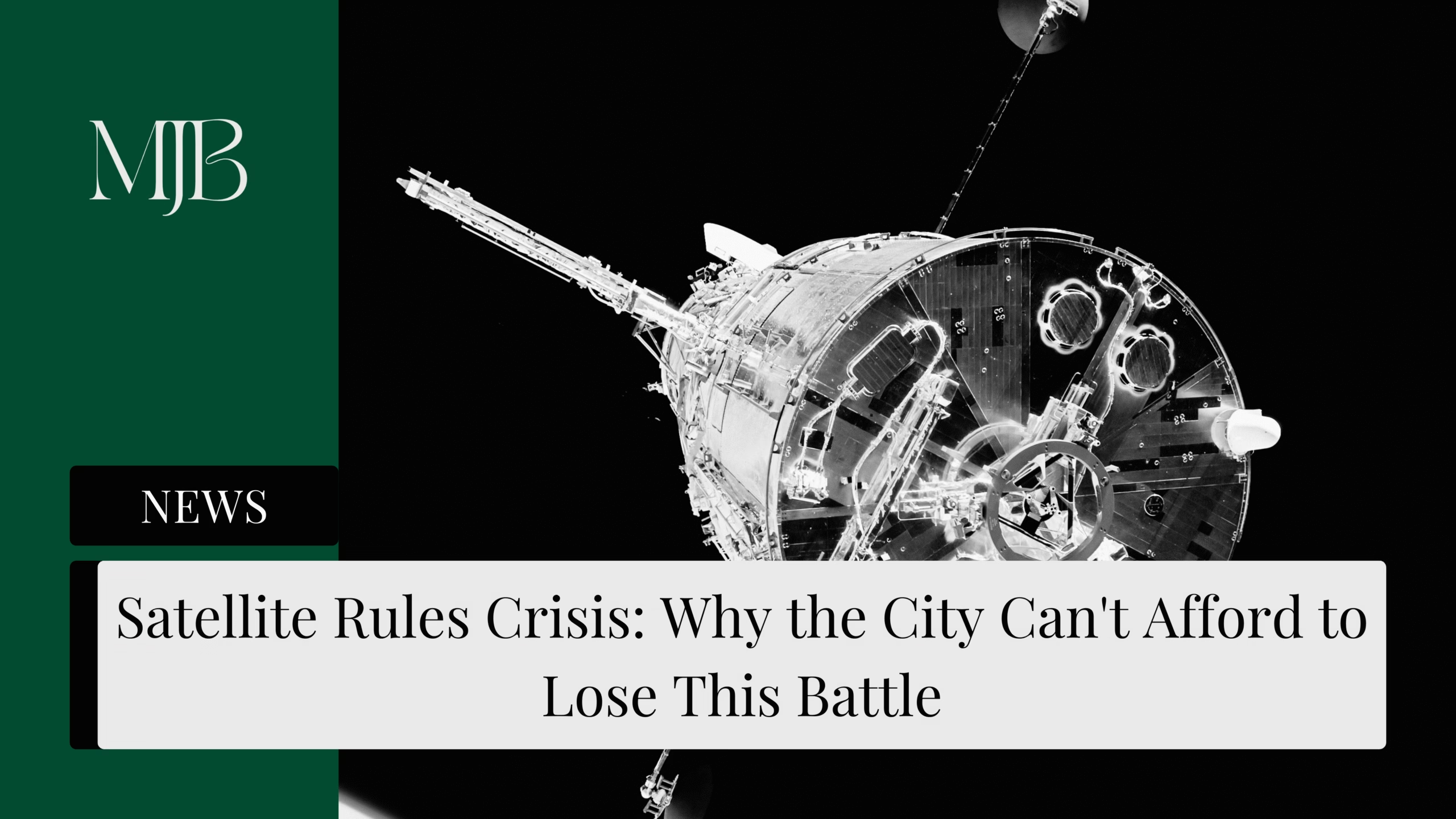
Right now, a seemingly obscure satellite interference rule is about to get hammered by American tech giants, and the UK could lose billions in the process. EPFD regulations (Equivalent Power Flux Density) might sound like science fiction, but they’re quietly holding up everything from drone operations to London’s financial infrastructure. In November, global diplomats will decide whether to weaken these protections. If they do, UK defence capabilities could tank, and the City’s trading networks could collapse. Let’s break it down.
The EPFD Rule: Why It Matters More Than You Think
Here’s the thing about satellite infrastructure: it’s invisible, it’s critical, and it’s about to become a battlefield. Right now, over 10,000 Low Earth Orbit (LEO) satellites—think SpaceX Starlink, Amazon Kuiper—coexist peacefully with older geostationary (GSO) networks. They do this because of EPFD rules, which set strict limits on interference. It’s like air traffic control for the sky, but for radio signals.
Without these protections, you’re looking at chaos. US tech firms want the rules weakened so they can pack more satellites into orbit with less restriction. Sounds efficient? Wrong. It would knock out the competition—meaning smaller players and non-American providers can’t offer services on the same terms. For the UK, this is a problem.

UK Defence: A Blueprint for Disaster
Our military relies on GSO satellite networks for command and control, intelligence, surveillance and reconnaissance. These systems need near-99.99% reliability. If EPFD rules collapse, that reliability tanks. We’re talking outages of hours or days annually. For context: that’s not some minor inconvenience. It’s the difference between coordinated drone operations and comms blackouts.
The ripple effects are severe. Small satellite terminals under 45cm—vital for autonomous warfare and field operations—would become infeasible. Coverage of existing UK satellite assets could shrink by 50%. Regions like the Middle East, Baltic states and northern air routes would lose critical coverage. Watch this space: if the rules change, the Ministry of Defence becomes dependent on foreign providers with zero sovereign control.
The City’s Hidden Crisis: When Infrastructure Fails
London’s financial sector doesn’t just sit on a trading floor anymore. Data centres, algorithmic trading and remote operations all depend on stable satellite connectivity. It’s the backbone of global transactions. When satellites go down, billions stop moving. When interference spikes, latency increases—and in finance, microseconds cost money.
The UK space industry is worth £16.4bn. Companies like Surrey Satellite Technology and Ministry of Defence contractors could face vendor lock-in with US providers. Cyber security gets worse too: elevated interference from uncontrolled LEO systems lowers the bar for adversarial jamming. You can’t tell if an outage was an accident or a deliberate attack. That’s a nightmare for national security and financial stability.

The Bottom Line
Ofcom needs to fight hard at the upcoming World Radiocommunication Conference in Shanghai next year. The UK should also stop waiting and invest in sovereign capabilities: domestic launch sites at Saxa Vord, manufacturing revival, and deeper AUKUS and NATO alliances. This isn’t about being anti-American. It’s about survival. If we lose control over satellite infrastructure, we lose leverage over the City, our defence forces and our future.
FAQ
What exactly are EPFD rules and why do they matter?
EPFD (Equivalent Power Flux Density) rules limit how much interference low-orbiting satellites can cause to older, geostationary networks. They’ve allowed over 10,000 LEO satellites to coexist with GSO systems safely. Without them, the newer satellites crowd out the older systems, reducing connectivity options and increasing competition-killing interference.
Could weakened EPFD rules really affect London’s financial sector?
Yes. Data centres and trading infrastructure depend on stable, reliable satellite links for global transactions. If interference spikes or outages increase, latency becomes unpredictable—and in finance, that costs real money. It could also force UK firms into vendor lock-in with foreign providers.
How would this impact UK defence operations?
UK military systems rely on GSO satellites for command, intelligence and surveillance with near-99.99% reliability. Increased interference could cause outages of hours or days annually, disrupt drone operations and manpack comms, and shrink coverage of critical regions by 50%. Small terminals essential for autonomous warfare would become infeasible.
What’s the timeline for these rule changes?
The ITU Plenipotentiary Conference happens in Doha in November 2026. The critical World Radiocommunication Conference follows in Shanghai next year. Decisions made then will shape satellite infrastructure for years to come.
What should the UK do about this?
Ofcom must champion existing EPFD rules at the upcoming conferences. The UK should also invest in sovereign capabilities: domestic launch sites, manufacturing revival and deeper AUKUS and NATO partnerships. This ensures we’re not dependent on US companies for critical infrastructure.
DISCLAIMER
Effective Date: 15th July 2025
The information provided on this website is for informational and educational purposes only and reflects the personal opinions of the author(s). It is not intended as financial, investment, tax, or legal advice.
We are not certified financial advisers. None of the content on this website constitutes a recommendation to buy, sell, or hold any financial product, asset, or service. You should not rely on any information provided here to make financial decisions.
We strongly recommend that you:
- Conduct your own research and due diligence
- Consult with a qualified financial adviser or professional before making any investment or financial decisions
While we strive to ensure that all information is accurate and up to date, we make no guarantees about the completeness, reliability, or suitability of any content on this site.
By using this website, you acknowledge and agree that we are not responsible for any financial loss, damage, or decisions made based on the content presented.