
Retail investors just claimed the top spot in the UK investment trust market and they’re not giving it up. According to Warhorse Partners’ latest State of the Nation report, individual investors now hold £50.5bn worth of investment trusts, a 37% share of the entire market. Five years ago, that figure was £40.3bn and 34%. So what’s driving the shift? Lower interest rates, better dividends, and trusts finally getting their communications act together. Meanwhile, wealth managers and institutions are quietly trimming their positions. If you hold investment trusts — or you’re thinking about it — here’s what the shift means.
Retail Investors Are Taking Over
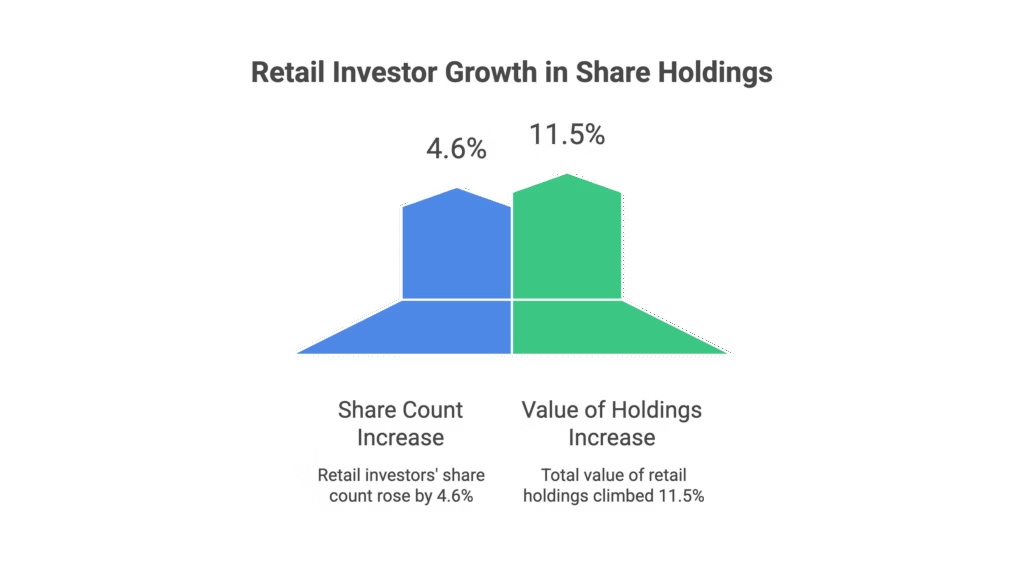
The numbers tell a clear story. Retail investors — whether on platforms, in savings schemes, or holding good old paper share certificates — increased their share count by 4.6% last year. The total value of those holdings climbed 11.5%.
Analysts point to a few tailwinds fuelling the surge:
- Falling interest rates. The Bank of England is expected to cut from 3.75% this spring, making yield-generating trusts more attractive than cash.
- Better dividend policies. Trusts have been sharpening their income credentials to lure individual investors.
- Smarter communications. More trusts are investing in how they explain themselves — and it’s working.
Jonathan Davis, editor at the Investment Trusts Handbook, summed it up well: 2025 marked a “strong comeback” for the sector, with narrowing discounts, solid returns, and a renewed edge over open-ended funds.
His headline stat? 80% of investment trusts are now outperforming open-ended funds with equivalent mandates. That’s not a small margin — that’s a structural advantage.
Wealth Managers and Institutions Are Quietly Pulling Back
While retail investors lean in, the big players are leaning out — at least by share count.
Institutional investors now hold 27% of the market by value (£35.8bn), up from £33.3bn in 2020. But the number of shares they hold actually fell 5.4% last year. Translation: fewer positions, but higher-value ones. Institutions are cherry-picking rather than casting wide nets.
Wealth managers told a similar story — share numbers dropped 9%, though the value of their holdings still nudged up 4.4% to £38.3bn. Ongoing consolidation and rising investment minimums are squeezing mid-sized firms, pushing many to merge or scale up just to stay relevant.
Davis noted that these two trends — retail rising, wealth managers retreating — have been building for years and show no signs of reversing.

Why Investment Trusts Are Winning With Everyday Investors
Investment trusts have had a bit of an image problem historically. They’re less flashy than ETFs and less familiar than ISA funds. But that’s changing.
More trusts are now actively courting retail investors through better disclosure, regular updates, and a stronger social and media presence. They’re explaining what they actually do — and why it matters.
The result? Individual investors are rewarding them with their money.
With the alternative asset space also heating up — think private equity, hedge funds, renewable energy, and property trusts — there’s growing breadth in what investment trusts offer. That’s not just interesting for institutions. It’s increasingly relevant for self-directed investors looking beyond vanilla equities.
Key Takeaways
Retail investors now own more of the UK investment trust market than any other group — and the gap is widening. Falling rates, stronger dividends, and better investor communications are driving the shift. Wealth managers and institutions are consolidating rather than expanding. And with 80% of trusts beating their open-ended equivalents, the case for individual investors paying attention has rarely been stronger.
FAQ
Q1: What are investment trusts and how do they differ from funds?
A: Investment trusts are closed-ended funds listed on a stock exchange, meaning you buy shares rather than units. Unlike open-ended funds, they can trade at a discount or premium to their net asset value — which creates both risk and opportunity.
Q2: Why are retail investors buying more UK investment trusts?
A: A combination of lower interest rates, improved dividend policies, and better investor communications has made trusts more attractive to individual investors. The Bank of England’s expected rate cuts this spring are likely to extend that trend.
Q3: Why are wealth managers reducing their investment trust holdings?
A: Industry consolidation and rising investment minimums are putting pressure on smaller wealth managers, forcing many to streamline their portfolios or merge. Fewer, higher-conviction positions has become the default strategy.
Q4: Are investment trusts outperforming regular funds?
A: According to Jonathan Davis, editor at the Investment Trusts Handbook, 80% of investment trusts are currently outperforming open-ended funds with comparable mandates — a significant advantage that’s helping attract retail capital.
Q5: What alternative assets are investment trusts investing in?
A: The sector is showing growing exposure to private equity, hedge funds, renewable energy, and property trusts — giving investors access to asset classes that are harder to reach through traditional retail products.
DISCLAIMER
Effective Date: 15th July 2025
The information provided on this website is for informational and educational purposes only and reflects the personal opinions of the author(s). It is not intended as financial, investment, tax, or legal advice.
We are not certified financial advisers. None of the content on this website constitutes a recommendation to buy, sell, or hold any financial product, asset, or service. You should not rely on any information provided here to make financial decisions.
We strongly recommend that you:
- Conduct your own research and due diligence
- Consult with a qualified financial adviser or professional before making any investment or financial decisions
While we strive to ensure that all information is accurate and up to date, we make no guarantees about the completeness, reliability, or suitability of any content on this site.
By using this website, you acknowledge and agree that we are not responsible for any financial loss, damage, or decisions made based on the content presented.