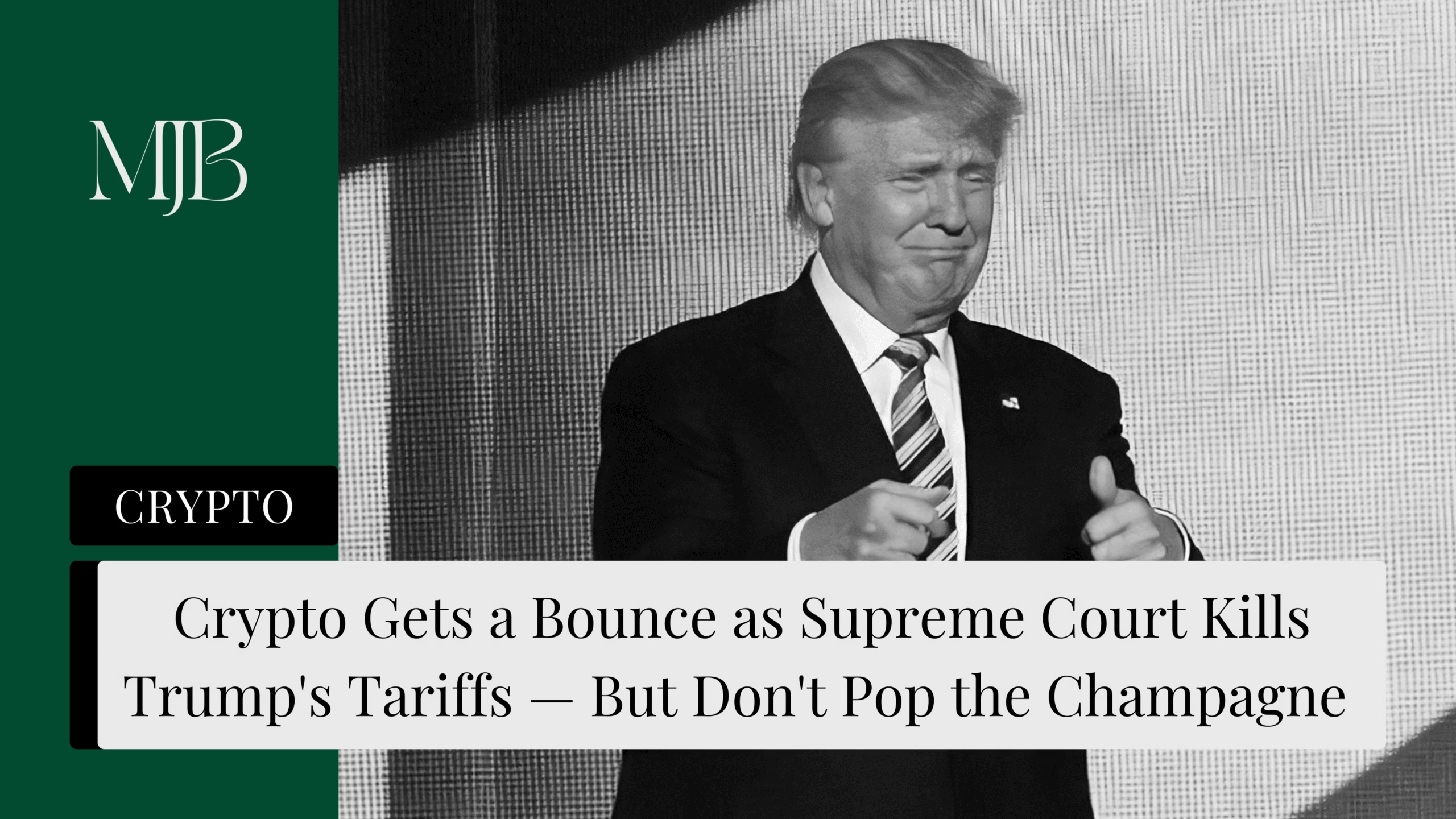
The US Supreme Court just nuked Trump’s global tariffs and markets noticed. In a landmark 6–3 ruling, the Court declared that sweeping import duties imposed under emergency powers were flat-out illegal. Bitcoin jumped, the S&P 500 popped, and for a brief moment, risk appetite was back. But as any seasoned trader knows, relief rallies have a habit of fading fast. Here’s what actually happened, what it means for crypto, and why the story isn’t over yet.
Supreme Court Strikes Down Trump’s Tariffs — What the Ruling Actually Says
Chief Justice John Roberts led the majority opinion, joined by five fellow justices across ideological lines. The three dissenters? Thomas, Alito, and Kavanaugh.
The crux of the case: Trump used the International Emergency Economic Powers Act (IEEPA) to slap broad “reciprocal” tariffs on imports from China, Canada, Mexico, the EU, Japan, and South Korea. The Court’s view was clear — IEEPA, a statute built for genuine national emergencies, doesn’t hand a president the keys to rewrite trade policy by decree.
Under the major questions doctrine, the Court ruled that actions with vast economic and political consequences require explicit backing from Congress — not executive workarounds.
The upshot: most global IEEPA-based tariffs are now invalid. Sector-specific duties under laws like Section 232 remain in place, but the sweeping tariff regime that rattled supply chains and spooked markets? Gone.
Could $150 Billion in Tariff Refunds Be Coming?
The ruling opens the door to an estimated $130–$175 billion in tariff refunds. Companies that paid these duties — including small businesses like New York wine importer V.O.S. Selections and educational toy firm Learning Resources, both of which brought the cases that reached the Supreme Court — could now be in line to claw back substantial sums.
The Court didn’t spell out a refund mechanism, so the heavy lifting now falls to lower courts and the Treasury Department to figure out how claims get processed — and when.
If executed at scale, this cash flowing back into the private sector could act as what some traders are already calling “accidental stimulus.” It’s an unusual dynamic: a court ruling potentially injecting liquidity into the economy without a single congressional vote.
How Crypto and Stock Markets Reacted
Stocks Pop First
Traditional markets moved swiftly. The S&P 500 and Nasdaq-100 surged to session highs on the announcement — a textbook risk-on response to lower inflation fears and easing trade tensions.
Crypto Follows — Then Fades
Crypto followed. Sort of.
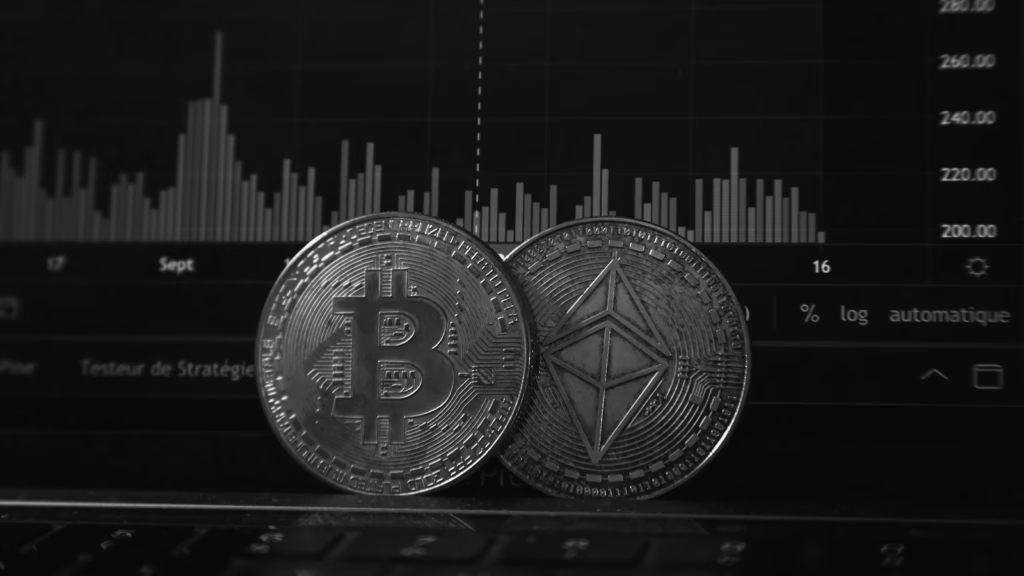
- Bitcoin (BTC) climbed around 2%, briefly reclaiming $68,000 before sliding back towards $67,000
- Ethereum (ETH) and major altcoins posted modest gains but failed to hold breakout levels
- The broader crypto market cap ticked higher alongside equities, then consolidated
The logic makes sense: removing broad tariffs eases fears of imported inflation, supply chain disruption, and tit-for-tat trade wars — all factors that historically strengthen the US dollar and squeeze risk assets like crypto. Less tariff pressure = marginally friendlier macro backdrop for digital assets.
But the bounce lacked conviction. This was relief, not euphoria.
Why Traders Aren’t Fully Buying the Rally
Three Headwinds Keeping Sentiment in Check
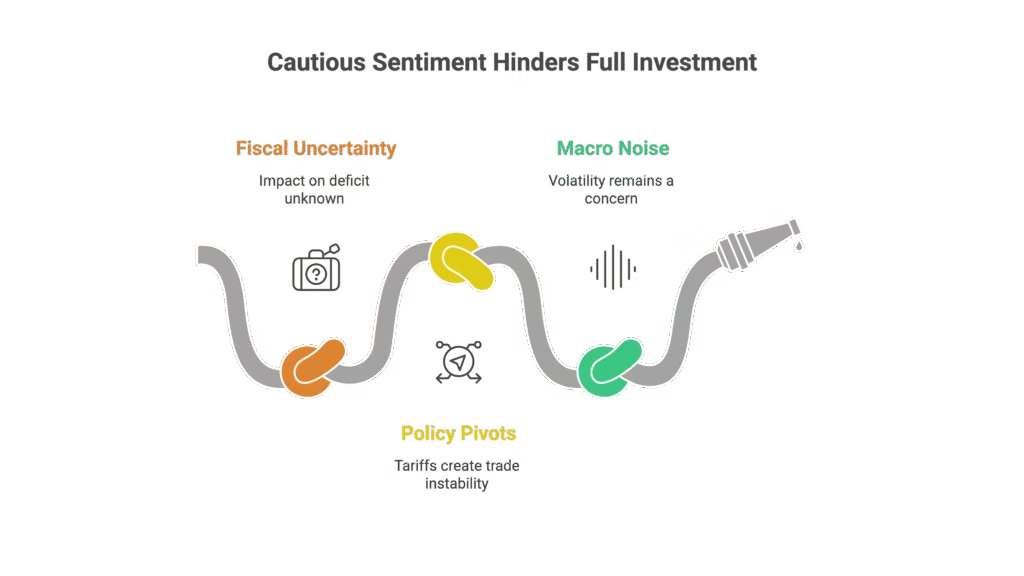
Despite the initial pop, sentiment remains cautious. A few things are keeping traders from going all-in:
- Fiscal uncertainty: If $150 billion in refunds flows out of federal coffers, what does that do to the deficit?
- Policy pivots: Trump didn’t wait — within hours of the ruling, he announced new 10% global tariffs under Section 122 of the Trade Act of 1974, later raising that to 15% the following day
- Macro noise ahead: Key economic data releases are still incoming, and volatility isn’t going anywhere
The ruling is widely seen as net positive but not a structural catalyst. Think of it as removing a headwind rather than adding a tailwind. The road ahead still has plenty of bumps.
What This Means Going Forward
The Supreme Court’s decision cleared one major macro overhang — but Trump moved fast. New 10% global tariffs under Section 122 were announced within hours, later bumped to 15%. So while IEEPA is off the table, tariff uncertainty very much isn’t.
With refund logistics still unresolved, fresh duties already landing, and broader economic data yet to fully filter through, expect continued volatility rather than a clean breakout. The next few weeks will be telling.
Keep an eye on how Section 122 legal challenges develop, Treasury guidance on refunds, and whether Bitcoin can find a sustained footing above $67,000.
FAQ
Q1: What did the Supreme Court rule on Trump’s tariffs?
A: In a 6–3 decision, the Court ruled that Trump’s use of the International Emergency Economic Powers Act to impose sweeping global tariffs was unconstitutional. The justices held that trade actions of this scale require clear congressional authorisation, not executive emergency powers.
Q2: Which tariffs are still in effect after the ruling?
A: Sector-specific tariffs imposed under laws like Section 232 (such as steel and aluminium duties) remain intact. Only the broad global tariffs applied under IEEPA have been struck down.
Q3: Why did Bitcoin only rise 2% on such a big ruling?
A: The crypto market treated the ruling as a macro relief event rather than a direct bullish catalyst. While easing trade tensions are generally positive for risk assets, traders remain cautious about fiscal uncertainty, potential policy pivots, and upcoming economic data.
Q4: Could companies really receive $150 billion in tariff refunds?
A: Policy analysts estimate $130–$175 billion in collected duties may now be subject to legal challenge. However, the Court didn’t set out a refund process — that’s now down to lower courts and the Treasury Department to work out, which could take time.
Q5: Did Trump try to reimpose tariffs after the ruling?
A: He already has. Within hours of the ruling, Trump announced new 10% global tariffs under Section 122 of the Trade Act of 1974, later raising that figure to 15%. Section 301 investigations are also underway, which could form the basis for further duties down the line.
DISCLAIMER
Effective Date: 15th July 2025
The information provided on this website is for informational and educational purposes only and reflects the personal opinions of the author(s). It is not intended as financial, investment, tax, or legal advice.
We are not certified financial advisers. None of the content on this website constitutes a recommendation to buy, sell, or hold any financial product, asset, or service. You should not rely on any information provided here to make financial decisions.
We strongly recommend that you:
- Conduct your own research and due diligence
- Consult with a qualified financial adviser or professional before making any investment or financial decisions
While we strive to ensure that all information is accurate and up to date, we make no guarantees about the completeness, reliability, or suitability of any content on this site.
By using this website, you acknowledge and agree that we are not responsible for any financial loss, damage, or decisions made based on the content presented.