Fresnillo just delivered its best financial year on record and the market promptly sold the news. Shares in the Mexico-based precious metals miner dropped 5.1% to 3,910p in morning trading, snapping a jaw-dropping 419.3% year-long rally. Record revenues, tripled profits, a bumper dividend. So what went wrong? Two words: production guidance.
Record Numbers, But a Catch
The headline figures are genuinely impressive. Revenue climbed 30.5% to $4.5bn (£3.4bn), pre-tax profit nearly tripled to $2bn, and net cash ballooned from $458m to $1.9bn. Surging gold and silver prices did the heavy lifting — gold was hovering around $5,209.5 per ounce, with silver at $82.50.
The board rewarded shareholders accordingly, proposing a final ordinary dividend of 128.92 cents per share — the highest payout since the company listed, and a sizeable jump from the 35.2 cents paid the prior year.
Strong prices, tight cost controls, and a cash-rich balance sheet. On paper, a triumph.
Production Is the Problem
Dig beneath the financials, and the picture gets murkier.
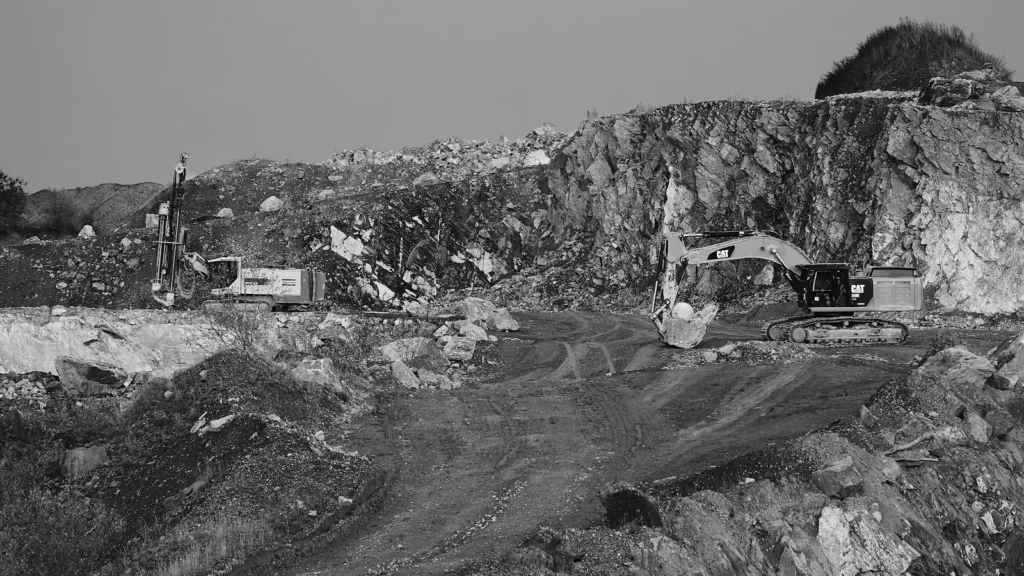
Gold output hit 600.3koz, which beat guidance — but still came in 5% below 2024 levels. The culprit? Lower ore grades, reduced processing volumes, and the cessation of mining at the San Julian site.
Silver production fared worse. At 48.7moz, it was in line with guidance but fell 13.5% year-on-year, hit by similar operational headwinds plus the end of contributions from the Silverstream contract.
Production costs did fall — down 11.1% to $1.4bn — thanks to lower volumes processed across Herradura, Fresnillo, Cienega, and Saucito. But lower costs driven by doing less mining isn’t exactly a bullish signal.
Adam Vesette, market analyst at eToro, put it plainly: Fresnillo’s results are “a triumph of price over production,” with record earnings masking tougher underlying operational challenges — from ore grade pressures to the Silverstream loss.
Is the Rally Over?
For a stock that had quintupled in a year, the bar was always going to be high. Chris Beauchamp, chief market analyst at IG, noted that with production costs expected to rise and output guidance cut, “investors see little reason to chase the shares at current levels, especially in such a risk-off environment.”
Dan Coatsworth at AJ Bell was equally measured, saying the “lukewarm reception” to these results will need to be offset by real future profit growth — which ultimately means “getting more gold and silver out of the ground.”
There’s also a minor sting for income investors. Despite sitting on $1.9bn in cash — what Coatsworth memorably described as “swimming in cash like a veritable Scrooge McDuck” — Fresnillo opted against a special dividend. Management wants to retain firepower for capital investment and potential M&A. Logical, perhaps, but not the cherry on top that some shareholders were hoping for.
What It All Means
Fresnillo’s recent story has been largely written by macro tailwinds: geopolitical uncertainty, the green energy transition, and surging demand for gold and silver. Those same tailwinds could persist — but production needs to recover for the share price rally to resume.
If ore grades improve, San Julian-type disruptions stay isolated, and M&A delivers accretive growth, the long-term bull case holds. If output keeps declining, all the price tailwinds in the world won’t keep investors happy.
For now, the market’s verdict is clear: record profits are nice, but sustainable production matters more.
FAQ
Q1: Why did Fresnillo’s share price fall despite record profits?
A: Investors focused on declining gold and silver production and cautious guidance for the year ahead, rather than the strong financials. When a stock has already rallied 400%+, the bar for positive surprises is very high.
Q2: How much did Fresnillo’s revenue and profit grow?
A: Revenue rose 30.5% to $4.5bn, while pre-tax profit nearly tripled to $2bn, driven primarily by higher gold and silver prices rather than increased volumes.
Q3: Why did silver and gold production fall at Fresnillo?
A: Both metals were hit by lower ore grades, reduced processing volumes, and the end of mining at the San Julian site. Silver also suffered from reduced contributions from the Silverstream contract, which has now been terminated.
Q4: Did Fresnillo pay a special dividend?
A: No. The board proposed a record ordinary dividend of 128.92 cents per share but declined to pay a special dividend, preferring to retain cash for investment and potential acquisitions.
Q5: Is Fresnillo still a strong long-term investment?
A: That depends on whether production recovers. The company has a strong balance sheet and benefits from structurally high precious metal prices, but investors will want to see output growth — not just price-driven profit — before pushing shares higher again.
DISCLAIMER
Effective Date: 15th July 2025
The information provided on this website is for informational and educational purposes only and reflects the personal opinions of the author(s). It is not intended as financial, investment, tax, or legal advice.
We are not certified financial advisers. None of the content on this website constitutes a recommendation to buy, sell, or hold any financial product, asset, or service. You should not rely on any information provided here to make financial decisions.
We strongly recommend that you:
- Conduct your own research and due diligence
- Consult with a qualified financial adviser or professional before making any investment or financial decisions
While we strive to ensure that all information is accurate and up to date, we make no guarantees about the completeness, reliability, or suitability of any content on this site.
By using this website, you acknowledge and agree that we are not responsible for any financial loss, damage, or decisions made based on the content presented.