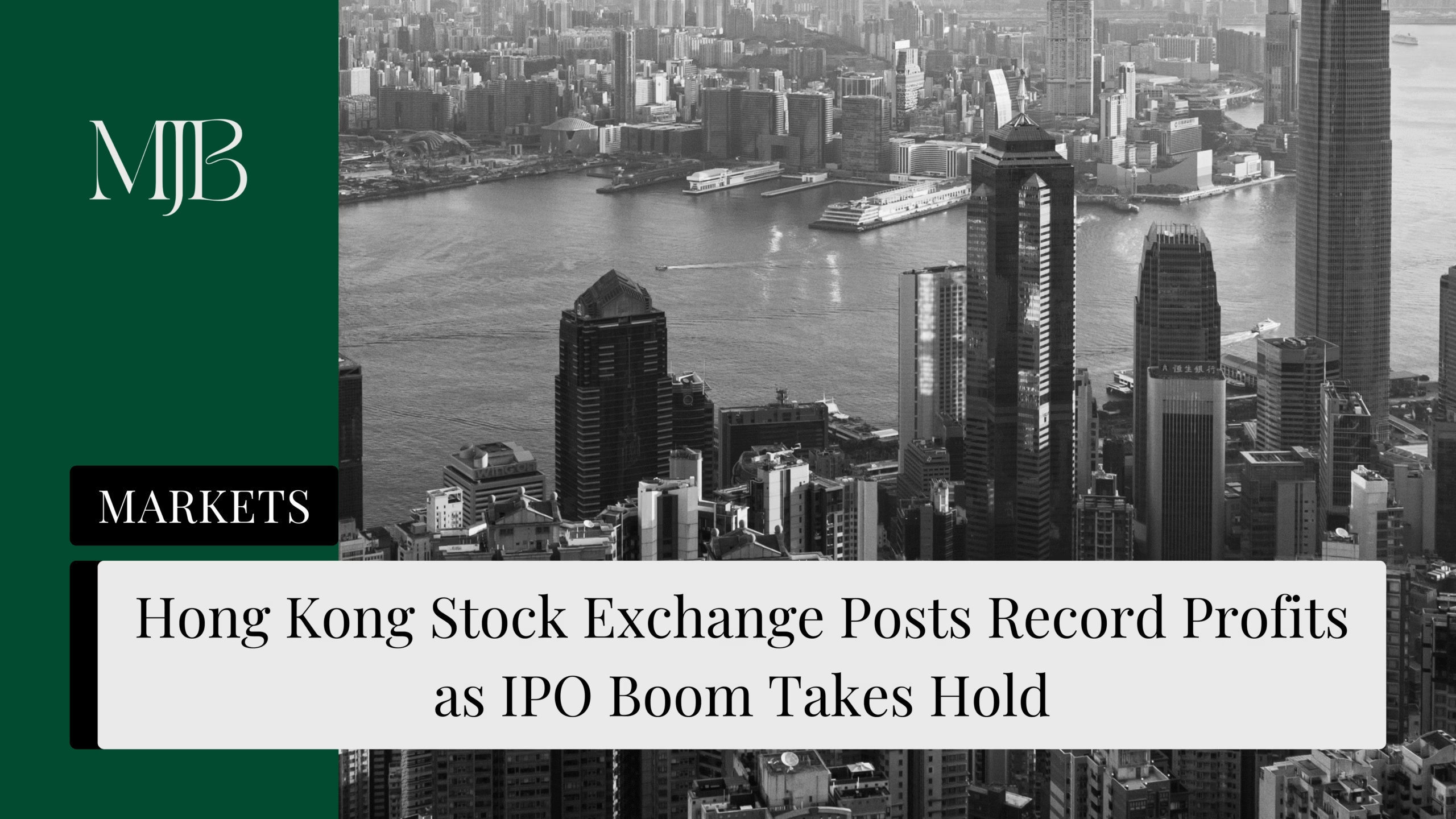
Hong Kong is back and it’s got the numbers to prove it. HKEX, the city’s stock exchange operator, just posted its second consecutive year of record profits, with net profit jumping 36% to HK$17.8bn (£1.7bn) in 2025. After a bruising 2023 slump, Hong Kong has clawed its way back to become the world’s second most active IPO destination — behind only the US. If that doesn’t signal a comeback, i’m not sure what does.
The Numbers Behind the Rebound
Core revenues — think trading and clearing fees — climbed 32% to HK$27.1bn, while average daily turnover surged 90% to HK$250bn. That’s a lot of capital finding its way into Hong Kong-listed stocks.
The exchange saw 119 listings in 2025, raising a combined HK$287bn — a 200% year-on-year increase. And the pipeline? Over 400 companies have already filed to list. The queue is long, and it’s growing.
For context: in just the first two weeks of 2026, Hong Kong listings raised more capital than London managed across the whole of 2025. That’s not a typo.

Who’s Running the Show?
Credit where it’s due — Bonnie Chan, who stepped up as CEO in 2024, inherited a sluggish exchange fighting off post-pandemic hangover and intense competition from mainland China’s markets.
Chan, a former Davis Polk capital markets partner, came in with a clear mandate: revitalise. And so far, so good. Following the results, she noted that global investors had returned with conviction, that innovation from mainland China and across Asia kept markets vibrant, and that liquidity had deepened across the board.
It’s the kind of statement that sounds like PR gloss — except the numbers actually back it up.
Beyond IPOs: Fixed Income, Derivatives, and Commodities
Chan is quick to point out that HKEX isn’t a one-trick pony. The exchange is actively building out a multi-asset ecosystem spanning fixed income and derivatives, aiming to attract investors seeking diversification beyond equities.
Settlement Infrastructure
HKEX took a 20% stake in CMU Omniclear last year — a new settlement house positioning itself as a rival to Belgium’s Euroclear. If it works, it could give Hong Kong a serious edge in post-trade infrastructure.
Commodities Play
The HKEX-owned London Metal Exchange has approved Hong Kong as an official warehouse location. The goal: turn the city into a commodities hub linking China’s vast metals market with global buyers. It’s an ambitious move, and one that could pay off handsomely if executed well.
The US-China Factor
Let’s not overlook the elephant in the room. US-China tensions have been a quiet tailwind for Hong Kong. With mainland companies increasingly wary of US capital markets — and Beijing easing regulatory hurdles for overseas fundraising — Hong Kong has become the go-to alternative.
It’s a geopolitical windfall as much as a strategic win. The question is whether HKEX can sustain this momentum when (or if) the political climate shifts.
Key Takeaways
Hong Kong’s stock exchange is firing on all cylinders — record profits, a 200% surge in IPO fundraising, and a growing pipeline of listings. Under Bonnie Chan, HKEX is diversifying beyond equities into fixed income, derivatives, and commodities infrastructure. The US-China dynamic has been a surprising tailwind, but the exchange is smart to build structural depth for the long game. Keep an eye on this one.
Want to stay across global market trends shaping where capital flows? Bookmark us and check back regularly.
FAQ
Q1: Why did Hong Kong’s stock exchange profits increase so sharply in 2025?
A: HKEX benefited from a surge in IPO activity, higher trading volumes, and growing investor confidence. A 90% jump in average daily turnover and a 200% rise in IPO fundraising drove core revenues up 32%.
Q2: How does Hong Kong compare to other global IPO markets?
A: In 2025, Hong Kong ranked second globally for IPO activity, behind the US. It also outpaced London significantly — raising more in the first two weeks of 2026 than London did in all of 2025.
Q3: What role did US-China tensions play in Hong Kong’s listing boom?
A: Mainland Chinese companies, uncertain about access to US capital markets, increasingly turned to Hong Kong as a listing venue. Beijing also eased regulatory requirements for overseas fundraising, adding further fuel.
Q4: Who is Bonnie Chan and what is her strategy for HKEX?
A: Bonnie Chan became CEO of HKEX in 2024, succeeding Nicolas Aguzin. A former capital markets lawyer, she’s focused on broadening the exchange’s product mix — including fixed income, derivatives, and commodities — to reduce reliance on IPO cycles.
Q5: What is CMU Omniclear and why does it matter?
A: CMU Omniclear is a new settlement house in which HKEX holds a 20% stake. It aims to compete with Euroclear, the dominant European settlement infrastructure, potentially giving Hong Kong a stronger role in global post-trade services.
DISCLAIMER
Effective Date: 15th July 2025
The information provided on this website is for informational and educational purposes only and reflects the personal opinions of the author(s). It is not intended as financial, investment, tax, or legal advice.
We are not certified financial advisers. None of the content on this website constitutes a recommendation to buy, sell, or hold any financial product, asset, or service. You should not rely on any information provided here to make financial decisions.
We strongly recommend that you:
- Conduct your own research and due diligence
- Consult with a qualified financial adviser or professional before making any investment or financial decisions
While we strive to ensure that all information is accurate and up to date, we make no guarantees about the completeness, reliability, or suitability of any content on this site.
By using this website, you acknowledge and agree that we are not responsible for any financial loss, damage, or decisions made based on the content presented.